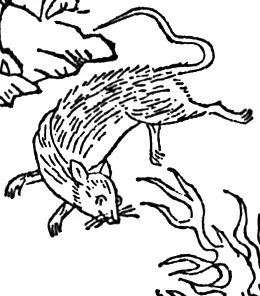
A sourced illustration has not yet been added. This gap is included in the coverage record.
Overview
Shuairan is a multicoloured mountain serpent in the Western Wilderness section of the Shenyi jing. Its head and tail are comparatively large. If something strikes its head, the tail arrives; if the tail is struck, the head arrives. A blow to the middle brings both ends together. The account makes coordinated defensive response its principal defining behaviour.
Sunzi's Nine Situations chapter uses the serpent as a comparison for a well-coordinated army. In Lionel Giles's 1910 translation, the shuai-jan lives in the Ch'ang mountains and answers a blow at either end with the other; an attack on its middle brings both into action. The next paragraph asks whether an army can imitate it. The answer compares enemies from Wu and Yue who help one another when a storm catches them in the same boat. This is a military analogy for mutual support, while the Shenyi jing provides the multicoloured body and enlarged head and tail.
Origins & earliest records
China; Shenyi jing received text
Records & interpretation
Directly read named primary-text passage. Hosted introductory discussion disputes attribution to Dongfang Shuo; no secure Han composition date asserted.
Selected bibliography
Documented works and useful reading. This is not a list of every appearance.
- 01
Shenyi jing
Western Wilderness; coordinated serpent account; received text and displayed notes distinguished.
- 02
The Art of War, XI: The Nine Situations, §§29–30
Selected 1910 translation; the snake comparison and shared-boat example are directly read. Translation date does not date composition of the Chinese text.
Family & connections
A source-supported family tree or inspiration record has not yet been compiled for this profile. Related reading below indicates a connection in subject matter, not a proven lineage or creative influence.
Primary records and illustrations
Shenyi jing
Western Wilderness. Western Wilderness; coordinated serpent account
Directly read received-text transcription. Identifying passage: 中頭則尾至,中尾則頭至,中腰則頭尾並至。 Traditional author attribution disputed; no historical scan or illustration assigned.
References
Sources supporting this profile. Linked pages have their own scope and editorial standards.
- Primary-text transcriptionShenyi jing: Western Wilderness; coordinated serpent accountResearch access: 2026-10-05
- Primary-text translationSun Tzu, The Art of War, chapter XI §§29–30; Lionel Giles translation (1910)Research access: 2026-10-05
Image credits
A sourced illustration has not yet been added. This gap is included in the coverage record.