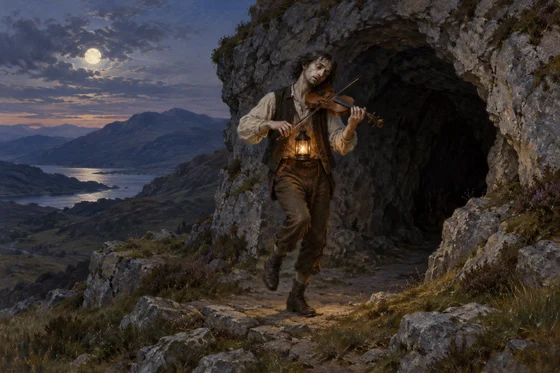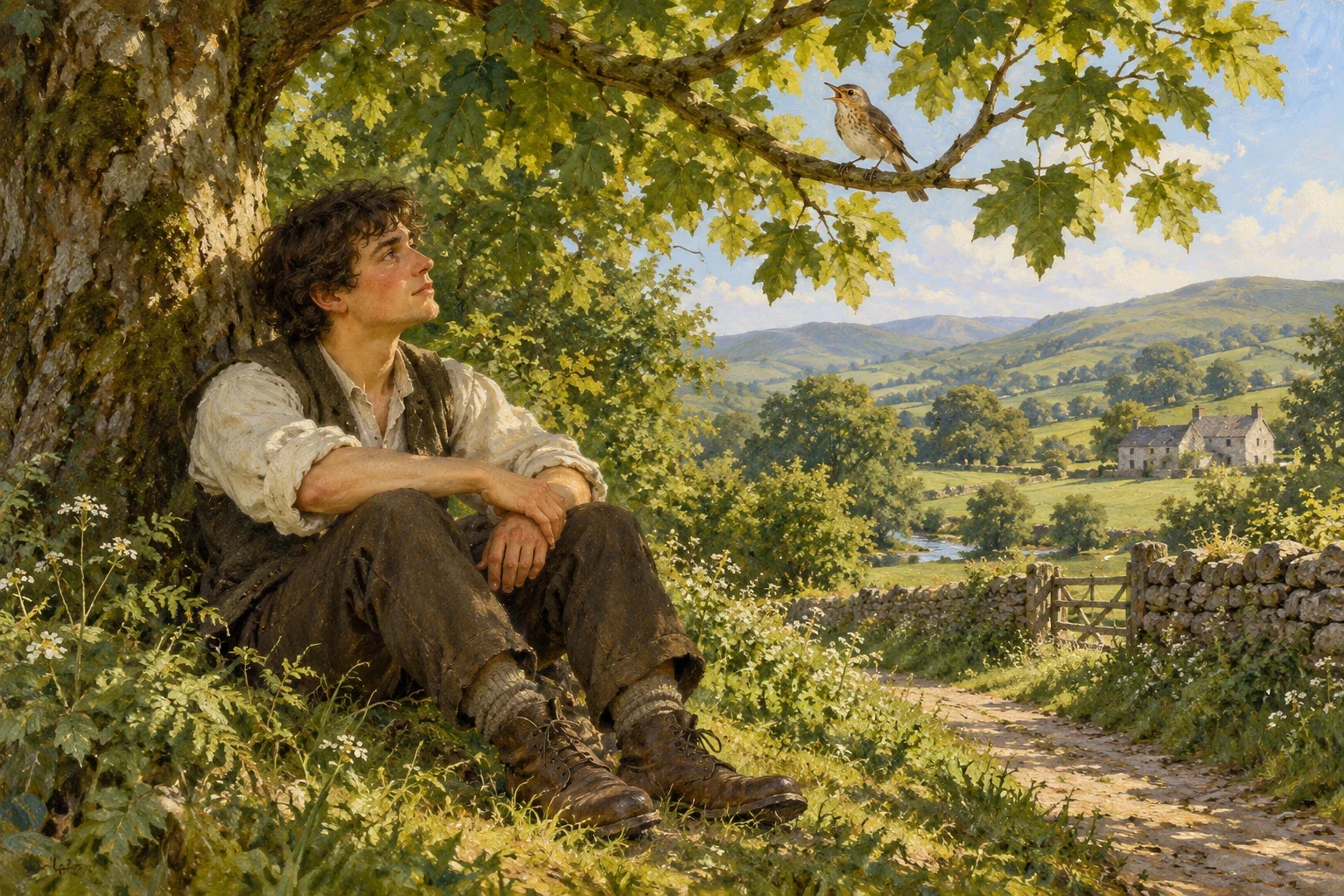
AI-generated interpretation of Shon ap Shenkin listening to the enchanting bird in Sikes’s Welsh tale, before the tree withers. The bird’s plumage, faces, costume, farmhouse and exact landscape are artistic choices; the source gives no species and does not identify this as a bird of Rhiannon.
AI-generated interpretation of Shon ap Shenkin listening to the enchanting bird in Sikes’s Welsh tale, before the tree withers. The bird’s plumage, faces, costume, farmhouse and exact landscape are artistic choices; the source gives no species and does not identify this as a bird of Rhiannon.
Overview
In Wirt Sikes’s account, a small singing bird draws Shon ap Shenkin out of ordinary time. Shon is a young man living near Pant Shon Shenkin in Carmarthenshire. On an early summer morning he hears exceptionally beautiful birdsong beside his path and sits beneath the tree to listen. When the song stops, the tree that had been green and living is withered and barkless. He returns to the farmhouse believing that only a few minutes have passed, but the building has aged and ivy covers it.
An unfamiliar old man stands in the doorway. Shon asks what he is doing there, and the man indignantly calls the house his own. Once Shon gives his name and explains the music, the man recognises the story of a relative who disappeared long ago. He says his grandfather had often spoken sorrowfully of the missing Shon. He also reports Catti Maddock of Brechfa’s explanation: fairies had Shon in their power, and would release him only when the last sap of the sycamore dried up.
The old man calls Shon his uncle and offers an embrace. Before the two men can embrace, Shon crumbles into dust on the doorstep. No fixed number of elapsed years is supplied. The story’s family expressions are retained without constructing a corrected genealogy, and the end is not made into a death caused by touching the old man. The bird’s species, appearance and independent intentions are also unspecified; its song is the immediate lure within a tale explained through fairy power.
Sikes says a farmer’s wife told him the local story near its reputed setting. He places it in a chapter on fairy music, compares it with the Birds of Rhiannon and suggests a relationship to a separate Taffy ap Sion story. Those are the collector’s comparisons, not proof that this bird is one of Rhiannon’s or that the narratives have a verified common origin. The complete section’s note47 cites Lady Charlotte Guest’s Mabinogion for the preceding literary comparison.
Origins & earliest records
London: Sampson Low, Marston, Searle, & Rivington. BookI chapterVII sectionI, printed pp91–94, with complete framing and note47.
Records & interpretation
Complete historical narrative, ending, printed attribution and attached apparatus.
Selected bibliography
Documented works and useful reading. This is not a list of every appearance.
- 01
British Goblins: Welsh Folk-lore, Fairy Mythology, Legends and Traditions
London: Sampson Low, Marston, Searle, & Rivington. BookI chapterVII sectionI, printed pp91–94, with complete framing and note47.
Family & connections
A source-supported family tree or inspiration record has not yet been compiled for this profile. Related reading below indicates a connection in subject matter, not a proven lineage or creative influence.
References
Sources supporting this profile. Linked pages have their own scope and editorial standards.
- Historical primary folklore collectionBritish Goblins: Welsh Folk-lore, Fairy Mythology, Legends and Traditions — complete selected narrative and apparatusResearch access: 2026-10-27
Image credits
AI-generated illustrationAI-generated interpretation of Shon ap Shenkin listening to the enchanting bird in Sikes’s Welsh tale, before the tree withers. The bird’s plumage, faces, costume, farmhouse and exact landscape are artistic choices; the source gives no species and does not identify this as a bird of Rhiannon.
AI-generated interpretation of Shon ap Shenkin listening to the enchanting bird in Sikes’s Welsh tale, before the tree withers. The bird’s plumage, faces, costume, farmhouse and exact landscape are artistic choices; the source gives no species and does not identify this as a bird of Rhiannon.