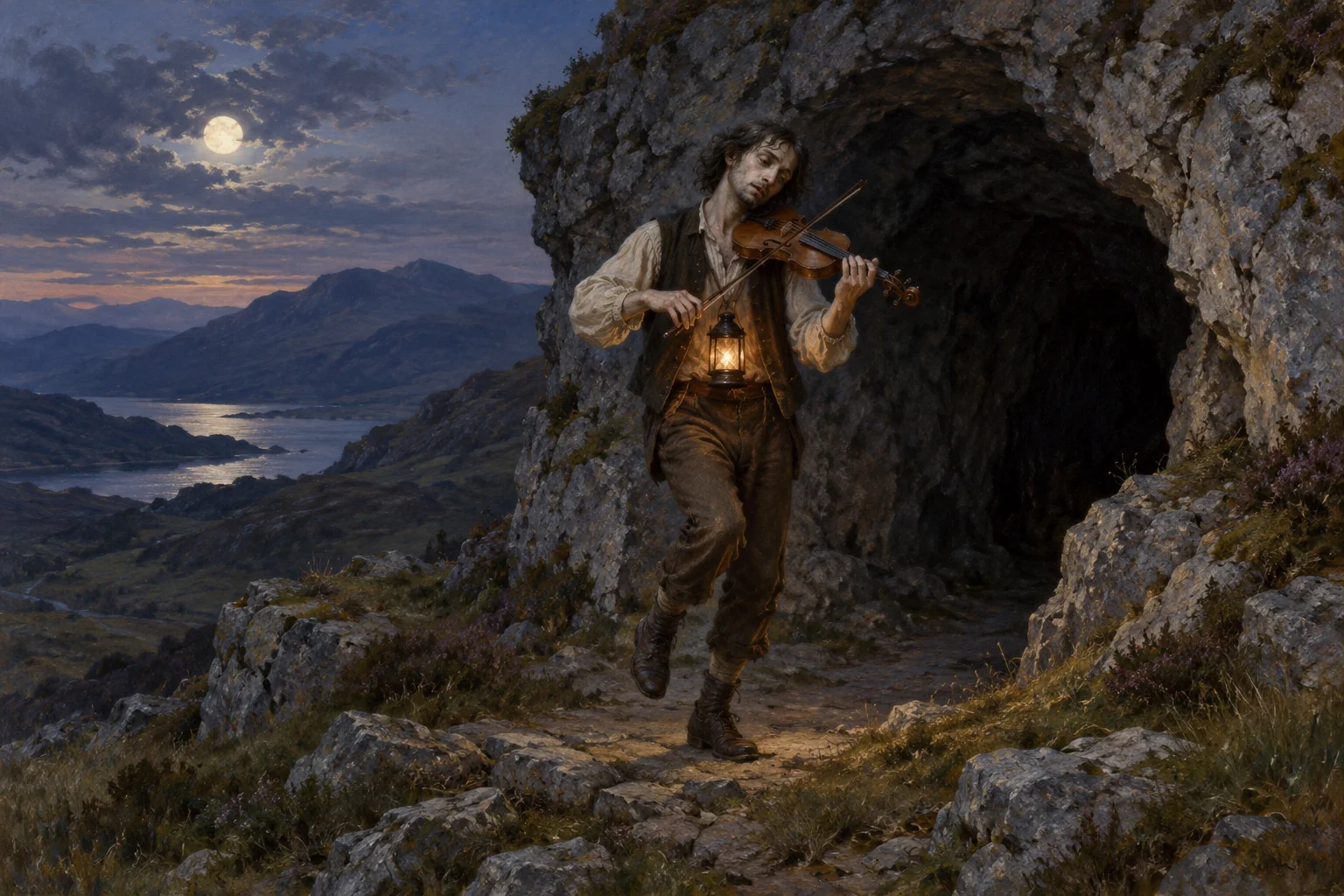
AI-generated interpretation of Iolo ap Hugh at the cave mouth in Sikes’s Welsh tale. Fiddle, chest lantern and unwilling dance are source-based; the exact cave, landscape, clothing, features and restrained bodily pose are artistic choices. This is not a verified cave location, a medical image or evidence of an actual haunting.
AI-generated interpretation of Iolo ap Hugh at the cave mouth in Sikes’s Welsh tale. Fiddle, chest lantern and unwilling dance are source-based; the exact cave, landscape, clothing, features and restrained bodily pose are artistic choices. This is not a verified cave location, a medical image or evidence of an actual haunting.
Overview
Iolo ap Hugh is the fiddler in a Welsh narrative that Wirt Sikes associates with the air Ffarwel Ned Pugh. A reputed North Wales cave is feared as an entrance that draws in anyone approaching too closely. The surrounding lore includes a terrified fox and an encounter said to have permanently sobered Elias ap Evan. These are reports attached to the dangerous place, not demonstrated properties of an actual surveyed cavern.
On a misty Hallow E’en, Iolo enters the cave to investigate, carrying a large supply of bread and cheese and seven pounds of candles. He does not return to ordinary life. Much later, an old shepherd hears unfamiliar music near the entrance and recognises Iolo emerging there. The fiddler dances while playing, with a lantern hanging at his breast. Moonlight briefly reveals a marble-pale face, fixed eyes, a loosely hanging head and arms that appear to work without their owner’s willing control. He vanishes back inside, seeming to be drawn inward rather than walking freely.
Years later the shepherd lives in another parish. On a cold December Sunday evening, the congregation hears music rise beneath the church aisle, pass along the building and fade into the wind. The shepherd identifies the melody as Iolo’s cave tune. The parson writes it down from the old man’s whistling. The ending links the music to Ffarwel Ned Pugh, adds that it can supposedly be heard at the cave on Hallow E’en, and reports a leap-year tradition in which an aligned star permits a view of Iolo and other inmates. No rescue or release concludes the story.
Sikes frames the tale as a musician and victim under fairy control and cites Cambrian Quarterly, volumeI, page45, in note49. That literary mediation and the narrative’s claims about a tune are kept distinct from independently verified musical history or present-day instructions for visiting a cave. The local and subterranean place associations remain part of the story, while the exact route, Iolo’s biography and the identity of any controlling beings are left unestablished.
Origins & earliest records
London: Sampson Low, Marston, Searle, & Rivington. BookI chapterVII sectionIV, printed pp99–102; full continuation and note49.
Records & interpretation
Complete selected narrative, ending, source attribution and apparatus.
Selected bibliography
Documented works and useful reading. This is not a list of every appearance.
- 01
British Goblins: Welsh Folk-lore, Fairy Mythology, Legends and Traditions
London: Sampson Low, Marston, Searle, & Rivington. BookI chapterVII sectionIV, printed pp99–102; full continuation and note49.
Family & connections
A source-supported family tree or inspiration record has not yet been compiled for this profile. Related reading below indicates a connection in subject matter, not a proven lineage or creative influence.
References
Sources supporting this profile. Linked pages have their own scope and editorial standards.
- Historical primary literary/folklore collectionBritish Goblins: Welsh Folk-lore, Fairy Mythology, Legends and Traditions — complete selected account and apparatusResearch access: 2026-10-27
Image credits
AI-generated illustrationAI-generated interpretation of Iolo ap Hugh at the cave mouth in Sikes’s Welsh tale. Fiddle, chest lantern and unwilling dance are source-based; the exact cave, landscape, clothing, features and restrained bodily pose are artistic choices. This is not a verified cave location, a medical image or evidence of an actual haunting.
AI-generated interpretation of Iolo ap Hugh at the cave mouth in Sikes’s Welsh tale. Fiddle, chest lantern and unwilling dance are source-based; the exact cave, landscape, clothing, features and restrained bodily pose are artistic choices. This is not a verified cave location, a medical image or evidence of an actual haunting.