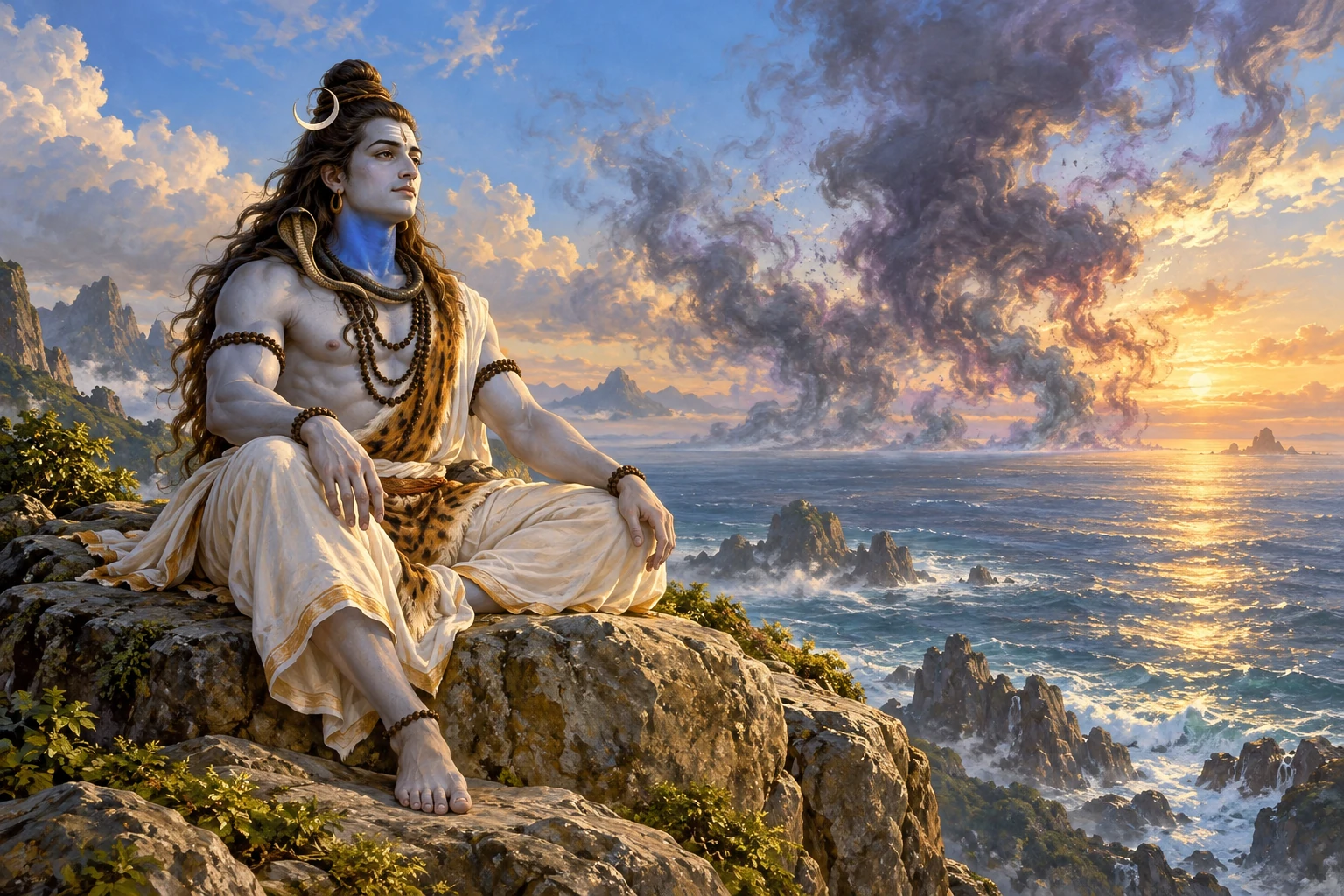
AI-generated interpretation of Śiva as Nilakantha after the Kalakuta episode in Ganguli’s Mahābhārata. His portrait, garments, serpent, crescent, forehead marks, ornaments and coastal seat are artistic additions not specified by this selected passage. This is not a historical cult image, archaeological reconstruction or Final Fantasy character design.
The source explains the blue throat through Śiva holding the poison there. The picture presents an imagined aftermath; it does not add a goddess restraining his throat or an ordinary poisoning remedy.
Overview
Ganguli’s ocean-churning account places Śiva’s intervention within a collective attempt to obtain amrita. Ananta uproots the Mandara mountain after the gods seek help from Vishnu and Brahman. The ocean agrees to be churned in return for a share, and the tortoise king agrees to support the mountain. The gods and Asuras use Mandara as the churning staff and Vasuki as the cord. These participants have separate roles: this selected passage does not identify the tortoise king as another named incarnation or make Śiva responsible for setting the machinery in motion.
The effort disturbs more than the water. Aquatic creatures die under the mountain, uprooted trees fall and friction starts fires among its inhabitants. Indra extinguishes the fires with rain. When the exhausted gods ask for help, Narayana gives them strength to resume. The narrative describes the emergence of celestial figures, objects and Dhanwantari carrying a vessel of nectar. It then places the appearance of Kalakuta while the churning continues. This ordering belongs to the selected epic witness and is not silently harmonized with other accounts.
Kalakuta engulfs the earth and blazes with fumes; its smell stupefies the three worlds. Brahman asks Śiva to intervene. Śiva swallows the poison for the safety of creation, and the narrator then says that Maheswara holds it in his throat. The passage explains that he has since been called Nilakantha, blue-throated. It gives no separate action to a goddess restraining his throat and does not introduce another remedy. The source calls the poison Kalakuta; a different poison name is not substituted here.
The section ends by returning to the struggle over the nectar. The Asuras prepare for hostilities, and Narayana employs an enticing female form; the charmed Danavas and Daityas put the amrita in her hands. The later distribution and fighting are outside this selected section. The narrative presents divine agency within a sacred epic, rather than a witnessed event or a universal statement about every Hindu tradition.
The Gosainkunda lake-and-springs account refers to the poison episode in explaining a particular landscape. The selected epic unit instead follows the churning, its named participants and the intervention itself. It is also distinct from the Kirāta hunting encounter. These are different narrative settings involving Śiva, rather than interchangeable versions of one scene.
Origins & earliest records
The Mahabharata of Krishna-Dwaipayana Vyasa, Book 1, Adi Parva, Astika Parva XVII–XVIII, translated into English prose by Kisari Mohan Ganguli. The hosted title metadata gives 1883–1896 as the translation publication period. XVII supplies the nectar-churning frame; XVIII contains the complete selected intervention. No exact physical printing or Sanskrit critical edition was independently collated.
Records & interpretation
Complete selected sections XVII and XVIII read. Inline explanatory parentheses retained; no attached note markers occur in the tool-observed selected primary bodies. The following section and the whole epic are not claimed read.
Selected bibliography
Documented works and useful reading. This is not a list of every appearance.
- 01
The Mahabharata of Krishna-Dwaipayana Vyasa, Book 1: Adi Parva, Astika Parva XVII–XVIII
Complete XVII setup and XVIII narrative read. Hosted page markers include p.58 in XVII and pp.59–60 in XVIII. Title metadata and signed translator’s-preface attribution checked; no physical titlepage or Sanskrit collation claimed.
Family, evolution & connections
Shiva (Final Fantasy)
In Ganguli’s complete Ādi Parva XVIII, Śiva swallows Kalakuta at Brahman’s request for creation’s safety, holds it in his throat and is called Nilakantha. This is limited historical sacred-name context beside a separate fictional Shiva. It does not make the poison episode the origin of the ice summon, transfer divine identity or anatomy, or establish developer consultation.
Śiva receives Gangá (Griffith’s Rámáyan)
These episodes describe distinct interventions by Śiva in different sacred-epic witnesses. In Griffith’s Rámáyan he receives, restrains and releases Gangá; in Ganguli’s selected Mahābhārata passage he takes in the poison produced during the ocean churning. The river’s journey and the ancestral rites belong to the first account, while the poison and throat transformation belong to the second. Their shared deity does not make the episodes interchangeable.
References
Sources supporting this profile. Linked pages have their own scope and editorial standards.
- Historical primary sacred-text translationGanguli, complete Adi Parva XVIII: churning and Kalakuta interventionResearch access: 2026-10-25
- Historical primary sacred-text translationGanguli, complete Adi Parva XVII: framing question and nectar questResearch access: 2026-10-25
Image credits
Modern interpretation of a historical literary accountAI-generated interpretation of Śiva as Nilakantha after the Kalakuta episode in Ganguli’s Mahābhārata. His portrait, garments, serpent, crescent, forehead marks, ornaments and coastal seat are artistic additions not specified by this selected passage. This is not a historical cult image, archaeological reconstruction or Final Fantasy character design.
The source explains the blue throat through Śiva holding the poison there. The picture presents an imagined aftermath; it does not add a goddess restraining his throat or an ordinary poisoning remedy.