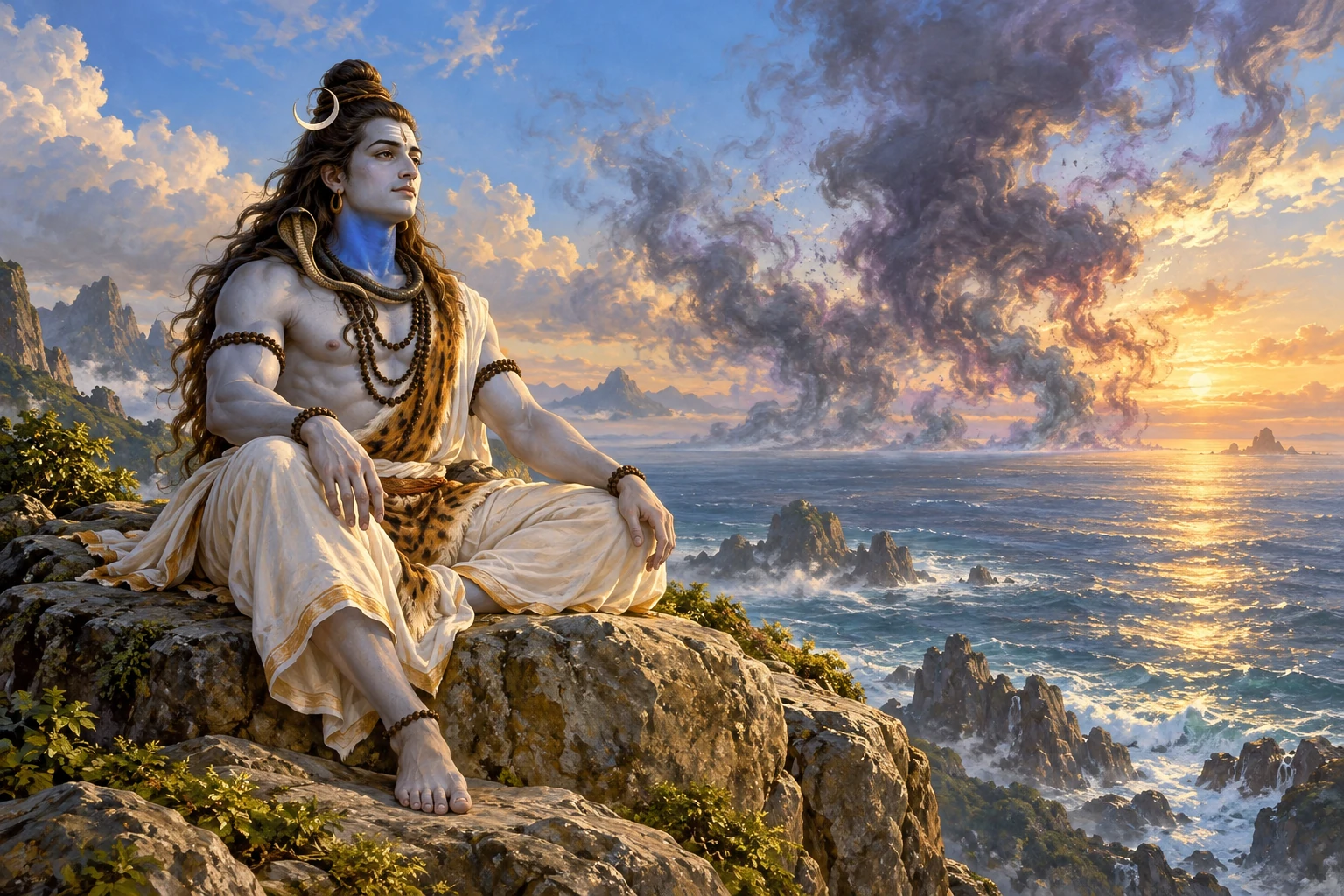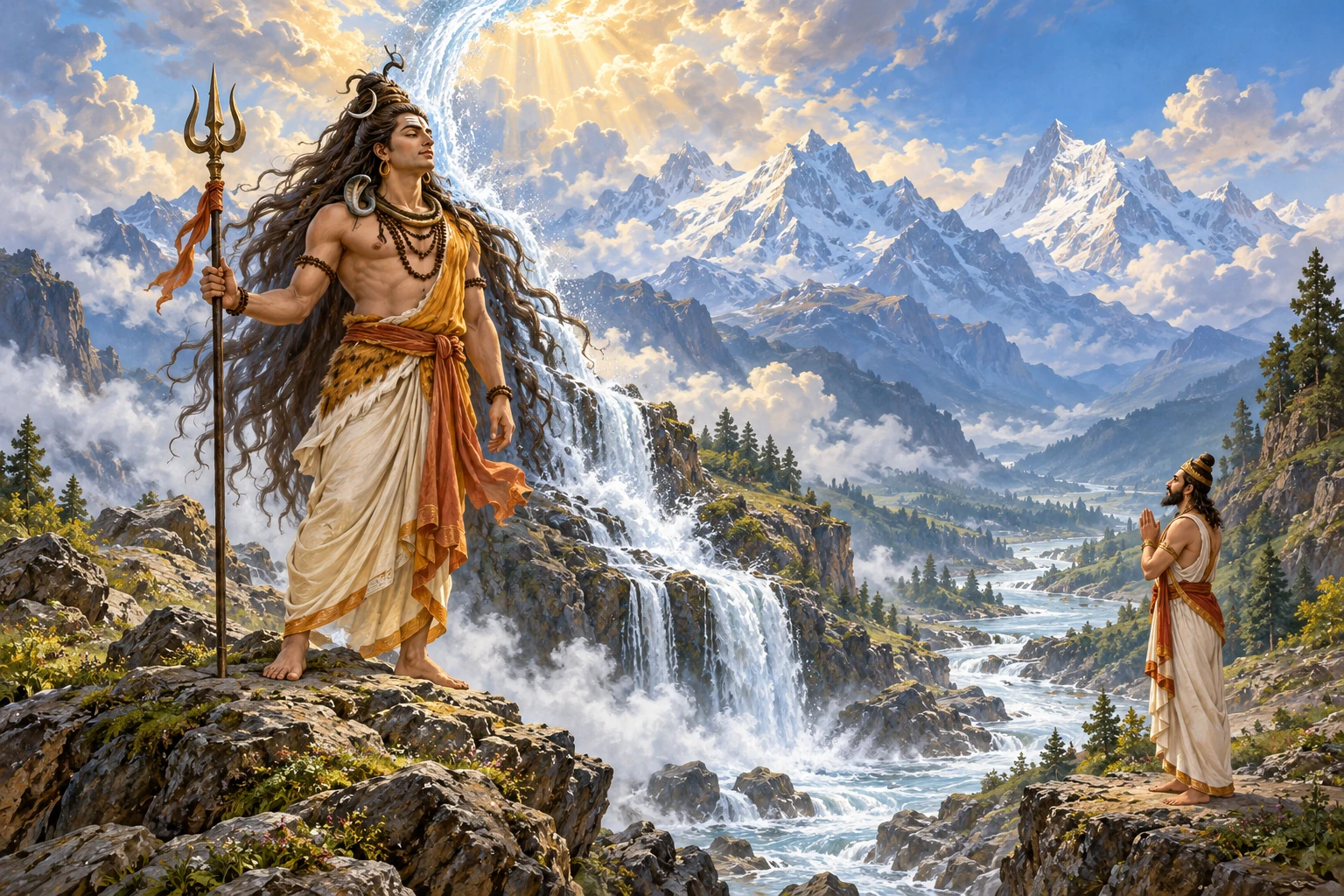
AI-generated interpretation of Śiva receiving and releasing Gangá in Griffith’s Rámáyan. The river, matted locks, trident and Bhagírath’s devotion follow the selected episode. Faces, poses, garments and landscape are imagined; the crescent, serpent and forehead markings are additional artistic choices, not details specified in these cantos. This is a modern sacred-narrative illustration, not archaeological or ethnographic evidence.
Śiva, Gangá and Bhagírath retain distinct roles. No connection to fictional ice powers is asserted by the image.
Overview
Griffith’s selected Rámáyan cantos place Śiva’s intervention within a multigenerational attempt to bring Gangá down from heaven. Anśumán finds the ashes of Sagar’s sons but cannot obtain water for the necessary offerings. Garuḍ tells him that ordinary earthly water will not suffice: Gangá must wash the ashes so the dead can reach heaven. Anśumán recovers the sacrificial horse, while the river’s descent remains unachieved through the efforts of Sagar, Anśumán and Dilípa. These events explain the request made to the deity rather than supplying an unrelated general river-origin account.
Bhagírath entrusts his kingdom to ministers and undertakes prolonged austerities. When Brahmá grants him a boon, he asks for the river to cleanse his ancestors’ remains and for a son to continue his line. Brahmá approves but says that earth alone cannot endure the heavenly torrent: only the trident-wielding Śiva can receive its weight. A further year of devotion wins Śiva’s consent. The translation calls him Umá’s lord, and its attached note explicitly identifies that title with Śiva. His role is thus to mediate a descent requested through penance, rather than to create the river or cause the earlier destruction of the princes.
Gangá descends fiercely, intending to sweep the god away. Śiva holds her among the dense tangles of his hair, where she cannot find a route to earth. Bhagírath renews his austerities, and Śiva eventually releases her into Vindu’s lake. Seven streams emerge: three flow east, three west, and the seventh follows the royal ascetic. The poem describes a celestial gathering and waters made holy through Śiva’s touch. This particular sequence contains both restraint and release; a picture of a river issuing from his locks should not erase her initial confinement or the petitioner’s renewed effort.
The river’s onward journey has another interruption. She floods the sage Jahnu’s sacrificial ground, and he drinks up her stream in anger. The assembled divine company asks him to treat her as his child; he releases her through his ears, explaining the name Jáhnavi in this witness. Gangá then follows Bhagírath to the sea and into the opened depths where Sagar’s sons lie. The king pours funeral offerings over their ashes, and the narrative says their spirits attain heavenly release. These acts belong respectively to Jahnu, the river and the king, rather than being additional powers indiscriminately assigned to Śiva.
Brahmá praises Bhagírath’s achievement and calls the river his eldest child, connecting her with the name Bhágirathí. The king completes the prescribed offerings, bathes and returns to rule a prosperous realm. A closing address to Ráma praises the benefits of hearing the descent story. This is a sacred narrative and its own account of purification, lineage and devotion, not an empirical explanation of river hydrology or a guarantee about every modern ritual. It remains distinct from the Kalakuta poison intervention, the Gosainkunda springs and the Kirata encounter with Arjuna; those sources describe different episodes involving the same deity.
Origins & earliest records
Book I, cantos XLII–XLIV in Griffith’s 1870–1874 English verse Rámáyan. The complete Gangá descent and ancestral deliverance episode is read with the preceding condition for the ritual. No earliest oral origin or uniform modern Hindu doctrine claimed.
Records & interpretation
Complete consecutive cantos XLII–XLIV and all notes 192–199 read in Griffith’s historical English translation. No independent Sanskrit critical-edition or physical print-page collation.
Selected bibliography
Documented works and useful reading. This is not a list of every appearance.
- 01
The Rámáyan of Válmíki, Book I, XLII–XLIV
Complete Sagar’s Sacrifice, Bhagírath and The Descent of Gangá, including notes 192–199. XLII provides the ancestral quest’s setup; XLIII–XLIV describe the descent and its outcome.
Family, evolution & connections
Shiva (Final Fantasy)
Final Fantasy uses the name Shiva for a recurring fictional figure. This Rámáyan account supplies a distinct religious context: Śiva receives and restrains Gangá’s descent so Bhagírath can complete ancestral rites. The sacred narrative does not explain the game character’s ice abilities or establish that designers consulted Griffith’s translation. Its deity, river goddess and royal petitioner remain separate from the fictional continuity.
Śiva’s Kalakuta intervention (Ganguli)
These episodes describe distinct interventions by Śiva in different sacred-epic witnesses. In Griffith’s Rámáyan he receives, restrains and releases Gangá; in Ganguli’s selected Mahābhārata passage he takes in the poison produced during the ocean churning. The river’s journey and the ancestral rites belong to the first account, while the poison and throat transformation belong to the second. Their shared deity does not make the episodes interchangeable.
References
Sources supporting this profile. Linked pages have their own scope and editorial standards.
- Historical English translation of a sacred epicGriffith, Rámáyan I, XLII–XLIV, complete with notes 192–199Research access: 2026-10-26
Image credits
Modern interpretation of a historical literary accountAI-generated interpretation of Śiva receiving and releasing Gangá in Griffith’s Rámáyan. The river, matted locks, trident and Bhagírath’s devotion follow the selected episode. Faces, poses, garments and landscape are imagined; the crescent, serpent and forehead markings are additional artistic choices, not details specified in these cantos. This is a modern sacred-narrative illustration, not archaeological or ethnographic evidence.
Śiva, Gangá and Bhagírath retain distinct roles. No connection to fictional ice powers is asserted by the image.