Shangyang rainbird passage, citing Kongzi Jiayu Bianzheng, historical text facsimile; documentary source-page facsimile
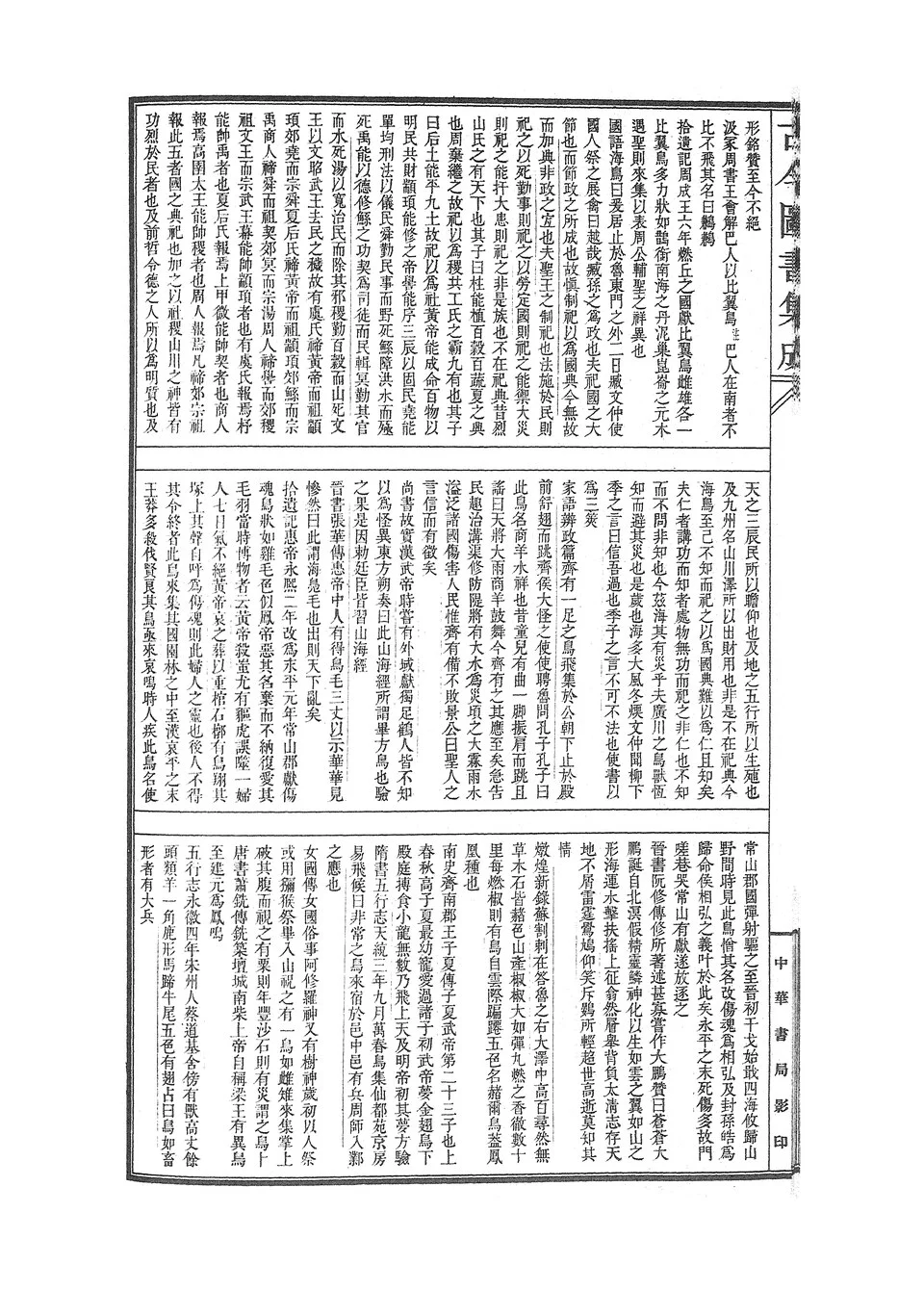
Primary text facsimile, not creature artwork. Inspected middle panel names Shangyang and quotes the one-legged rainbird story.1700–1725 refers to the compilation; the physical page bears a later Zhonghua facsimile imprint, whose date is not established here.
Overview
Shangyang is a rain-associated bird that appears in a story of a one-legged dance at the court of Qi. Confucius is consulted about the occurrence and advises preparation for heavy rain, including drainage and protective works. The narrative makes the unusual bird a sign that can be understood by a learned interpreter. Its importance lies in recognizing the warning and responding intelligently rather than merely observing an extraordinary body.
Later mythographic discussions relate the bird to a rain master, while other sources allocate similar weather associations to different birds. This entry keeps the named court episode separate from a comprehensive meteorological mythology. It does not treat the legendary visit as a verified historical forecast or propose the bird as a real species. The story offers a comparison with Bifang because unusual avian anatomy can signal different kinds of event in different texts.
Origins & earliest records
The selected work or object is a witness to this representation. Its date is not asserted to be the beginning of the tradition; textual layers and regional variants need separate review.
Records & interpretation
The linked source and contextual bibliography support the stated motifs. Material objects document iconography; narratives document imagined encounters. Neither alone is zoological confirmation.
Selected bibliography
Documented works and useful reading. This is not a list of every appearance.
- 01
Court-of-Qi rainbird narrative
Selected reading or object; bibliography is not exhaustive. Secondary links identify primary passages where a direct primary edition was not verified.
Family & connections
A source-supported family tree or inspiration record has not yet been compiled for this profile. Related reading below indicates a connection in subject matter, not a proven lineage or creative influence.
Primary records and illustrations
Gujin Tushu Jicheng, quoting Kongzi Jiayu, Bianzheng
Digitized volume 519; compiled early 18th century. Scan page 69; text section citing 家語辨政篇
Primary facsimile now directly inspected at page69-960px returned by Commons imageinfo: middle register quotes Kongzi Jiayu Bianzheng, explicitly naming the one-legged bird, Shangyang, rain omen and practical preparations. This is a textual facsimile, not an illustration of a bird. The margin identifies a Zhonghua Shuju facsimile imprint; the encyclopedia compilation date does not date this physical reprint. Earlier unproofread transcription provided the lead; the named passage is now confirmed on the actual scan.
The cited story places Shangyang at the court of Qi, where a bird with one leg spreads its wings and hops before the palace. A messenger asks Confucius to explain the sight. His answer identifies the bird as a sign of approaching water and recalls children hopping on one foot while chanting about its rain dance. The prediction leads to practical preparation: channels are cleared and embankments repaired. Heavy rain then floods other states, while prepared Qi escapes comparable damage. In this account the creature functions within a story of foresight and public administration, rather than simply as an animal that mechanically creates rain. The passage also records a human imitation of the bird’s movement.
Encyclopedia background
An additional attributed reference, separate from the editorial profile above.
Read the open encyclopedia overview
The Shangyang (商羊), (or shang yang) in Chinese mythology was a rainbird (i.e. it could predict rain). It was one of several important mythical birds in this tradition. The Shangyang was particularly associated with the Lord of Rain, Yu Shi. Once, the Shangyang was said to have visited the royal court of Qi, where it danced on one leg. After seeing this, a delegation was sent to Confucius in the neighboring state of Lu to ask about the meaning of the event. Confucius, who was familiar with the Shangyang, predicted heavy rain and advised the people to dig drainage channels and build dikes. By following the sage's advice, Qi avoided the disaster caused by a subsequent flood, while other states that ignored this advice were heavily damaged. This legendary incident has often been used to illustrate the foolishness of those who ignore wise advice. Mythographer Lihui Yang associates Yu Shi with the Bi Fang bird, instead.
Text from Wikipedia contributors, “Shangyang (rainbird)”. CC BY-SA 4.0. Extracted introduction; formatting changed. Retrieved 5 October 2026. The source article may have changed since retrieval.
References
Sources supporting this profile. Linked pages have their own scope and editorial standards.
- Secondary reference with scholarly bibliographyCourt-of-Qi rainbird narrativeResearch access: 2026-10-05
- Primary-text transcriptionGujin Tushu Jicheng, quoting Kongzi Jiayu, Bianzheng — exact primary witnessResearch access: 2026-10-05
Image credits
Historical text facsimileShangyang rainbird passage, citing Kongzi Jiayu Bianzheng, historical text facsimile; documentary source-page facsimile
Primary text facsimile, not creature artwork. Inspected middle panel names Shangyang and quotes the one-legged rainbird story.1700–1725 refers to the compilation; the physical page bears a later Zhonghua facsimile imprint, whose date is not established here.