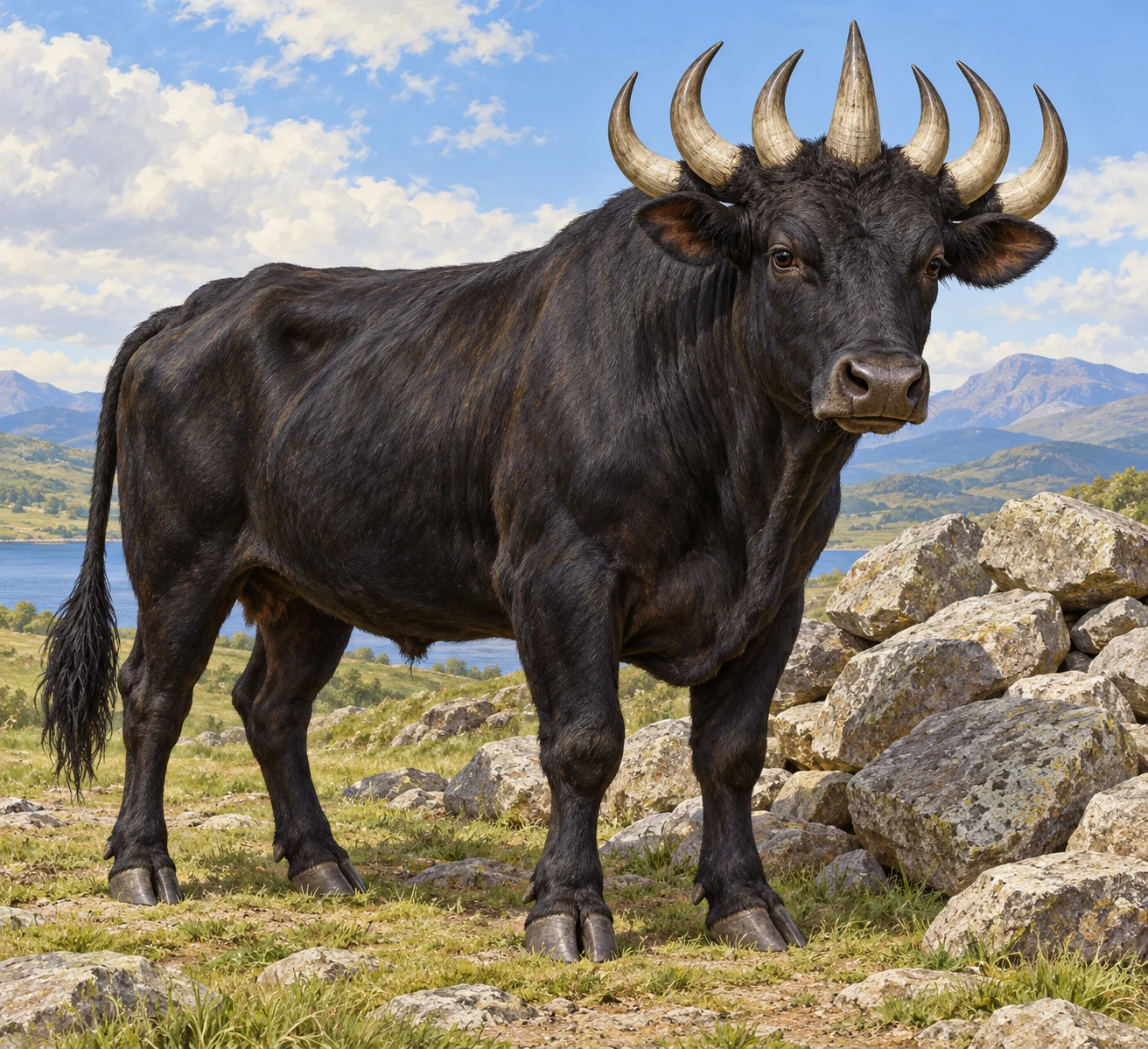
AI-generated reconstruction of one of the seven-horned oxen in Kirby’s telling.
A hundred black oxen, each with seven horns, are textual. This representative animal’s horn arrangement, proportions and pose are imagined; no real cattle breed or extinct species is identified.
Overview
The oxen appear in The Orphan Boy and the Hell-Hounds, which Kirby attributes to Kreutzwald. A mistreated herd-boy flees his employer and receives provisions and advice from a vanished old man. After years of travelling, he reaches a mountain, sees enormous creatures pass and meets a rider on a black horse. The rider offers him employment beyond the mountain. There, a cellar hewn into rock and closed by threefold iron doors contains savage dogs. The employer warns that if one gets out the others will follow, and that the last dog’s release would bring the end of the world. This is a warning within the tale, not a destruction the ending actually narrates.
The work requires a supply of immense stones, piled on a hill by human hands, to close holes dug beneath the doors. The employer shows the youth a stall containing a hundred black oxen, each with seven horns. Their size is compared with the largest oxen of the Ukraine. The narrative specifies their colour, number and extraordinary horn count, but gives no arrangement for the horns or particular cattle breed. Kirby’s note speculates about an extinct or nearly extinct wild ox; that historical suggestion does not establish a zoological identity for these seven-horned animals.
Six yoke of oxen are to draw a stone away on a wagon. A special crowbar makes a touched stone roll into the wagon by itself, so the automatic loading belongs to that implement rather than an unmentioned power of the cattle. The servant must inspect the enclosure three times by day and once at night. After a few months, the dogs dig a hole large enough for their tails to protrude, but a replacement stone blocks it and they must begin again. The oxen are therefore part of the guardian’s working arrangement, rather than attackers, mounts or creatures said to fly.
Years later, an eagle urges the youth to leave while his master sleeps. It claims that God created the master to guard the hounds and that he can do his own work without a servant. The youth takes the master’s swift horse, despite the master calling after him, and returns to human society to marry and live comfortably. The final line says that the horse died long ago. It gives no later fate for the oxen, releases no hound and does not say that the enclosure has failed. The herd remains a particular component of this narrative, not a description of ordinary cattle in Estonia.
Origins & earliest records
The chapter is headed Kreutzwald in Kirby’s 1895 English compilation. Kirby describes Kreutzwald’s Estonian collection of 1866 and Löwe’s German translation of 1869 in his introduction and bibliography, while acknowledging that his own book includes full tales, abridgments and notices. The selected story is presented as a continuous narrative; no specific oral teller is identified there. Esthonia is Kirby’s historical geographical and literary frame, not a modern boundary to impose on every version. His comparison of the hounds’ keeper with Odin is attributed to commentators in a note and is not adopted as an identity for the keeper or his cattle.
Records & interpretation
The full selected narrative, ending and relevant printed note are retained with the compiler’s preface, source discussion and relevant bibliography entries. Earlier Estonian and German publications are reported through Kirby, not independently consulted.
Selected bibliography
Documented works and useful reading. This is not a list of every appearance.
- 01
The Hero of Esthonia and Other Studies in the Romantic Literature of That Country
Complete selected tale and ending, relevant original notes, compiler preface and source account; two-volume publication treated as one source family.
Family & connections
A source-supported family tree or inspiration record has not yet been compiled for this profile. Related reading below indicates a connection in subject matter, not a proven lineage or creative influence.
References
Sources supporting this profile. Linked pages have their own scope and editorial standards.
- Historical English compiled traditional narrative, retained complete publication witnessKirby 1895 — complete selected narrative and original source contextResearch access: 2026-10-18
Image credits
AI-generatedAI-generated reconstruction of one of the seven-horned oxen in Kirby’s telling.
A hundred black oxen, each with seven horns, are textual. This representative animal’s horn arrangement, proportions and pose are imagined; no real cattle breed or extinct species is identified.