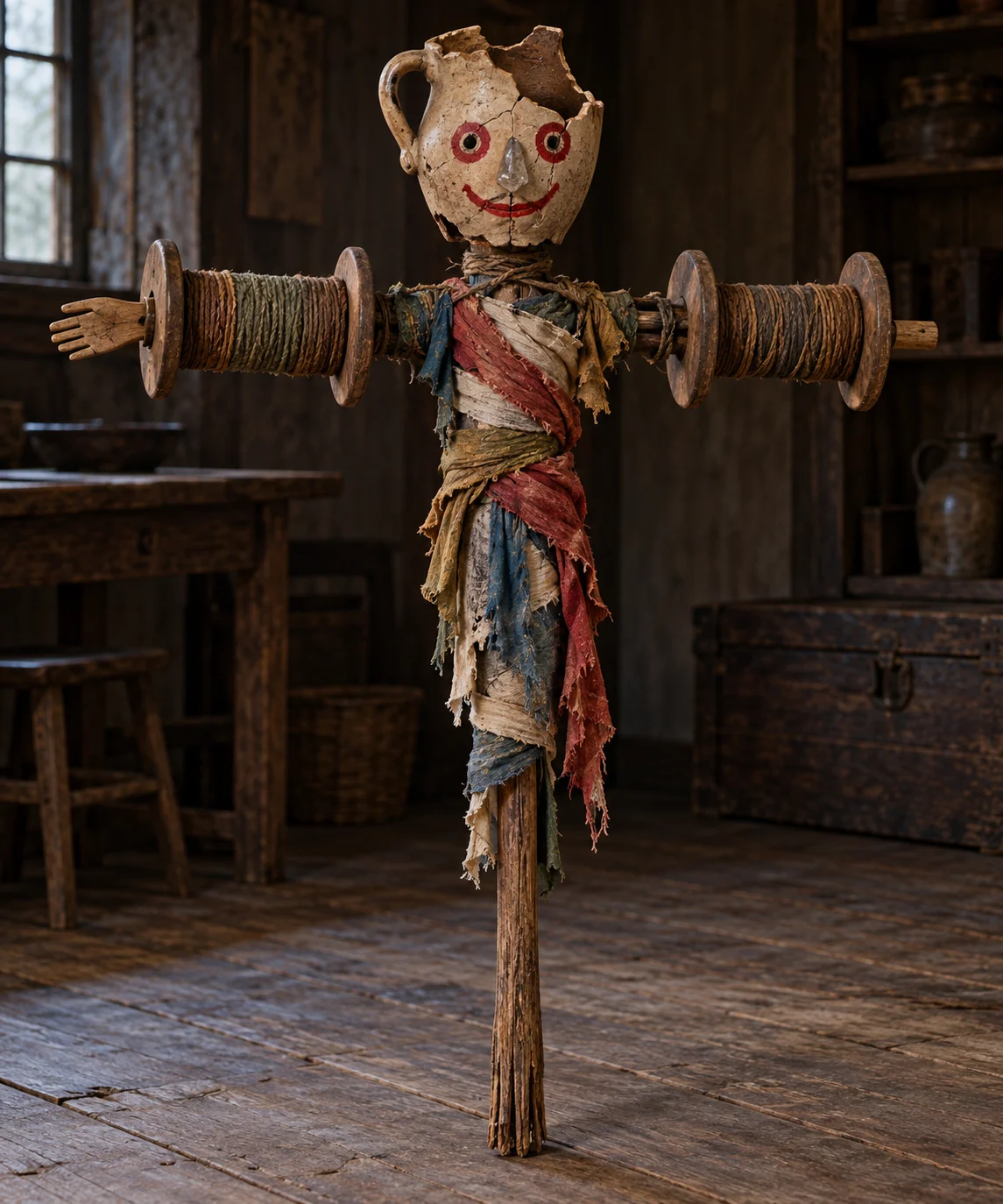
AI-generated reconstruction of the assembled figure in Jannsen’s Treasure-Bringer.
Materials and painted features follow the narrated assembly. Exact reel design, fixings and other unspecified construction are imagined; this is an independent literary interpretation, not an ethnographic replica or ritual demonstration.
Overview
In The Treasure-Bringer, attributed by Kirby to Jannsen, a ruined farmer asks the wandering Michel for help. Michel describes a Kratt made secretly from domestic materials: a broomstick body, a broken jug for its head, a piece of glass for a nose and two old yarn reels for arms. In the farmer’s later assembly scene, the eyes and mouth are painted red and the body is wrapped in coloured rags. The figure eventually grasps him with a wooden hand. These construction details belong to this telling; the text does not supply a complete design for its legs, joints or attachment methods.
Michel promises that an animated figure would serve its maker, unseen by anyone else, bringing money, grain and hay in loads no greater than a man could carry. His explanations include stories about other owners: one creature defeated a supposedly impossible sieve task by patiently collecting the remaining drops, and another punished a master whose meal offering had been replaced with sand. These are accounts spoken by Michel, not events that the present farmer successfully repeats. Michel also warns that the bargain costs the maker his soul and that dismissing the servant would require a task it could not perform.
The farmer makes the figure and carries it to the woodland crossroads on successive Thursday nights. On the third night it comes alive and asks what he wants. Overwhelmed by fear, he runs away without answering. The creature pursues him, catches his shoulder and declares that deserting it has broken the compact: it is no longer his servant but his tormentor. His property deteriorates, his cattle die and people leave him alone. When he asks Michel for help, the old man refuses and complains that he has not received the comfortable life the farmer promised him.
Finally the farmer tries to destroy the figure by setting his own house alight. After the roof falls, the creature rises unharmed from the ruins, still visible only to its maker. The farmer shrieks and dies of terror while Michel stands nearby. The tale thus ends with failed acquisition of wealth and failed destruction of the constructed being. It does not narrate this farmer enjoying a successful period of treasure delivery. Kirby’s comparative note about another familiar is retained as a comparison, rather than made into an additional incident or a universal rule for every Kratt.
Origins & earliest records
Kirby heads this complete English narrative Jannsen and places it among stories of the Devil and black magic. His source discussion and bibliography identify Harry Jannsen’s German selection Märchen und Sagen des estnischen Volkes, published in two parts in 1881 and 1888, while noting that some stories in that selection derive from Kreutzwald. The exact earlier-language witness for this individual tale has not been independently checked here. Kirby’s historical religious-stage theory is preserved as compiler context, not adopted as a present account of Estonian people or belief. The profile treats the story’s constructed figure and its narrated bargain, not a claimed contemporary ritual practice.
Records & interpretation
The full selected narrative, ending and relevant printed note are retained with the compiler’s preface, source discussion and relevant bibliography entries. Earlier Estonian and German publications are reported through Kirby, not independently consulted.
Selected bibliography
Documented works and useful reading. This is not a list of every appearance.
- 01
The Hero of Esthonia and Other Studies in the Romantic Literature of That Country
Complete selected tale and ending, relevant original notes, compiler preface and source account; two-volume publication treated as one source family.
Family & connections
A source-supported family tree or inspiration record has not yet been compiled for this profile. Related reading below indicates a connection in subject matter, not a proven lineage or creative influence.
References
Sources supporting this profile. Linked pages have their own scope and editorial standards.
- Historical English compiled traditional narrative, retained complete publication witnessKirby 1895 — complete selected narrative and original source contextResearch access: 2026-10-18
Image credits
AI-generatedAI-generated reconstruction of the assembled figure in Jannsen’s Treasure-Bringer.
Materials and painted features follow the narrated assembly. Exact reel design, fixings and other unspecified construction are imagined; this is an independent literary interpretation, not an ethnographic replica or ritual demonstration.