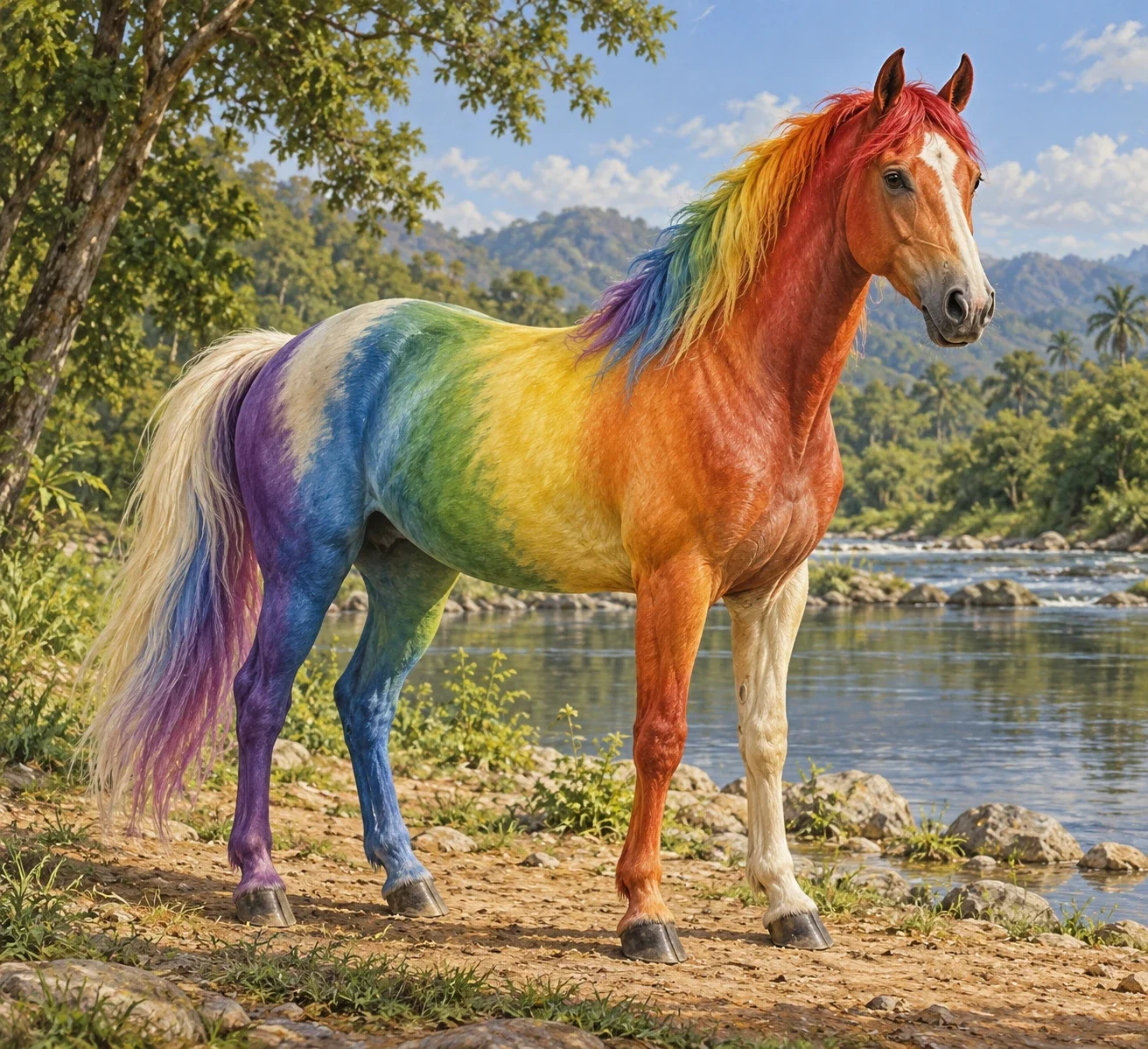
Portrayal of The Seven-Coloured Horse in Bienvenido Fabián’s Tale.
Portrayal selects the complete horse alone beside a river when available to Juanito’s call. The seven-colour palette and placement are imagined; ordinary equine anatomy, no wings or hybrid form, and no copied source art.
Overview
Andrade’s tale 111, signed by Bienvenido Fabián of San Pedro de Macorís, follows a horse whose name specifies seven colours. It first enters a father’s maize plot at night. The two older sons fall asleep while guarding the crop. Juanito, the youngest, stays awake and fixes pins to the maize leaves, allowing him to catch the intruder with a rope after its tongue is pricked. The horse speaks and promises assistance whenever Juan calls for it in danger. Juan releases it, and the crop is no longer eaten. The story does not describe the arrangement of the seven colours, a named breed, wings or a special number of limbs.
The brothers leave to seek their fortunes. A woman carrying a child, identified by the narrator as the Virgin Mary, blesses Juan after he shares food that the others refused. His brothers subsequently throw him into wasps and then into water containing shifting mud. The first escape is attributed to divine help. During the second he calls the horse and is rescued. This distinction matters: the narrative does not assign every favourable event to the animal. Juan later finds work selling water and washing dishes, while the horse remains available to his call rather than being kept as an ordinary employer-owned mount.
A royal ribbon-racing competition offers marriage to the princess after three successful performances. Juan’s employers leave him at home, but he goes to the river and summons the horse, requesting princely clothes and shoes. He competes on its back, wins a ribbon and disappears, then returns to washing dishes. The sequence repeats with finer clothing. His employers dismiss his hints that he was the admired rider and mistreat him. At the final race the pair complete the required success, and Juan marries Princess María. The horse’s speed is compared to a cloud of wind, but this witness does not explicitly describe flight. Nearby variants in Andrade’s collection give other horses different adventures; their bird transformations, feather quests and airborne travel are not added to Fabián’s horse.
Origins & earliest records
Complete tale 111, Bienvenido Fabián, San Pedro de Macorís, printed pp. 145-147; named contributor entry and recording-method discussion retained.
Records & interpretation
Complete selected original Spanish tale and printed footnotes read; all selected native story pages viewed. Full preface, collection-method pp. 24-27 and contributor context read. No whole-book or independent field-validation claim.
Selected bibliography
Documented works and useful reading. This is not a list of every appearance.
- 01
Folk-Lore from the Dominican Republic
Complete tale 111, printed pp. 145-147. Memoirs of the American Folk-Lore Society XXIII. Original Spanish narrative; original English editorial framing distinguished.
Family & connections
A source-supported family tree or inspiration record has not yet been compiled for this profile. Related reading below indicates a connection in subject matter, not a proven lineage or creative influence.
References
Sources supporting this profile. Linked pages have their own scope and editorial standards.
- Primary historical Spanish folklore account with original editorial contextAndrade 1930 original narrative and collection framingResearch access: 2026-10-18
Image credits
AI-generatedPortrayal of The Seven-Coloured Horse in Bienvenido Fabián’s Tale.
Portrayal selects the complete horse alone beside a river when available to Juanito’s call. The seven-colour palette and placement are imagined; ordinary equine anatomy, no wings or hybrid form, and no copied source art.