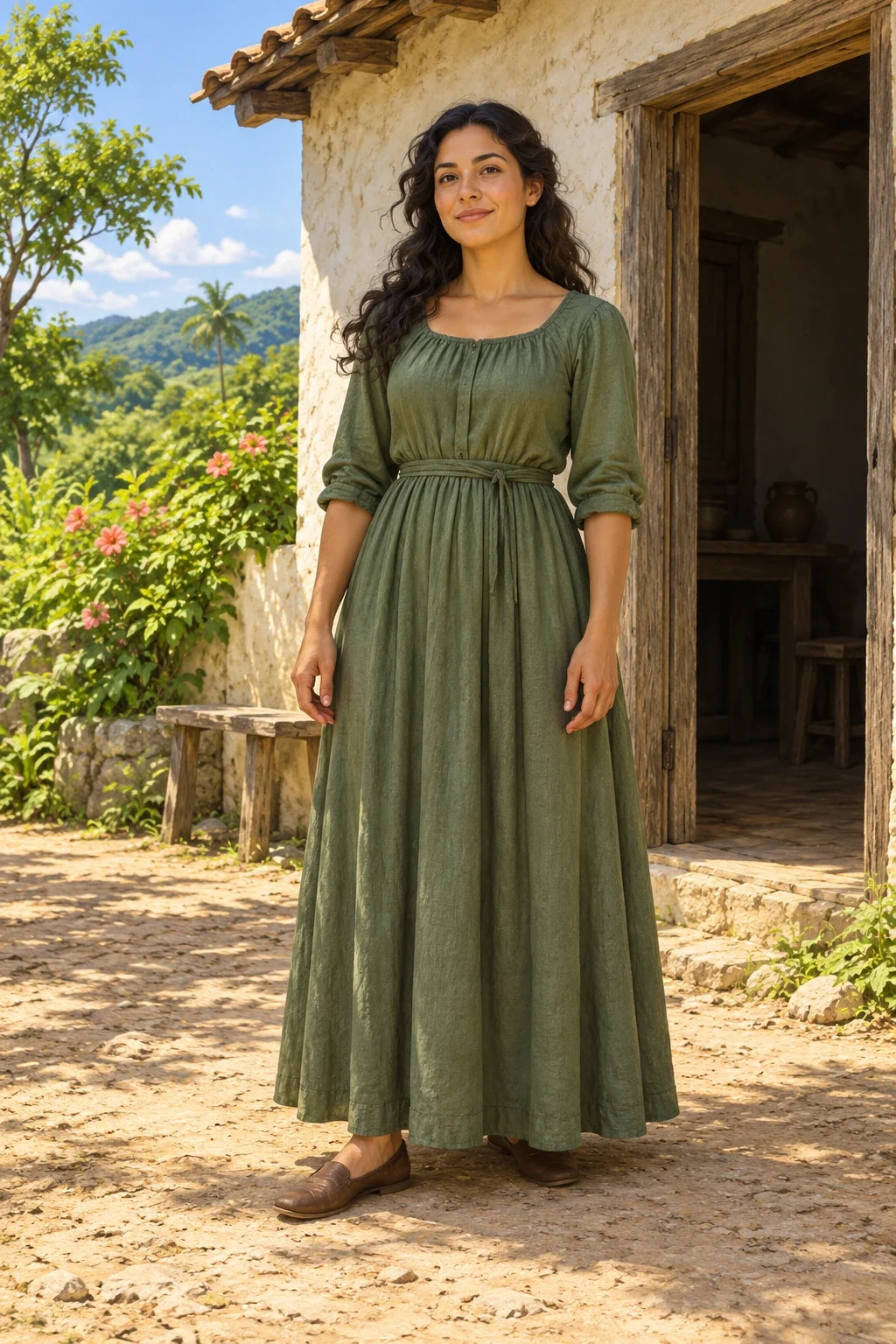
Portrayal of Avena in María Porte’s Tale.
Portrayal selects Avena as an adult human-looking woman outside her house at the first meeting with Juansito. Face, age, complexion, hair, modest dress and house details are interpreted; no cult iconography, crown, halo or classical-deity identification.
Overview
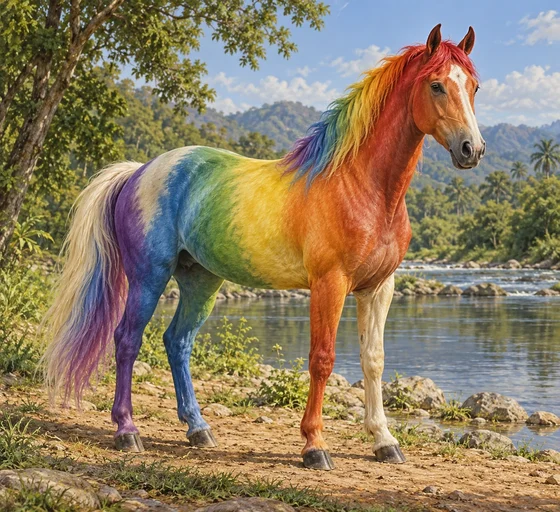
La diosa Avena is the figure sought through a portrait in Andrade’s tale 114, signed by María Porte of Monte Cristi. The story first follows Juansito, whose seven-coloured horse rescues and assists him after betrayal by his brothers. He collects a golden leaf, silk from another horse’s tail and a portrait despite warnings. His brothers use these objects to provoke a king into demanding the originals. The helper can obtain the tree and horse, but warns that Avena commands him, the boy and the king. Her title is the tale’s own designation; this account does not document an organised cult, grain goddess or identification with a classical deity.
On the journey Juansito releases an entangled eagle, frees a stranded whale and saves a mouse from a cat. The horse leaves him beside a lake where unsuccessful seekers remain with the water at their necks. Avena then requires him to reach Irene’s house before she does. He acquires an invisibility cap and swift boots by tricking two disputing heirs, reaches the house unseen and takes a piece of Irene’s dress hem and a lock of her hair as proof. Avena accepts his demonstration and agrees to leave the next day. The animal rescues and stolen magical objects form parts of Juansito’s journey; they are not powers or possessions explicitly assigned to Avena herself.
The king greets Avena as though she is already in his power and will shortly be his wife. She stops him and requires him to come to her house instead. There he must follow her example by jumping three cauldrons of tar on horseback. She clears them on her lean horse, while his fine mount manages only two. When he asks why Juansito does not jump, she says the boy has nothing to prove in that trial. The king’s last attempt kills him and his horse. Avena then offers marriage to Juansito, explaining that he has worked enough; their wedding concludes the tale. She is therefore an active setter of conditions and chooser of her husband, rather than a silent prize automatically transferred by the king. No bodily transformation or precise appearance is described for her.
Origins & earliest records
Complete tale 114, María Porte, Monte Cristi, printed pp. 150-155; named contributor entry and complete selected collection-method framing retained.
Records & interpretation
Complete selected original Spanish tale and printed footnotes read; all selected native story pages viewed. Full preface, collection-method pp. 24-27 and contributor context read. No whole-book or independent field-validation claim.
Selected bibliography
Documented works and useful reading. This is not a list of every appearance.
- 01
Folk-Lore from the Dominican Republic
Complete tale 114, printed pp. 150-155. Memoirs of the American Folk-Lore Society XXIII. Original Spanish narrative; original English editorial framing distinguished.
Family & connections
A source-supported family tree or inspiration record has not yet been compiled for this profile. Related reading below indicates a connection in subject matter, not a proven lineage or creative influence.
References
Sources supporting this profile. Linked pages have their own scope and editorial standards.
- Primary historical Spanish folklore account with original editorial contextAndrade 1930 original narrative and collection framingResearch access: 2026-10-18
Image credits
AI-generatedPortrayal of Avena in María Porte’s Tale.
Portrayal selects Avena as an adult human-looking woman outside her house at the first meeting with Juansito. Face, age, complexion, hair, modest dress and house details are interpreted; no cult iconography, crown, halo or classical-deity identification.