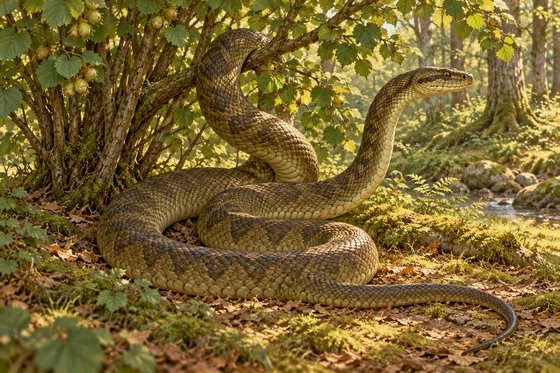
AI-generated interpretation of the prince in serpent form. Colour and pattern are editorial; no species or detailed original anatomy is asserted.
AI-generated interpretation of the prince in serpent form. Colour and pattern are editorial; no species or detailed original anatomy is asserted.
Overview
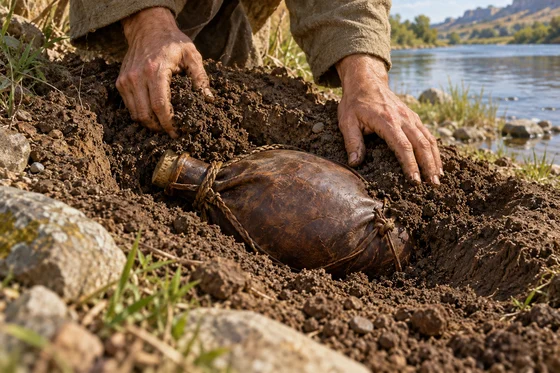
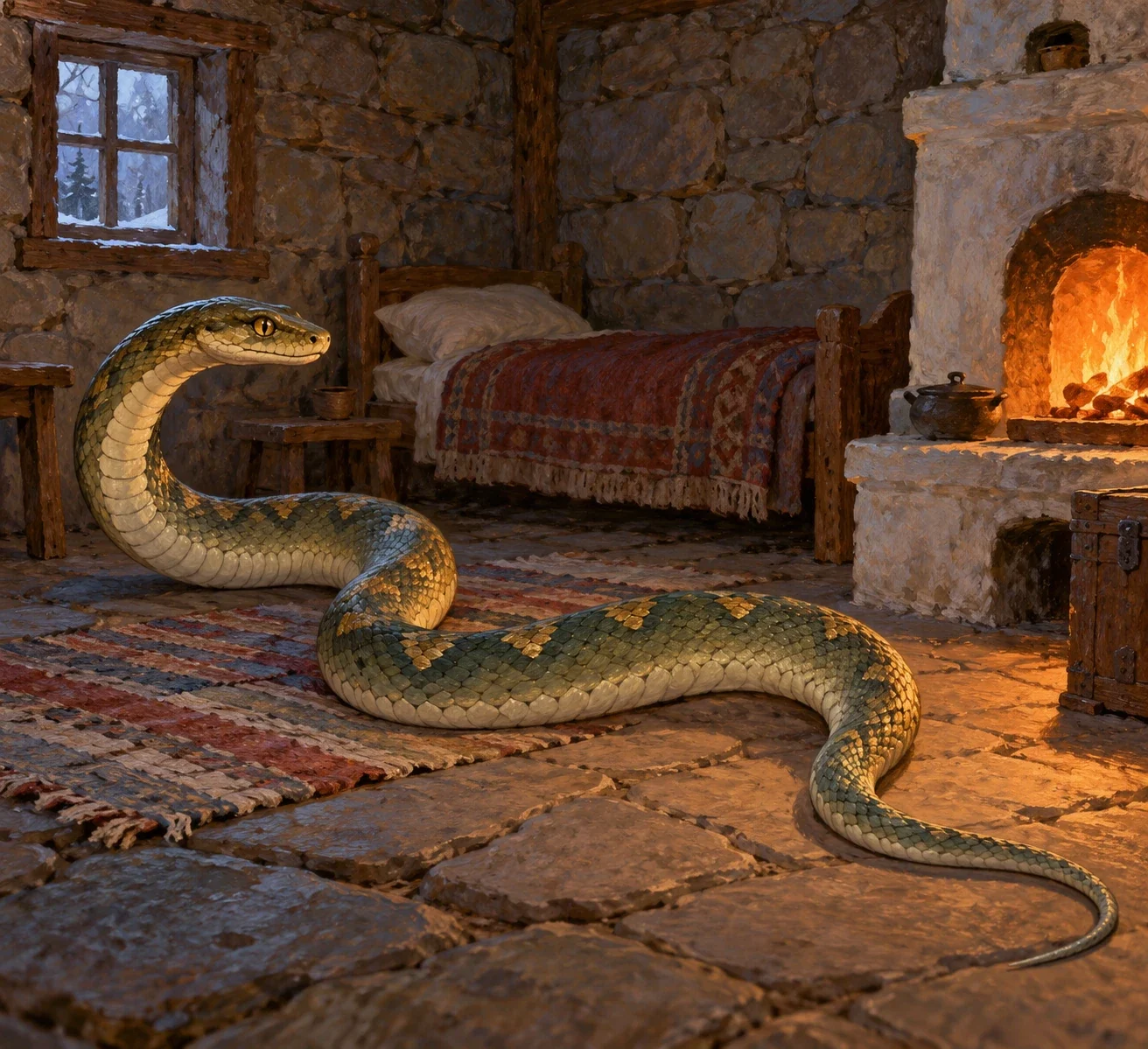
A childless Tsaritsa follows soothsayers’ advice to eat a boiled pike’s head. After a year she gives birth to a speaking serpent. He immediately asks for a stone hut with a bed, stove and warming fire, and demands marriage within a fortnight. He grows rapidly and rejects the assembled prospective brides. The youngest of twelve sisters, initially excluded as too young, says that he would choose her if she were brought before him. Before entering his dwelling, she asks the Tsar for twenty of each kind of garment and twenty pairs of shoes.
When the serpent asks his visitor to shed a skin, she agrees only on condition that he does likewise. Each discarded layer of her clothing answers a discarded serpent skin. After nineteen exchanges she retains her ordinary clothes and he his human skin; the narrative then describes him throwing off a final skin, which floats like gossamer. She catches it and burns it on the hearth. The text subsequently calls these his twenty serpent skins. Its awkward transition between the numbered exchanges and the final skin is retained rather than normalized into a new anatomy. He now stands before her as a human prince, and they marry.
The prince refuses to visit his parents. He eventually permits his wife to attend their court but warns that telling them of his discarded skins will make him disappear. She breaks the prohibition and returns to an empty home. Her search leads through the houses of the Mother of the Winds, the Mother of the Moon and the Mother of the Sun. Their sons initially threaten the smell of human visitors, yet supply guidance and silver, gold and diamond apples through their mothers. The Sun explains that her husband is marrying another woman in a distant kingdom.
Disguised as an old woman, the first wife trades the apples for three nights beside the prince. The second wife gives him sleeping draughts, preventing recognition during the first two vigils. On the third night he wakes and hears how the traveller found him. He condemns the second wife’s sale of access to him, restores the first wife’s rich clothing and sees her regain her youthful appearance after she removes the disguise and washes. The second wife is killed by wild horses. The narrative reunites the first couple through the wife’s sustained search, without explaining the original serpent birth beyond the pike-head episode.
Origins & earliest records
Bain’s selected English translation of narratives he labels Ruthenian, from the Kulish, Rudchenko and Dragomanov collections. The introduction supplies a broad historical language geography; the individual tale has no named teller or collection locality. The 1916 Harrap witness is a historical printed translation, not a recovered oral performance. Underlying original-language editions were not independently read.
Records & interpretation
Complete located tale in Bain’s 1916 English edition, printed pp.197–204; introduction and full footnote list inspected. Digital transcription reused from preserved source, locally reinspected 23 October; no new original PDF attempt.
Selected bibliography
Documented works and useful reading. This is not a list of every appearance.
- 01
Cossack Fairy Tales and Folk Tales
Bain’s selected English translation of narratives he labels Ruthenian, from the Kulish, Rudchenko and Dragomanov collections. The introduction supplies a broad historical language geography; the individual tale has no named teller or collection locality. The 1916 Harrap witness is a historical printed translation, not a recovered oral performance. Underlying original-language editions were not independently read.
Family & connections
A source-supported family tree or inspiration record has not yet been compiled for this profile. Related reading below indicates a connection in subject matter, not a proven lineage or creative influence.
References
Sources supporting this profile. Linked pages have their own scope and editorial standards.
- Historical translated primary narrative; preserved Gutenberg transcriptionBain 1916 — complete selected narrative, pp.197–204Research access: 2026-10-23
Image credits
AI-generated illustrationAI-generated interpretation of the prince in serpent form. Colour and pattern are editorial; no species or detailed original anatomy is asserted.
AI-generated interpretation of the prince in serpent form. Colour and pattern are editorial; no species or detailed original anatomy is asserted.