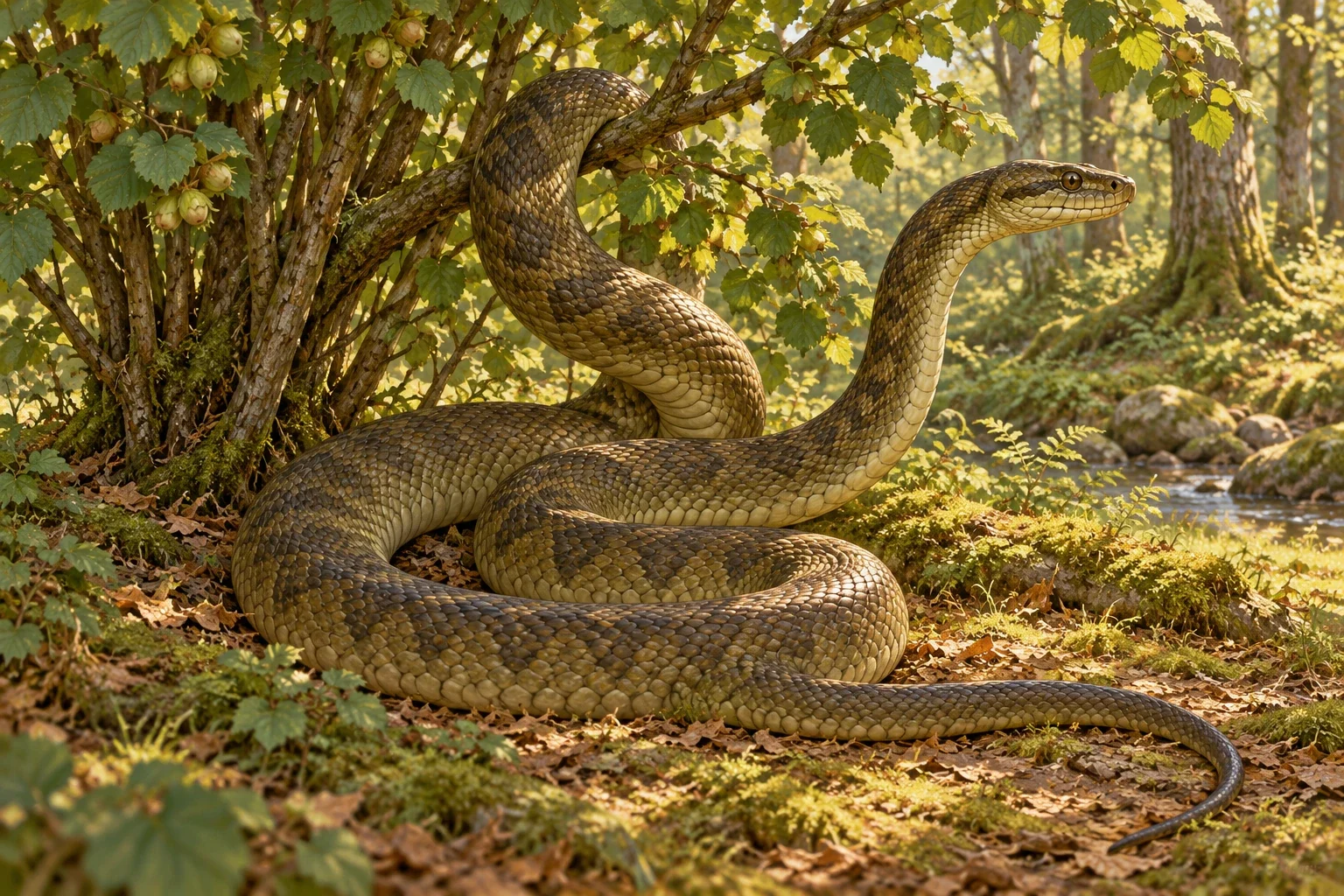
The serpent-wife beneath the hazel bush; snake appearance and woodland setting interpreted from Bain’s translated tale.
Original narrative illustration; unspecified visual details remain imagined, not authenticated ethnography.
Overview
A solitary labourer meets a huge serpent in a forest. She first threatens to eat him, then changes her demand and gives precise instructions for his work. He is to gather his employer’s corn while leaving one small sheaf, accept that sheaf instead of money, and burn it. A beautiful woman will emerge and become his wife. He follows the instructions, and the woman appears from the burning sheaf. After their marriage his master grants a place for a hut. The wife helps so effectively that the building and its furnishings seem to be ready almost without her husband’s effort. Her generosity establishes their household; the narrative presents her as more than an animal threatening a traveller.
Later he hears that his own ripe fields remain unharvested. Angry and impatient, he calls her a serpent, breaking the prohibition she had given him. At home he finds a large serpent coiled on his pillow and remembers her warning that this name would cost him his wife. His accusation was mistaken: she has already brought home and threshed all the grain. She departs for the forest, and he follows in grief. Beneath a hazel bush she asks for three farewell kisses, each with a different result. After the first he knows what is happening in the world; after the second he understands the languages spoken by people; after the third he knows what happens beneath the earth. She tells him to go to the Tsar, who will give him his daughter for that knowledge, and asks for prayers because she must remain a serpent forever. She disappears among the bushes; the man marries the Tsar’s daughter. The ending does not restore the first marriage or release the serpent-wife.
Origins & earliest records
The Serpent-Wife appears as a separate, unnamed figure in Bain’s translated selection. The tale supplies a forest encounter and a marriage without naming a village, teller or original-language title. It is followed by The Story of Unlucky Daniel and is distinct from the same volume’s later Serpent-Tsarevich and His Two Wives. This entry follows only the complete selected narrative.
Records & interpretation
Complete The Serpent-Wife, narrative printed pp.105–108; following section title leaf p.109 precedes The Story of Unlucky Daniel p.111. Complete introduction and entire footnote list checked; no footnote is attached to this selected tale.
Selected bibliography
Documented works and useful reading. This is not a list of every appearance.
- 01
Cossack Fairy Tales and Folk Tales
London: George G. Harrap & Co.; edition/date read in the transcription and confirmed by scan metadata. No physical title page inspected.
Family & connections
A source-supported family tree or inspiration record has not yet been compiled for this profile. Related reading below indicates a connection in subject matter, not a proven lineage or creative influence.
References
Sources supporting this profile. Linked pages have their own scope and editorial standards.
- Historical translated primary narrative; digitized transcriptionBain — complete English tale, introduction and source footnotes, 1916 transcriptionResearch access: 2026-10-21
- Edition metadata only; original PDF request failedInternet Archive metadata for the 1916 Harrap editionResearch access: 2026-10-21
Image credits
AI-generatedThe serpent-wife beneath the hazel bush; snake appearance and woodland setting interpreted from Bain’s translated tale.
Original narrative illustration; unspecified visual details remain imagined, not authenticated ethnography.