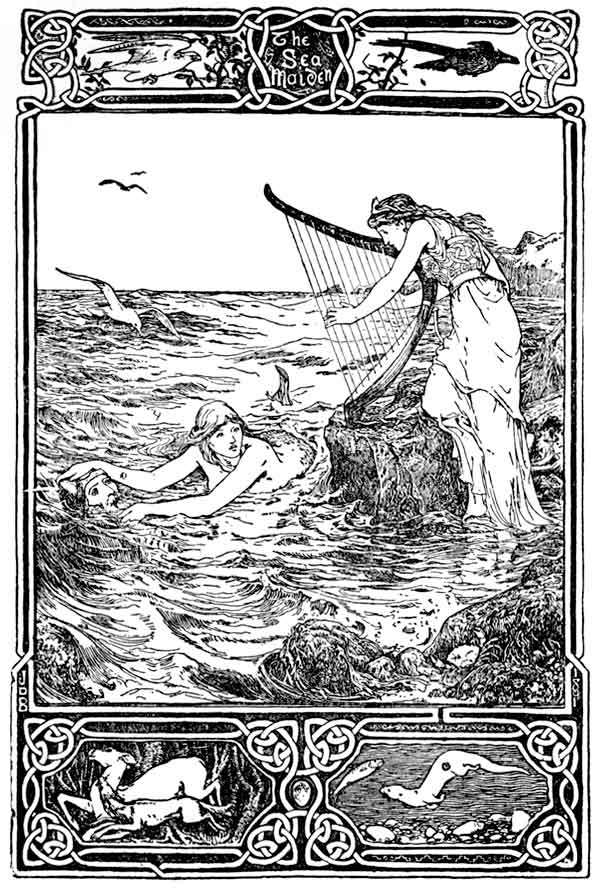
Batten: idealised Sea Maiden swallowing variant
Frontispiece is Batten’s idealised swallowing variant, explicitly distinguished from the main Campbell/Jacobs escape narrative; harp-playing maiden and sea mouth shown. John Dickson Batten (1860–1932) credited by title page. 1892 first publication; selected impression undated.
Overview
The being rises beside a fisherman’s boat and offers abundant catches in return for his first son when that child reaches twenty. The father agrees before believing he will have a son, and the promise eventually drives the young man to seek fortune elsewhere. After adventures involving giants and a separate three-headed lake beast, he marries a princess. On the day associated with the old bargain, the Sea-Maiden takes him into the lake. The wife’s harp draws her to listen, and interrupted music obtains progressively fuller glimpses of the captive. He escapes by assuming a falcon’s form, but the Sea-Maiden takes the wife instead.
The husband learns that the water being’s soul is outside her own body, in an egg held by a trout, nested through a hoodie and a white-footed hind on an island. His grateful dog, falcon and otter assist in reaching the successive creatures. Controlling the egg gives him power to demand his wife’s return; once she is safely with him, he breaks it and the Sea-Maiden dies. The text does not supply a fish tail or a standard mermaid anatomy. Jacobs also acknowledges omitting the animal helpers’ births and relocating another adversary’s encounter. His note observes a variant in which the captive is swallowed and says Batten idealised the frontispiece; neither detail is silently imposed on the main inspected story.
Origins & earliest records
Jacobs selects Campbell’s Popular Tales, number 4, for his 1892 adaptation and states two substantial editorial changes. The resulting English narrative is a literary witness to a Scottish Gaelic collection, with an unknown oral starting date. A separately mentioned swallowing variant remains attributed to the note.
Records & interpretation
The bargain, music response and external soul are explicit textual features. The source documents tale transmission, not the biological existence of a water species. The note’s admission of an idealised illustration also separates artistic representation from the main narrative’s unspecified anatomy.
In the literature
“the soul of the sea-maiden is in the egg”
THE SEA-MAIDEN; The soothsayer explains the captor’s vulnerability
A soothsayer locates the maiden’s soul in an egg nested through trout, hoodie and hind on an island. The black horse reaches the island, while the grateful dog, falcon and otter secure successive animals. Holding the egg wins the wife’s release; crushing it then kills the maiden. These helpers’ omitted birth background is not silently reconstructed.
Selected bibliography
Documented works and useful reading. This is not a list of every appearance.
- 01
Celtic Fairy Tales: The Sea-Maiden
Complete selected episode and source note inspected; the preface explicitly admits altering and combining translated sources.
- 02
Celtic Fairy Tales — The Sea-Maiden
Joseph Jacobs, Celtic Fairy Tales, undated selected PG7885 print/transcription, THE SEA-MAIDEN and noteXVII. Collector’s editing and differences from Campbell’s variants explicitly retained.
Family & connections
A source-supported family tree or inspiration record has not yet been compiled for this profile. Related reading below indicates a connection in subject matter, not a proven lineage or creative influence.
Located primary passages
Specific passages supporting details in this entry, grouped by their published witness.
Celtic Fairy Tales — The Sea-Maiden
Joseph Jacobs, Celtic Fairy Tales, undated selected PG7885 print/transcription, THE SEA-MAIDEN and noteXVII. Collector’s editing and differences from Campbell’s variants explicitly retained.
- A sea-maiden promises plentiful fish in return for the fisherman’s first son when he reaches twenty. The bargain succeeds, but the father’s increasing fear leads the son to seek his fortune with a sword. The sea-maiden’s later claim survives those intervening adventures.
- On the promise’s anniversary, the sea-maiden takes the now-married man into the loch. His wife uses music to bargain for progressively more of his body to emerge; when fully free he becomes a falcon and escapes, but the maiden takes his wife instead. The selected body does not say she swallowed him; that appears only in a separately cited variant.
- A soothsayer locates the maiden’s soul in an egg nested through trout, hoodie and hind on an island. The black horse reaches the island, while the grateful dog, falcon and otter secure successive animals. Holding the egg wins the wife’s release; crushing it then kills the maiden. These helpers’ omitted birth background is not silently reconstructed.
Complete selected body and noteXVII independently read. Distinct sea captor, carlin and three-headed beast are not conflated; absent causes and anatomies not invented. No songs or ritual-formula excerpts.
Primary source witness
Joseph Jacobs, Celtic Fairy Tales, undated selected PG7885 print/transcription, THE SEA-MAIDEN and noteXVII. Collector’s editing and differences from Campbell’s variants explicitly retained.
- Jacobs credits Campbell Popular TalesNo4, explicitly omits the animal comrades’ births and moves the carlin episode. He separately reports a variant in which the husband comes from the maiden’s mouth. These are compiler-reported differences; his medieval chronology and missionary-diffusion theory are not adopted as proof.
Confirms Jacobs’s selected adaptation and stated variant, not independently visited Campbell texts or medieval manuscript dates.
References
Sources supporting this profile. Linked pages have their own scope and editorial standards.
- Primary textJacobs, Celtic Fairy Tales: The Sea-Maiden and source noteResearch access: 2026-10-05
Image credits
Historical illustrationBatten: idealised Sea Maiden swallowing variant
Frontispiece is Batten’s idealised swallowing variant, explicitly distinguished from the main Campbell/Jacobs escape narrative; harp-playing maiden and sea mouth shown. John Dickson Batten (1860–1932) credited by title page. 1892 first publication; selected impression undated.