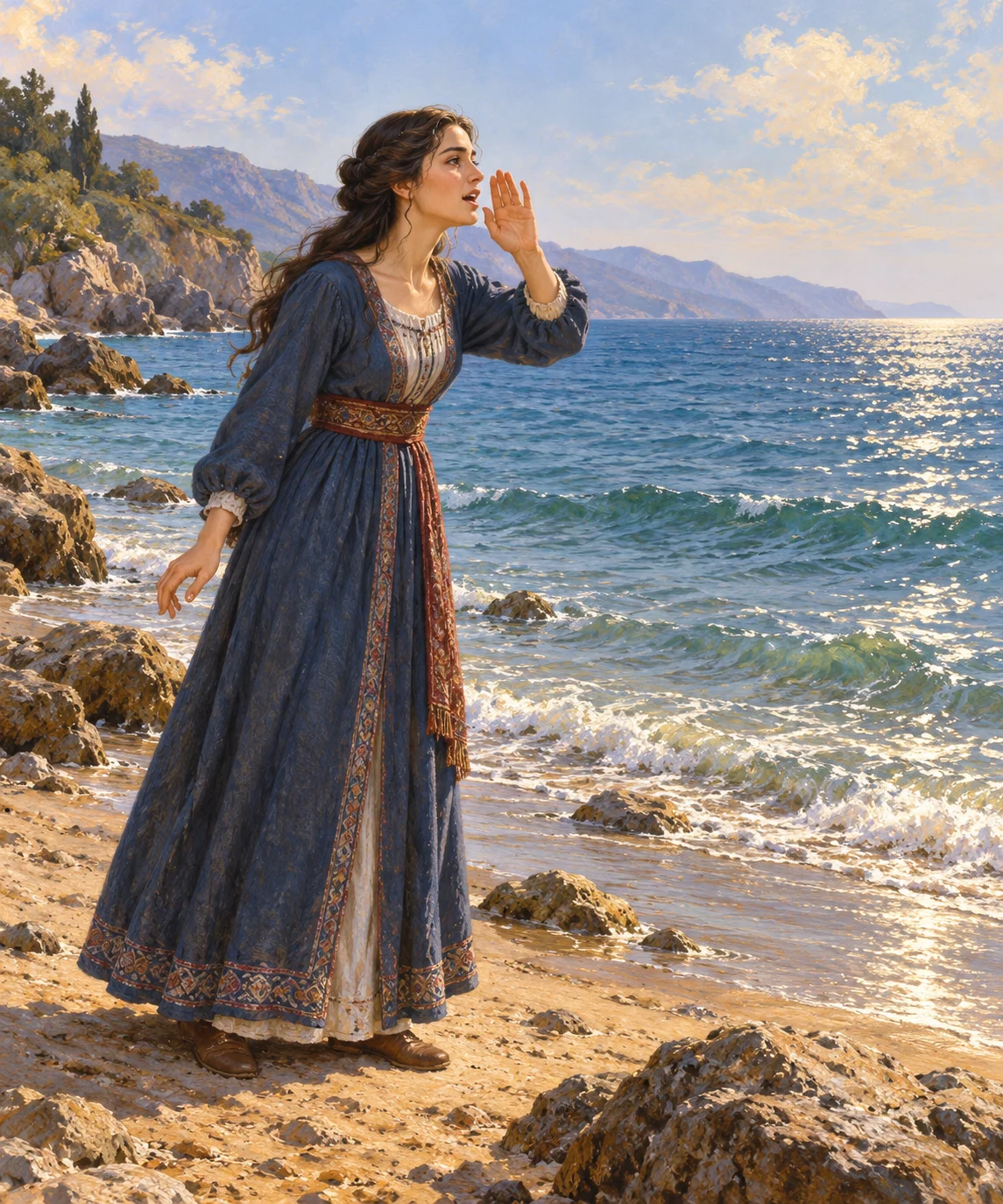
The sea daughter calls for help in her human married guise; appearance, clothing and shore imagined.
Original narrative illustration; appearance and staging imagined, not an authenticated cultural or zoological record.
Overview
A grandmother living beside the sea throws a loaf into it each morning and tells her grandson to continue after her death. He obeys, then discovers that someone has been cleaning his home and preparing his food. Hiding beneath the stairs, he sees a large fish come from the sea, shed its skin and become a young woman. When he catches her hand, she cries for her mother. A voice from the water, called the grandmother in the telling, reassures her that he is their son-in-law. They marry. Later the king sees the wife embroidering and desires her, so he threatens her husband with death unless he brings an impossibly capacious tent.
The wife calls to the underwater grandmother for their little tent. Even after seven days and nights of unfolding it, half remains folded. A carpet sufficient for that tent and a bunch of grapes that can feed the army without exhaustion defeat the king’s next demands. Finally he orders the husband to bring a three-day-old child able to speak and walk. The wife borrows her little brother from beneath the sea. On the journey the infant speaks to his brother-in-law; before the king he walks, slaps the ruler and rebukes his plan to kill the husband and abduct his sister. The king asks forgiveness and abandons his designs. The couple’s happy life is followed by the traditional closing of three apples falling from heaven.
Origins & earliest records
Macler’s tale III is headed “Dialecte de Tigranakert” and cites the Armenian text in Hamov Hodov, p.163. His preface identifies the1884 collection of Karekin Servantstiants and acknowledges Marie Sevadjian’s help explaining dialect vocabulary. No individual teller or precise collection occasion is supplied. The dialect heading and the collection’s broader Van context are retained without locating the fictional shore in a modern country.
Records & interpretation
Complete French III, pp.45–49, including its dialect heading, Armenian source-page footnote and complete ending. Original title, preface and selected narrative native pages inspected.
Selected bibliography
Documented works and useful reading. This is not a list of every appearance.
- 01
Contes arméniens
Paris: Ernest Leroux; French selections from Hamov Hodov, Constantinople1884. Original French text, not a modern translation.
Family & connections
A source-supported family tree or inspiration record has not yet been compiled for this profile. Related reading below indicates a connection in subject matter, not a proven lineage or creative influence.
References
Sources supporting this profile. Linked pages have their own scope and editorial standards.
- Original historical French translation of collected Armenian narrativesMacler1905: complete selected tales, preface and original edition witnessesResearch access: 2026-10-18
Image credits
AI-generatedThe sea daughter calls for help in her human married guise; appearance, clothing and shore imagined.
Original narrative illustration; appearance and staging imagined, not an authenticated cultural or zoological record.