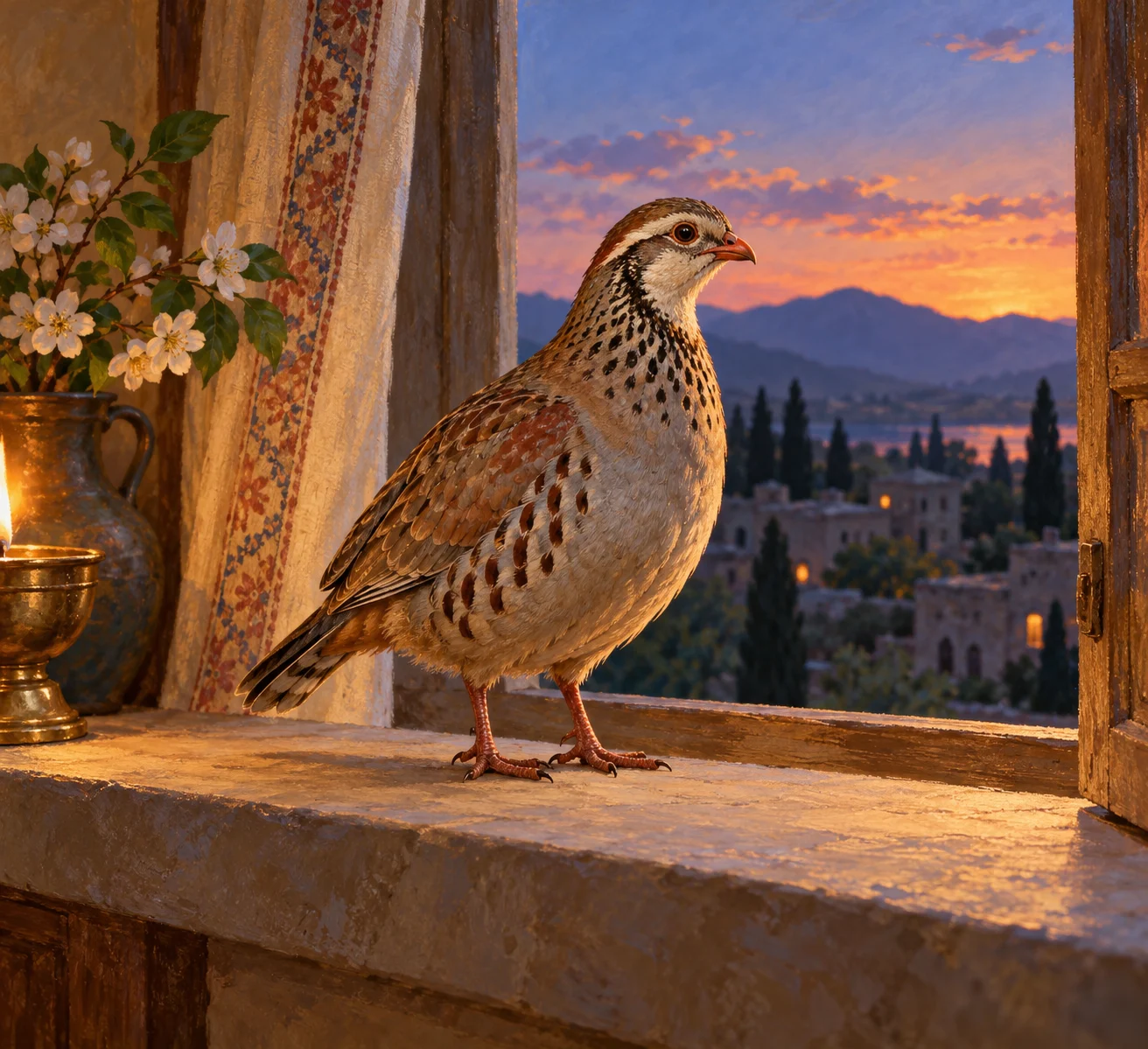
The husband visits in partridge form before the trap; detailed plumage and window setting imagined.
Original narrative illustration; appearance and staging imagined, not an authenticated cultural or zoological record.
Overview
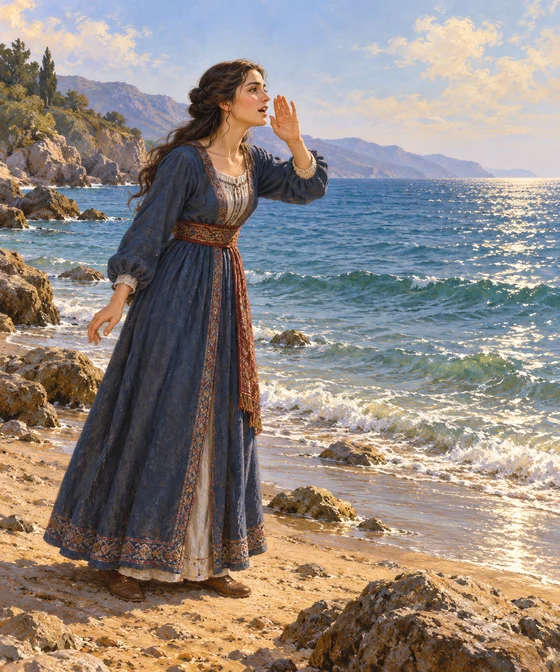
A mother who has forgotten clothing for her youngest daughter sighs beside a spring. An old man emerges from a stone there and promises an outfit if she brings the girl. Instead he takes her away, and only after a later visit does the mother learn that her daughter has become his son’s bride. The young wife returns to her family in elegant clothes and asks for a separate room. Her husband visits every evening in the form of a partridge and flies away before dawn. Her two sisters envy their happiness and set razors along the window. The arriving bird wounds himself against them and retreats to the spring, mistakenly blaming his wife.
When wife and mother come to inquire, the husband orders his father to take eagle form and abandon her in a lonely place. She survives on the sand and overhears a discussion of remedies during the night. Returning home, she obtains what the story says she needs, then approaches the spring disguised as a doctor and is admitted to treat the injured husband. The narrative presents the cure as immediate. Asked her fee, she instead asks him to remember the name Khngabrag, glossed by Macler as an incense sachet. He recognizes it as his wife’s name; she reveals herself and explains her suffering. The tale ends by affirming their continuing love. The narrated treatment is part of the fiction, not medical advice.
Origins & earliest records
Macler’s complete tale VI cites Hamov Hodov, p.179, within the same1884 Armenian collection translated in his1905 volume. This narrative also appears as “The Bride of the Fountain” in the already cached1898 Seklemian collection. The two witnesses are treated as versions of one story and reserved as one husband identity; their differing details are not multiplied into separate figures. No named oral teller or specific locality is assigned to this tale.
Records & interpretation
Complete French VI, pp.65–70, including the source footnote, comparative Ywenec note, recognition and complete final sentence. Native beginning, bird-visiting scene and ending viewed. Cached Seklemian t6 was read for identity comparison, not substituted for this version’s details.
Selected bibliography
Documented works and useful reading. This is not a list of every appearance.
- 01
Contes arméniens
Paris: Ernest Leroux; French selections from Hamov Hodov, Constantinople1884. Original French text, not a modern translation.
Family & connections
A source-supported family tree or inspiration record has not yet been compiled for this profile. Related reading below indicates a connection in subject matter, not a proven lineage or creative influence.
References
Sources supporting this profile. Linked pages have their own scope and editorial standards.
- Original historical French translation of collected Armenian narrativesMacler1905: complete selected tales, preface and original edition witnessesResearch access: 2026-10-18
Image credits
AI-generatedThe husband visits in partridge form before the trap; detailed plumage and window setting imagined.
Original narrative illustration; appearance and staging imagined, not an authenticated cultural or zoological record.