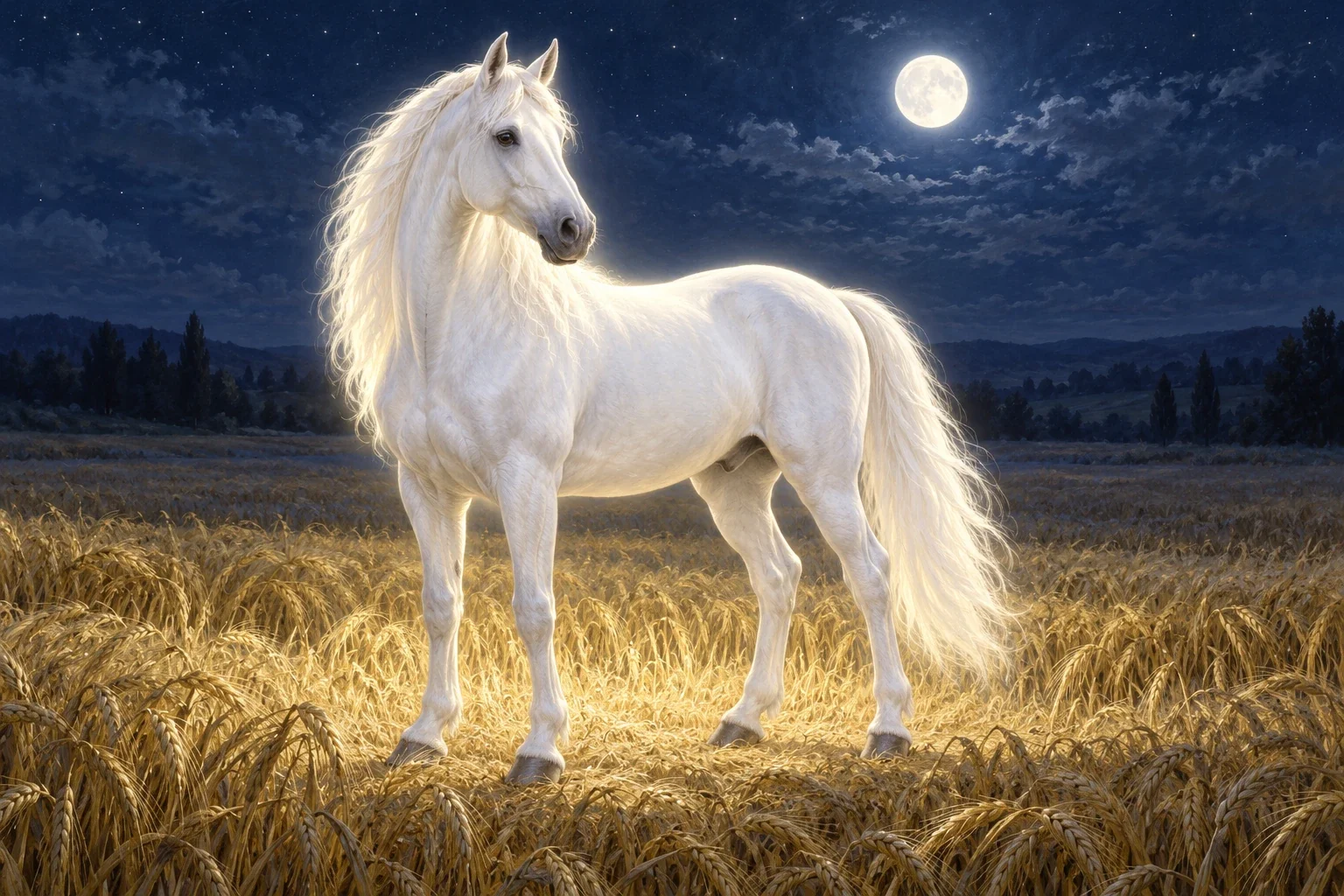
AI-generated interpretation of Brugman’s historical telling; individual appearance and staging imagined.
Overview
Schimmelchen is the speaking white horse who helps the youngest son in Brugman’s Godlewa tale IV. A father discovers that something is eating the family’s barley at night. The two elder sons fail to keep watch, but the youngest waits until midnight and catches a horse whose whiteness lights up the earth. The horse asks to be released and promises immediate help whenever the youth calls Schimmelchen. The youth accepts the bargain and lets it go.
When a king promises his daughter to a rider who can leap from the courtyard to the third storey, the youngest son obtains permission to go mushroom gathering instead of accompanying his brothers. Away from home, he calls the horse. Entering one of its ears and emerging from the other, he becomes a handsome nobleman. Horse and rider then make the extraordinary leap, and the princess gives the rider her ring. After dismissing the horse on his return, the youth has his ordinary appearance again.
The ring later shines through his attempted concealment and identifies him at the king’s feast, leading to marriage. This is the horse of tale IV, not the similarly addressed helper of tale V: no gift of summoning hairs is described here. Wollner compares the horse with Slavic wonder-horse traditions, including Sivka-Burka, but those comparative examples are not additional adventures or colours of this individual.
Origins & earliest records
A. Leskien and K. Brugman, Litauische Volkslieder und Märchen; Part III German translations by Karl Brugman, notes by Wilhelm Wollner
Records & interpretation
Complete selected German tale and attached footnotes, full relevant comparative notes, title/preface and Godlewa collection/translation framing read. Original tale headers and native ambiguity pages inspected.
Selected bibliography
Documented works and useful reading. This is not a list of every appearance.
- 01
Litauische Volkslieder und Märchen aus dem preussischen und dem russischen Litauen
Strassburg: Karl J. Trübner, 1882; Part III, pp. 357–358. The 1881 preface date is not the publication year.
Family & connections
A source-supported family tree or inspiration record has not yet been compiled for this profile. Related reading below indicates a connection in subject matter, not a proven lineage or creative influence.
References
Sources supporting this profile. Linked pages have their own scope and editorial standards.
- Digitized original bilingual historical edition; German translation readLeskien and Brugman, 1882 — complete German tale, relevant notes and collection framingResearch access: 2026-10-21
Image credits
AI-generated illustrationAI-generated interpretation of Brugman’s historical telling; individual appearance and staging imagined.