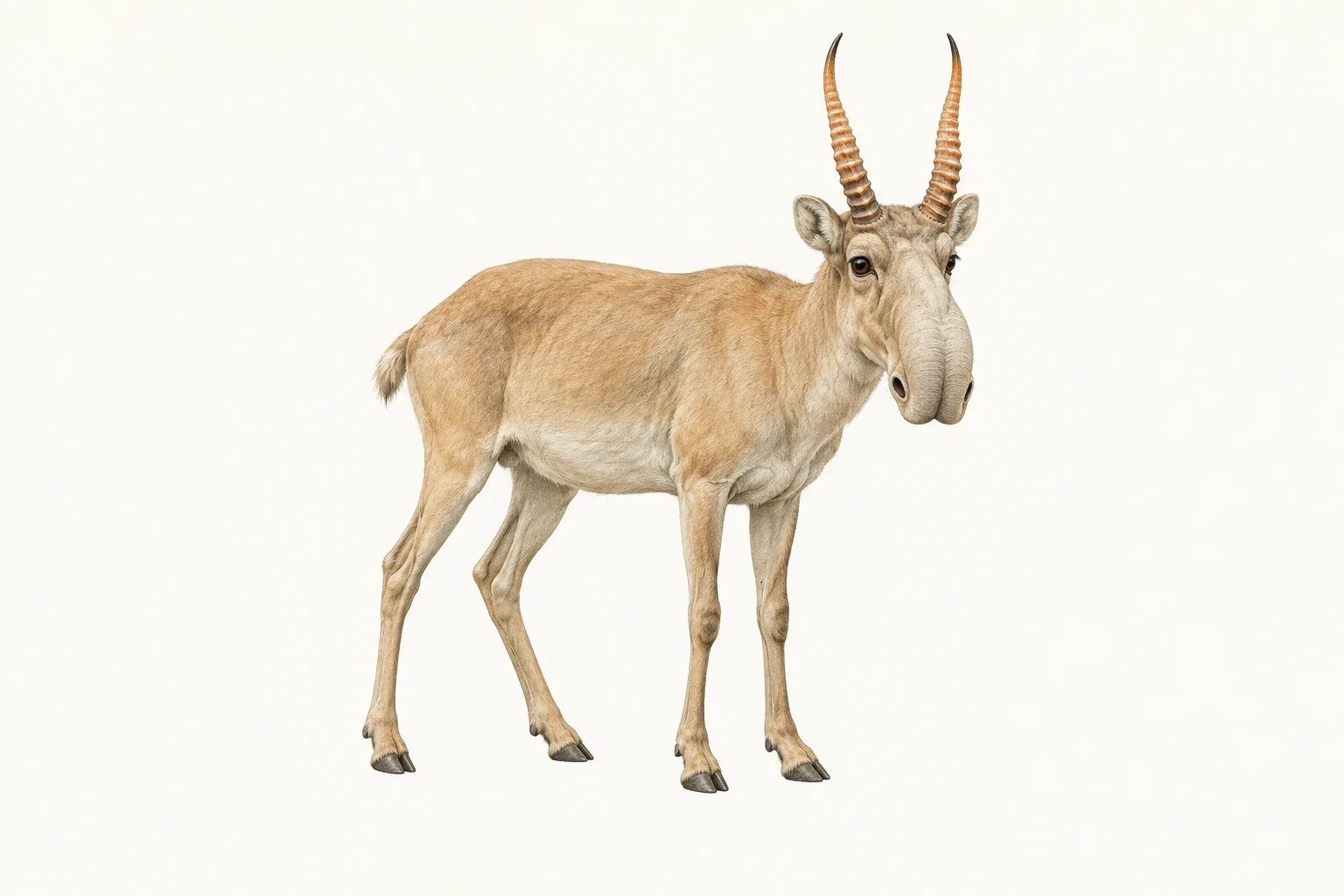
Saiga - AI-generated scientific interpretation.
Modern AI-generated scientific illustration. Diagnostic features follow the selected zoological sources; pose, individual pattern and fine details are interpretive. Not specimen photography or independent evidence.
Overview
The saiga has a conspicuous proboscis-like nose, a compact antelope body and slender legs. Its mobile nostrils are part of an enlarged nasal region associated with conditioning inhaled air in dusty, seasonally cold steppe environments. Adult males carry pale ringed horns, while females lack horns. A horned illustration therefore represents one sex rather than the whole species.
Herd movements connect feeding areas across open grassland and semi-desert. Seasonal coats and aggregations change the animal’s appearance and visibility. Migration should not be reduced to an identical route used by every population, and counts from one aggregation do not equal a species-wide census.
The 2015 mass mortality in Kazakhstan’s Betpak-Dala population prompted investigation of carcasses, pathogens and environmental conditions. Kock and colleagues identified haemorrhagic septicaemia associated with Pasteurella multocida and unusually warm, humid conditions. The multidisciplinary evidence explains a particular catastrophic event, rather than proving that every saiga death or population decline has that cause.
This episode illustrates the distinction between a pathogen’s presence and conditions allowing disease to spread or become severe. The selected research supplies a bounded historical case; it does not establish a current conservation category or a 2026 population total. Those changing assessments require separately dated evidence.
Origins & earliest records
Saiga tatarica is the living species accepted by the Mammal Diversity Database. This profile concerns the species; differing treatment of geographic populations does not warrant multiple new researched entries here.
Evidence & interpretation
Institutional observations document morphology and habitat. The 2018 mortality study combines pathology, microbiology and environmental analysis of the 2015 event. Direct PMC access later returned a browser challenge; claims are bounded to the earlier indexed primary account and the team’s institutional report.
Selected bibliography
Documented works and useful reading. This is not a list of every appearance.
- 01
Saiga
Selected bibliography; bounded source account, not exhaustive coverage.
- 02
Saigas on the brink: Multidisciplinary analysis of factors influencing mass mortality events
Selected bibliography; bounded source account, not exhaustive coverage.
- 03
Researchers uncover cause of mysterious mass death of saiga antelopes
Selected bibliography; bounded source account, not exhaustive coverage.
- 04
Saiga tatarica
Selected bibliography; bounded source account, not exhaustive coverage.
Family, evolution & connections
Taxonomic classification
A hierarchy of classified groups, not a chain of direct ancestors.
Source note: Species identity follows the Mammal Diversity Database; subspecies boundaries and current threat status are not resolved by this selected bibliography.
- kingdomAnimalia
- phylumChordata
- classMammalia
- orderArtiodactyla
- familyBovidae
- genusSaiga
- speciesSaiga tatarica
References
Sources supporting this profile. Linked pages have their own scope and editorial standards.
- InstitutionalSaigaResearch access: 2026-10-10
- ResearchSaigas on the brink: Multidisciplinary analysis of factors influencing mass mortality eventsResearch access: 2026-10-10
- InstitutionalResearchers uncover cause of mysterious mass death of saiga antelopesResearch access: 2026-10-10
- InstitutionalSaiga tataricaResearch access: 2026-10-10
Image credits
AI-generated scientific interpretationSaiga - AI-generated scientific interpretation.
Modern AI-generated scientific illustration. Diagnostic features follow the selected zoological sources; pose, individual pattern and fine details are interpretive. Not specimen photography or independent evidence.