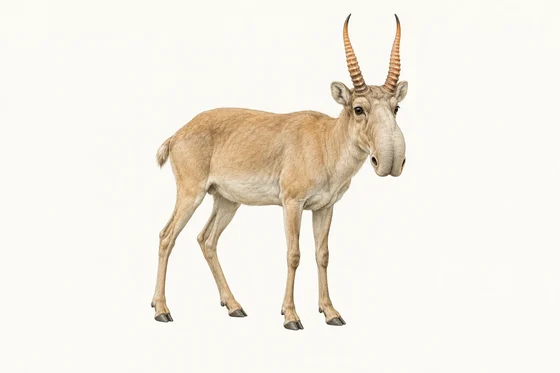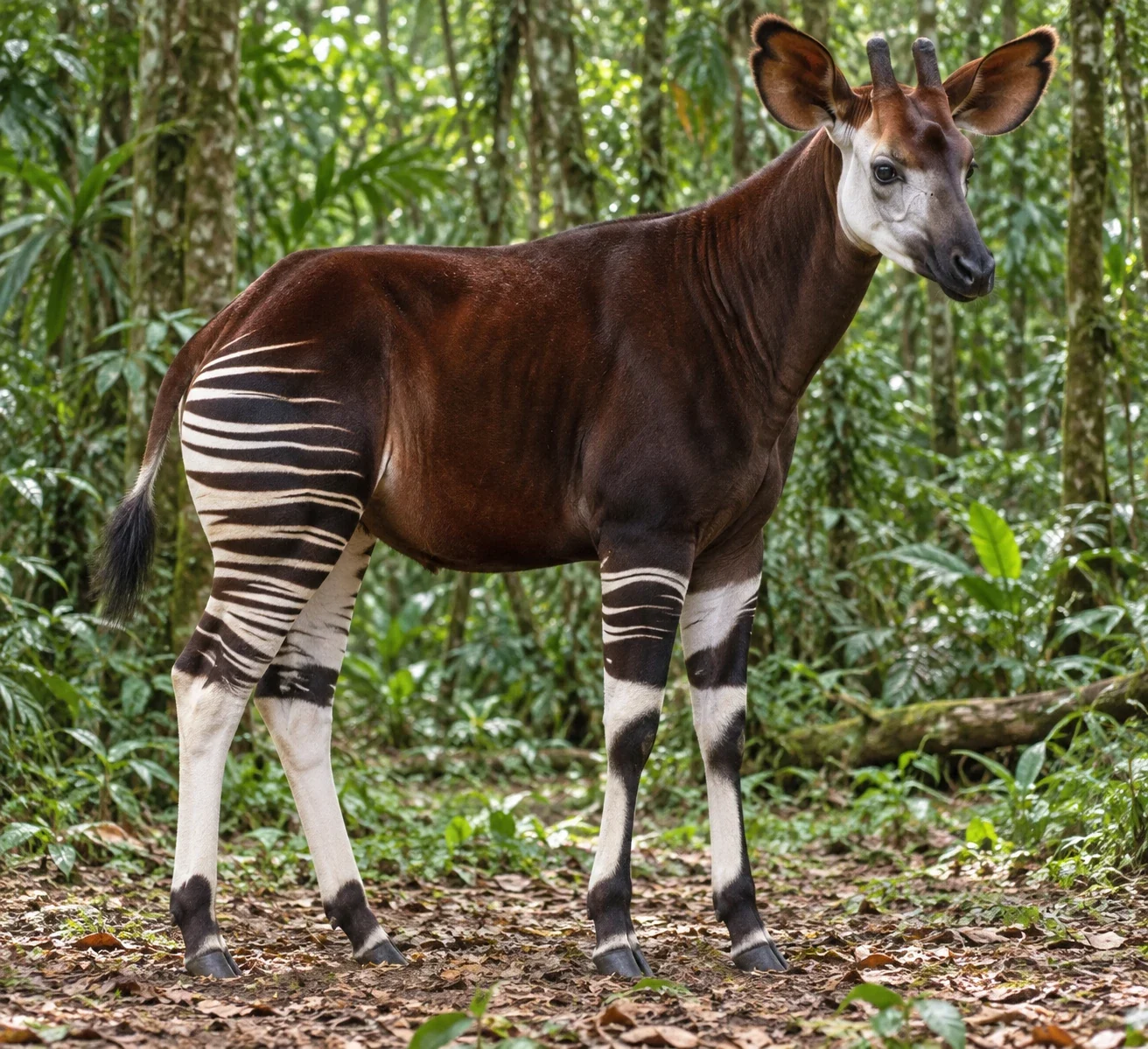
Okapi - AI-generated scientific interpretation.
Modern AI-generated scientific illustration. Diagnostic features follow the selected zoological sources; pose, individual pattern and fine details are interpretive. Not specimen photography or independent evidence.
Overview
An okapi’s stripes suggest a zebra at first glance, but its large ears, head and feeding apparatus belong to a giraffid. The body is dark reddish brown, with contrasting stripes concentrated around the rear and upper legs rather than across the entire trunk. Males have small ossicones, skin-covered bony projections unlike branched deer antlers.
The long prehensile tongue assists browsing on buds and leaves in forest vegetation. Large ears can rotate independently to detect sound. The shorter neck and forest setting distinguish its ecology from a giraffe feeding high above open savanna; neither form should be presented as a more advanced version of the other.
Agaba and colleagues sequenced giraffe and okapi genomes in 2016 to investigate differences in growth and cardiovascular development. The okapi supplied a close comparison lacking the giraffe’s extreme stature. Candidate genes and pathways emerged from comparative sequence analysis, but that approach does not demonstrate every proposed developmental effect in a living animal.
The comparative genome work also illustrates a sampling limitation. A genome assembly reconstructs sequence organization from sampled material, not the DNA of every okapi. Variation among individuals and population history require appropriate sampling; a reference genome should not be confused with a complete conservation census. The selected account therefore supplies morphology and a bounded genomic comparison without a current population estimate.
Origins & earliest records
Okapia johnstoni is the sole living species of Okapia and an extant giraffid. Modern taxonomic recognition does not mark the first knowledge of the animal by people living in its forest habitat.
Evidence & interpretation
Living animals and zoo observations document external morphology and browsing. Genome assemblies and comparative gene analyses support molecular relationships and candidate developmental hypotheses; sequence association alone does not prove a trait’s causal mechanism.
Selected bibliography
Documented works and useful reading. This is not a list of every appearance.
- 01
Okapi
Selected bibliography; bounded source account, not exhaustive coverage.
- 02
Giraffe genome sequence reveals clues to its unique morphology and physiology
Selected bibliography; bounded source account, not exhaustive coverage.
Family, evolution & connections
Taxonomic classification
A hierarchy of classified groups, not a chain of direct ancestors.
Source note: Conventional giraffid ranks follow the zoological account; relationship to giraffes does not imply direct descent from a living giraffe species.
- kingdomAnimalia
- phylumChordata
- classMammalia
- orderArtiodactyla
- familyGiraffidae
- genusOkapia
- speciesOkapia johnstoni
References
Sources supporting this profile. Linked pages have their own scope and editorial standards.
- InstitutionalOkapiResearch access: 2026-10-10
- ResearchGiraffe genome sequence reveals clues to its unique morphology and physiologyResearch access: 2026-10-10
Image credits
AI-generated scientific interpretationOkapi - AI-generated scientific interpretation.
Modern AI-generated scientific illustration. Diagnostic features follow the selected zoological sources; pose, individual pattern and fine details are interpretive. Not specimen photography or independent evidence.