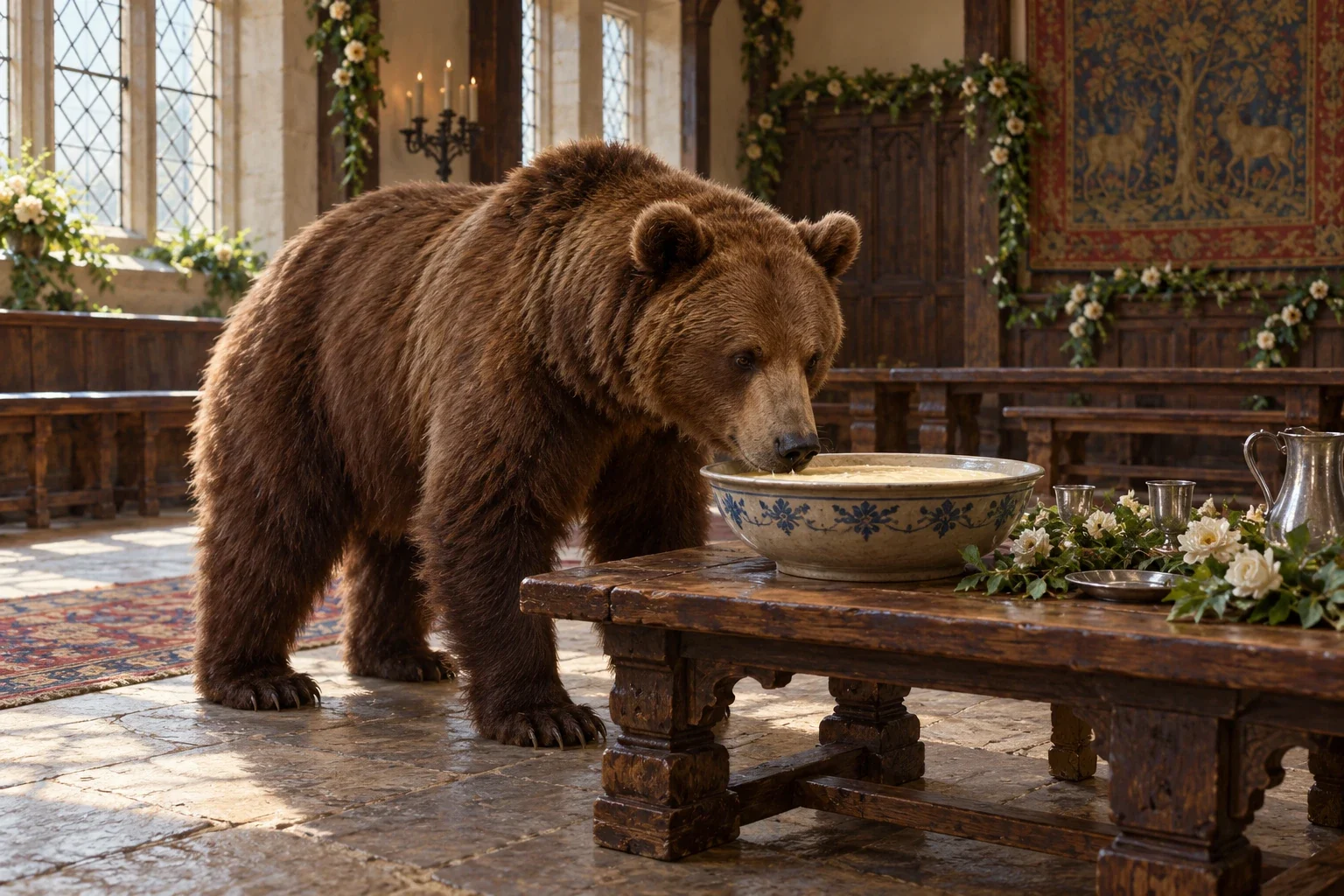
AI-generated literary interpretation of Robin Goodfellow’s demonstrated bear form at the wedding in Keightley’s account. The hall, tableware and individual appearance are imagined; this is not his fixed or universal form.
The source supplies Robin’s demonstrated bear transformation and wedding posset episode. Hall, furniture, flowers, tapestry, tableware, daylight and individual bear appearance are imagined. This is neither an authenticated historical scene nor a fixed Robin body or game design; no source artwork was used. The natural stance and foreground table obscure part of the far limb/paw. Full frame retained; natural far-limb occlusion accepted on root review.
Overview
Thomas Keightley presents a two-part account of Robin Goodfellow’s adventures in his Fairy Mythology. Robin is the child of a mortal woman and a fairy father. After leaving his mother and then a tailor, he sleeps and receives a written message granting wishes and the ability to change form. Its instructions favour helping honest people and punishing wrongdoers. The episodes that follow nevertheless include both assistance and intrusive mischief; they do not make him an invariably benevolent household guardian.
In the first part, Robin becomes a horse and induces a churlish man to mount. After a dangerous fall, the rider tries to take the horse through water and discovers that only a pack-saddle remains beneath him. Robin departs laughing. Keightley then reports his help to two lovers. These are particular adventures of this named figure, not proof that every being called a hobgoblin has the same powers or story.
The second part includes work done for a maid at night, such as processing flax and meal. Seeing his scant clothing, she supplies a waistcoat. Robin rejects the gift and ceases helping, contrasting the unwanted garment with milk or cream. Elsewhere he appears as a moving fire and misleads returning revellers until daylight. He also interrupts an assault on a woman by using hare and horse forms. A later episode has him outwit a weaver by substituting yarn for himself in bed.
At a wedding Robin extinguishes candles, provokes quarrels and changes into a bear, frightening the company away so that he can consume the posset. Finally his father, called Obreon in Keightley’s account, takes him to the fairies’ dancing and then Fairyland. The selected narrative ends with secrets Robin does not disclose. The bear scene is one demonstrated transformation, not his normal anatomy.
This profile follows Keightley’s mediated literary account, not an independently collated early chapbook. His nearby quotation from Burton associates the labels Hobgoblins and Robin Goodfellows with household labour rewarded by milk. That is a historical naming context, not a universal taxonomy. Keightley’s proposed early dating and Shakespeare relationship remain his arguments; neither establishes a source used by a modern fictional creator.
Origins & earliest records
Thomas Keightley, The Fairy Mythology, revised and enlarged edition, London: George Bell & Sons, 1892, pp.287–291; chapbook account and quoted Burton context, notes328–330 and335.
Records & interpretation
Complete selected chapbook account, subsequent quoted Burton paragraphs, relevant notes and edition title read in the cached historical text. The early chapbook, Burton original and Shakespeare sources were not independently collated.
Selected bibliography
Documented works and useful reading. This is not a list of every appearance.
- 01
The Fairy Mythology: Robin Goodfellow account and quoted Burton context
Selected account pp.287–291. Earlier dating and literary influence suggestions are attributed to the collector, not independently established.
Family, evolution & connections
Hobgoblin (Destiny)
Keightley quotes Burton associating Hobgoblins and Robin Goodfellows with household work rewarded by milk. His separate chapbook account follows a named Robin through transformations and pranks. This is a limited historical naming comparison, not shared anatomy, an identical narrative role or evidence of a modern creator’s source.
References
Sources supporting this profile. Linked pages have their own scope and editorial standards.
- Historical collector’s literary accountKeightley1892, complete selected Robin Goodfellow account and Burton quotationResearch access: 2026-10-24
Image credits
AI-generated literary interpretationAI-generated literary interpretation of Robin Goodfellow’s demonstrated bear form at the wedding in Keightley’s account. The hall, tableware and individual appearance are imagined; this is not his fixed or universal form.
The source supplies Robin’s demonstrated bear transformation and wedding posset episode. Hall, furniture, flowers, tapestry, tableware, daylight and individual bear appearance are imagined. This is neither an authenticated historical scene nor a fixed Robin body or game design; no source artwork was used. The natural stance and foreground table obscure part of the far limb/paw. Full frame retained; natural far-limb occlusion accepted on root review.