
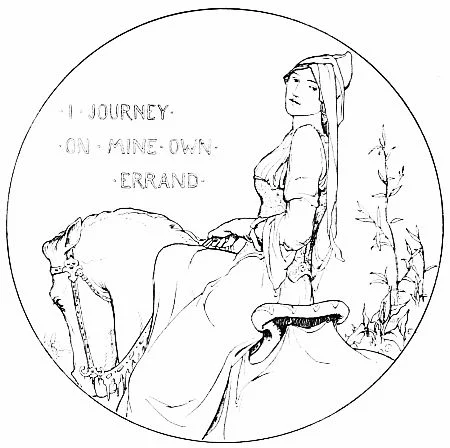
Rhiannon’s white horse in Batten’s meeting illustration, 1895
Rhiannon’s mount appears with an ornate bridle in this meeting scene. The still illustration cannot show the horse’s impossible distance from pursuing riders; its tack is the illustrator’s detail, not a fixed feature of the medieval account.
Overview
The horse is described as pure white and large, bearing a woman in shining gold along the road below Narberth’s mound. A messenger first tries to follow on foot, then on the fleetest horse he can obtain. Each increase in effort leaves the woman farther away, although her mount retains the same measured pace. The next day another rider repeats the attempt with the same result, establishing the effect through several separate encounters rather than a single mistaken estimate.
On the third day Powel pursues on his own horse and likewise fails. When he calls on the maiden to wait, she stops gladly and says it would have been better for his horse if he had asked sooner. The story locates agency in the woman’s response as well as the mount’s impossible travel. It does not name the horse, give it wings, make it speak or explain whether distance itself has been enchanted. Rhiannon’s later punishment involving the offer to carry visitors does not explicitly transform her into this horse. The mare and rescued colt in Teyrnon’s separate stable episode are also distinct animals.
Origins & earliest records
Jacobs’s selected 1895 Powel adaptation credits Lady Guest’s Mabinogion and acknowledges anglicised names and an omitted opening. Its horse episode is a medieval-derived literary witness. It does not establish when every oral account of Rhiannon’s mount began.
Records & interpretation
The repeated pursuit and unchanged visible pace provide textual evidence for supernatural travel. They are not speed measurements or evidence of an unknown equine breed. Anatomy absent from the passage remains absent, and symbolic horse associations are not asserted as literal transformation.
Selected bibliography
Documented works and useful reading. This is not a list of every appearance.
- 01
More Celtic Fairy Tales: Powel, Prince of Dyfed, pp. 26–29; note XXIX
Complete selected Powel episode and source note inspected. Jacobs acknowledges anglicised names and an omitted opening incident; this is not a new manuscript collation.
Family & connections
A source-supported family tree or inspiration record has not yet been compiled for this profile. Related reading below indicates a connection in subject matter, not a proven lineage or creative influence.
References
Sources supporting this profile. Linked pages have their own scope and editorial standards.
- Primary textMore Celtic Fairy Tales, selected 1895 edition: Powel, Prince of Dyfed, pp. 26–29; note XXIXResearch access: 2026-10-05
Image credits
Historical illustrationRhiannon’s white horse in Batten’s meeting illustration, 1895
Rhiannon’s mount appears with an ornate bridle in this meeting scene. The still illustration cannot show the horse’s impossible distance from pursuing riders; its tack is the illustrator’s detail, not a fixed feature of the medieval account.