
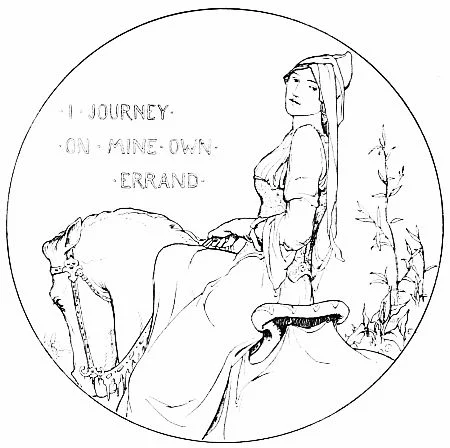
Batten’s Rhiannon riding her white horse, 1895
Rhiannon looks back from her horse beside the words “I journey on mine own errand.” Her dress and the horse’s harness belong to Batten’s Victorian interpretation of the first-branch meeting.
Overview
Rhiannon approaches the mound above Narberth on a great white horse, wearing shining gold. Men on foot and riders on the fastest available horses fall farther behind even as she maintains an even pace. Powel finally asks her to stop, and she readily does so, saying the request would have spared his horse. She identifies herself as Heveyth Hên’s daughter and explains that she has come to choose him rather than accept an unwanted husband. The scene makes consent and direct speech succeed where pursuit fails.
When Powel carelessly promises a boon to Gwawl, she devises an escape from the resulting marriage claim. Her small bag remains empty despite all food poured into it, allowing Powel to lure Gwawl inside and secure him. She then advises a settlement rather than his death. Later attendants falsely accuse her after her infant disappears. Her imposed penance involves offering to carry visitors on her back, but most refuse. The child’s foster-father returns him and disproves the accusation. This profile respects the figure’s continuing cultural and religious significance while attributing its specific events to a medieval-derived literary branch; it does not assume every Rhiannon tradition is identical.
Origins & earliest records
Jacobs says he follows Lady Guest’s Mabinogion with slightly anglicised names and omission of the opening incident. The selected adaptation is printed in 1895. The First Branch has an earlier medieval transmission, but this profile does not treat the adaptation’s date as the origin of the figure or claim to have collated its manuscripts.
Records & interpretation
The untouchable ride and inexhaustible bag are directly narrated wonders; the false accusation is explicitly overturned. These support a literary Otherworld-associated character, not a verified historical prosecution or a general claim about women. Religious reception requires its own sources.
Selected bibliography
Documented works and useful reading. This is not a list of every appearance.
- 01
More Celtic Fairy Tales: Powel, Prince of Dyfed, pp. 26–45; note XXIX
Complete selected Powel episode and source note inspected. Jacobs acknowledges anglicised names and an omitted opening incident; this is not a new manuscript collation.
Family & connections
A source-supported family tree or inspiration record has not yet been compiled for this profile. Related reading below indicates a connection in subject matter, not a proven lineage or creative influence.
References
Sources supporting this profile. Linked pages have their own scope and editorial standards.
- Primary textMore Celtic Fairy Tales, selected 1895 edition: Powel, Prince of Dyfed, pp. 26–45; note XXIXResearch access: 2026-10-05
Image credits
Historical illustrationBatten’s Rhiannon riding her white horse, 1895
Rhiannon looks back from her horse beside the words “I journey on mine own errand.” Her dress and the horse’s harness belong to Batten’s Victorian interpretation of the first-branch meeting.