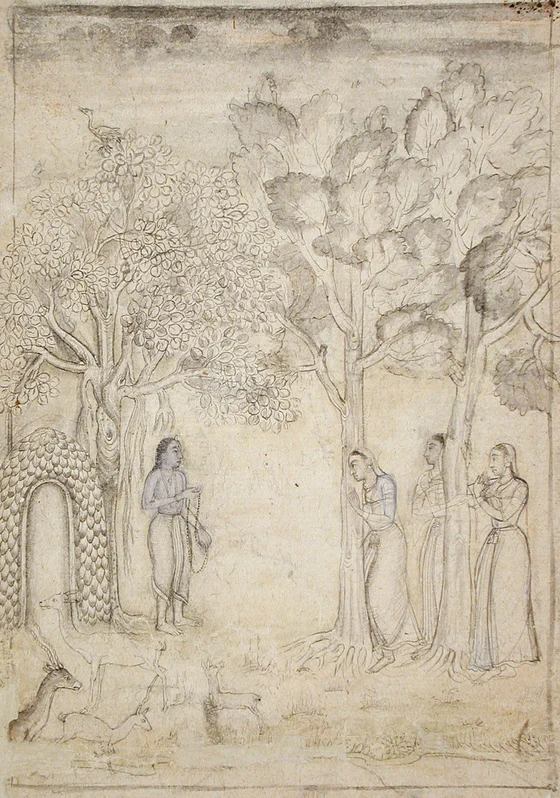
A sourced illustration has not yet been added. This gap is included in the coverage record.
Overview
Four forest companions determine their relative ages by memories of a fig tree. The elephant remembers it at his own height, the monkey at its smaller height, the hare as a two-leaved shoot, and the partridge remembers depositing the seed from which it grew. They honor seniority and travel over difficult ground stacked elephant, monkey, hare and partridge from bottom to top.
They adopt five restraints, spread them among animals and thereby bring peace and timely rain. A rishi corrects a king who attributes this prosperity to his own power; the king and his people then follow the animals’ example. At the end Bhagavant identifies the partridge as his own earlier life, the hare as Śāriputra, the monkey as Maudgalyāyana and the elephant as Ānanda. These are religious exemplars within a Buddhist narrative, not four hostile fabulous beasts.
The English translator calls the bird a partridge for comparison with the Tittira Jātaka, while noting Schiefner’s German Haselhuhn. The chapter’s note also says the cited Pāli and Chinese comparisons omit the hare. Those are the edition’s comparative statements, not a claim that those other texts have been independently inspected here.
Origins & earliest records
Indian Buddhist narrative preserved in Tibetan translation
Records & interpretation
Complete chapter XXIV, The Virtuous Animals and footnotes directly read in the digitized 1906 edition.
Selected bibliography
Documented works and useful reading. This is not a list of every appearance.
- 01
Tibetan Tales Derived from Indian Sources
XXIV, The Virtuous Animals, pp. 302–307 and notes; chapter footnote cites Kah-gyur iii, ff. 189–193
- 02
Tibetan Tales Derived from Indian Sources — XXIV The Virtuous Animals
Tibetan Tales Derived from Indian Sources, London: Kegan Paul, Trench, Trübner & Co., 1906, title-page transcription independently checked. Tibetan Kah-gyur to German by F. Anton von Schiefner, then German to English by W.R.S.Ralston. Complete selected chaptersXX288–290 andXXII–XXVIII296–313 with all notes independently read; source-language originals not collated.
Family & connections
A source-supported family tree or inspiration record has not yet been compiled for this profile. Related reading below indicates a connection in subject matter, not a proven lineage or creative influence.
Primary records and illustrations
Schiefner/Ralston, Tibetan Tales Derived from Indian Sources (London, 1906)
XXIV, The Virtuous Animals. pp. 302–307 and notes
Entire relevant chapter and footnotes read. Edition cites Kah-gyur iii, ff. 189–193; original Tibetan not independently checked. Original paraphrase, historical text public domain in the United States.
Located primary passages
Specific passages supporting details in this entry, grouped by their published witness.
Tibetan Tales Derived from Indian Sources
Tibetan Tales Derived from Indian Sources, London: Kegan Paul, Trench, Trübner & Co., 1906, title-page transcription independently checked. Tibetan Kah-gyur to German by F. Anton von Schiefner, then German to English by W.R.S.Ralston. Complete selected chaptersXX288–290 andXXII–XXVIII296–313 with all notes independently read; source-language originals not collated.
- Partridge, hare, monkey and elephant establish seniority by memories of a growing fig tree, with the partridge credited for dropping its seed. They arrange mutual respect and travel in a supported stack. Their adoption and teaching of ethical restraints bring concord and seasonal abundance, which the king initially credits to himself. A seer redirects the royal court toward the animals’ example, and the closing frame identifies the four as earlier forms of the Buddha and named disciples.
XXIV The Virtuous Animals, complete302–307; note Kah-gyuriii.ff189–193
German-mediated historical English translation, not direct Tibetan manuscript inspection. Whole book not claimed read. Page labels are hosted transcription markers, not separate facsimile collation. No ritual, spell formula, verse, medical procedure or modern adaptation copied.
References
Sources supporting this profile. Linked pages have their own scope and editorial standards.
- Historical translation of Buddhist narrativeSchiefner/Ralston, Tibetan Tales (1906), XXIV, The Virtuous Animals, pp. 302–307 and notesResearch access: 2026-10-05
Image credits
A sourced illustration has not yet been added. This gap is included in the coverage record.