
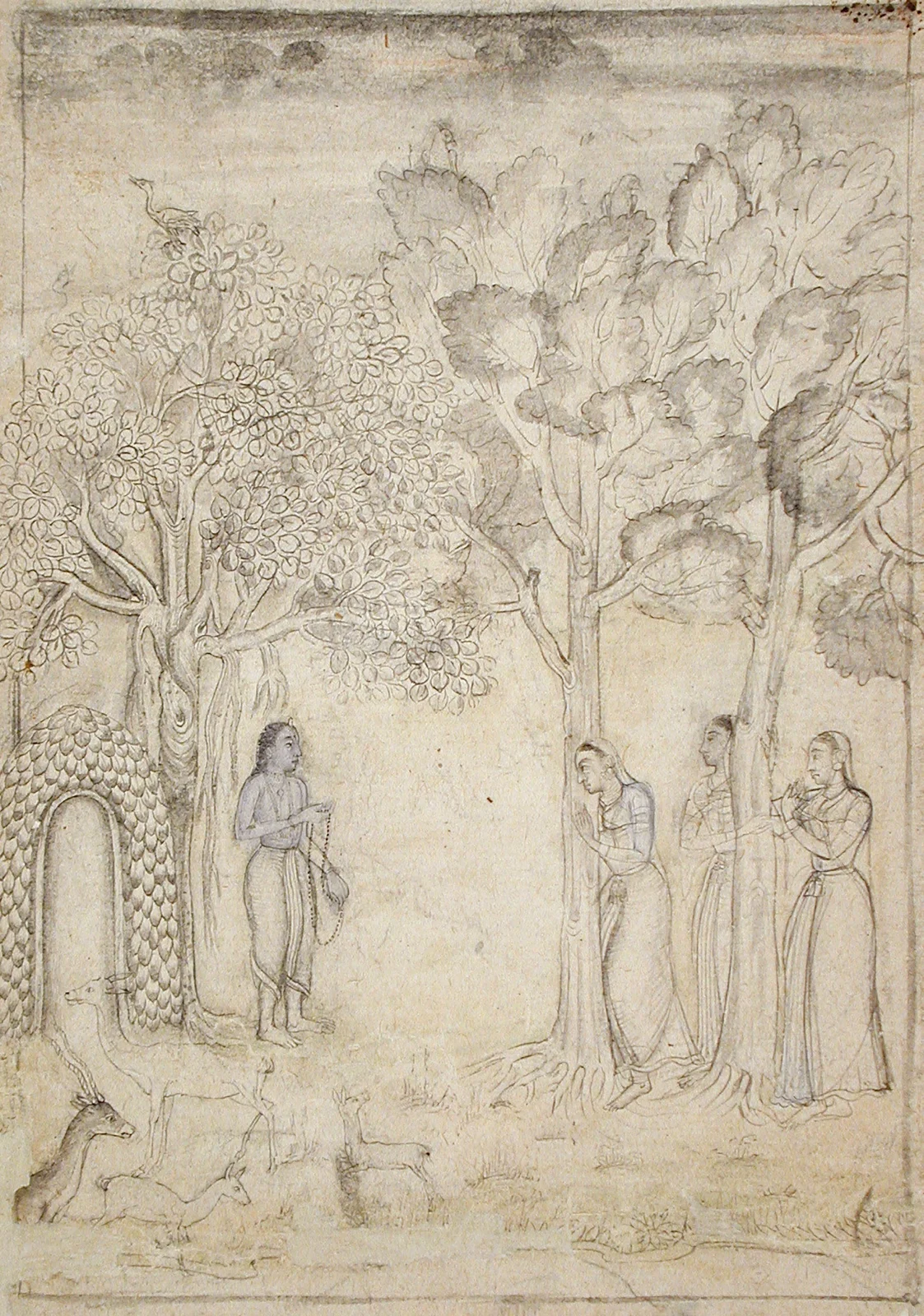
Mughal drawing of Rishyashringa holding a rosary outside his forest hermitage as three women approach
This Mughal drawing represents the Hindu epic encounter at the forest hermitage: the ascetic stands with a rosary while women sent from Anga approach among the trees. The museum identifies a small forehead protuberance, rather than prominent antlers. Its drought narrative differs from the Buddhist version in which the ascetic first forbids rain.
Overview
A forest ascetic recognizes as his son the boy born to a gazelle doe and abandoned by her. He raises him in his hermitage. Gazelle horns appear on the boy’s head as he grows, prompting the name Ṛshyaśringa. After his father’s death, the youth gains five kinds of insight through ascetic practice.
Angered when rain causes him to drop and break his water pot, he forbids the rain deity to send rain for twelve years. Princess Śāntā and her attendants approach disguised as ascetics, entice him onto a floating hermitage and overcome his discipline with wine and pleasure. His power fails and rain returns. After marrying Śāntā, he eventually resumes ascetic practice and regains insight. This is the collection’s explicitly Buddhist version of a story also known in Hindu epics, not a composite of those versions.
Griffith’s Ramayana translation, Book I.8–10, supplies a materially different Hindu epic witness. His father Vibháṇdak is alive during the expedition, the drought follows King Lomapád’s wrongdoing, and court-arranged visitors lure the secluded ascetic away; rain returns as he approaches the kingdom. Śāntā then becomes his wife. These cantos do not describe him first cursing the rain deity, as the Buddhist version does. The difference concerns the cause and resolution of the drought, not merely alternate spelling of his name.
Origins & earliest records
Indian Buddhist narrative preserved in Tibetan translation
Records & interpretation
Complete chapter XV, Ṛshyaśringa and footnotes directly read in the digitized 1906 edition.
In the literature
“gazelle horns appeared on his head”
XV Ṛshyaśringa, hosted printed-page marker253 · W.R.S.Ralston, English from Schiefner’s German Tibetan translation
The narrator locates the horns after childhood growth; the doe’s motherhood alone is not used as anatomical proof.
Selected bibliography
Documented works and useful reading. This is not a list of every appearance.
- 01
Tibetan Tales Derived from Indian Sources
XV, Ṛshyaśringa, pp. 253–256; chapter footnote cites Kah-gyur iv. fol. 136–137
- 02
The Ramayan of Valmiki
Book I, cantos VIII–X; complete three cantos read
- 03
Tibetan Tales Derived from Indian Sources — XV Ṛshyaśringa
Tibetan Tales Derived from Indian Sources, London: Kegan Paul, Trench, Trübner & Co., 1906, title-page transcription independently checked. Tibetan Kah-gyur to German by F. Anton von Schiefner, then German to English by W.R.S.Ralston. Complete selected XIII236–246 and XV253–256 with notes independently read; no independent Tibetan/German collation or whole introductory-book claim.
Family & connections
A source-supported family tree or inspiration record has not yet been compiled for this profile. Related reading below indicates a connection in subject matter, not a proven lineage or creative influence.
Primary records and illustrations
Schiefner/Ralston, Tibetan Tales Derived from Indian Sources (London, 1906)
XV, Ṛshyaśringa. pp. 253–256
Entire relevant chapter and footnotes read. Edition cites Kah-gyur iv. fol. 136–137; original Tibetan not independently checked. Original paraphrase, historical text public domain in the United States.
Located primary passages
Specific passages supporting details in this entry, grouped by their published witness.
Tibetan Tales Derived from Indian Sources
Tibetan Tales Derived from Indian Sources, London: Kegan Paul, Trench, Trübner & Co., 1906, title-page transcription independently checked. Tibetan Kah-gyur to German by F. Anton von Schiefner, then German to English by W.R.S.Ralston. Complete selected XIII236–246 and XV253–256 with notes independently read; no independent Tibetan/German collation or whole introductory-book claim.
- A gazelle doe bears a boy near a Rishi’s former resting place and abandons the unlike infant. The Rishi recognizes the child as his own and raises him; gazelle horns later give the boy his name. After the father dies, the youth gains insight and angrily bars rain after breaking a water pitcher. Śāntā arranges a disguised floating hermitage and intoxicating seduction; his power fails and rain returns. Their marriage deteriorates, and he finally returns to ascetic exertion and regains insight.
German-mediated English rendering and embedded reported biographies; original Tibetan texts and footnoted alternative works not collated. Page labels from transcription. No vow, religious formula, ritual instruction, medical preparation or verse copied.
References
Sources supporting this profile. Linked pages have their own scope and editorial standards.
- Historical translation of Buddhist narrativeSchiefner/Ralston, Tibetan Tales (1906), XV, Ṛshyaśringa, pp. 253–256Research access: 2026-10-05
- Comparative historical epic translationVālmīki, Ramayan, translated by R. T. H. Griffith (1870–1874), I.8–10Research access: 2026-10-05
Image credits
Historical illustrationMughal drawing of Rishyashringa holding a rosary outside his forest hermitage as three women approach
This Mughal drawing represents the Hindu epic encounter at the forest hermitage: the ascetic stands with a rosary while women sent from Anga approach among the trees. The museum identifies a small forehead protuberance, rather than prominent antlers. Its drought narrative differs from the Buddhist version in which the ascetic first forbids rain.