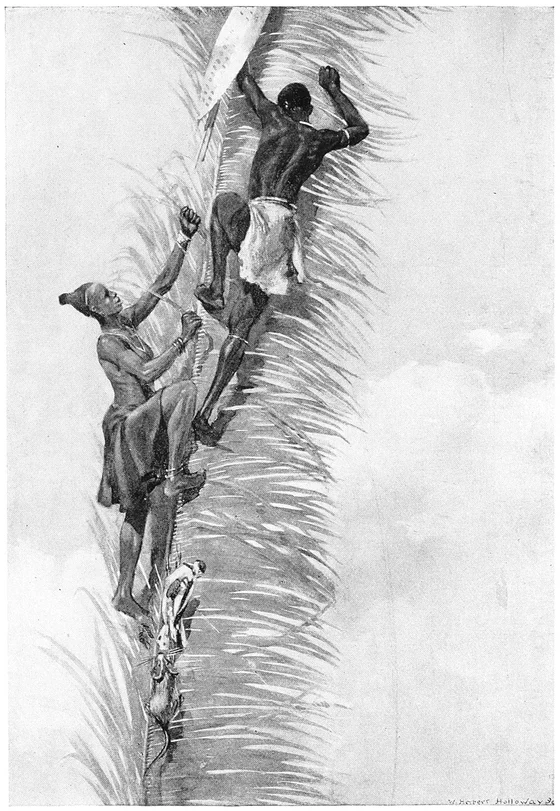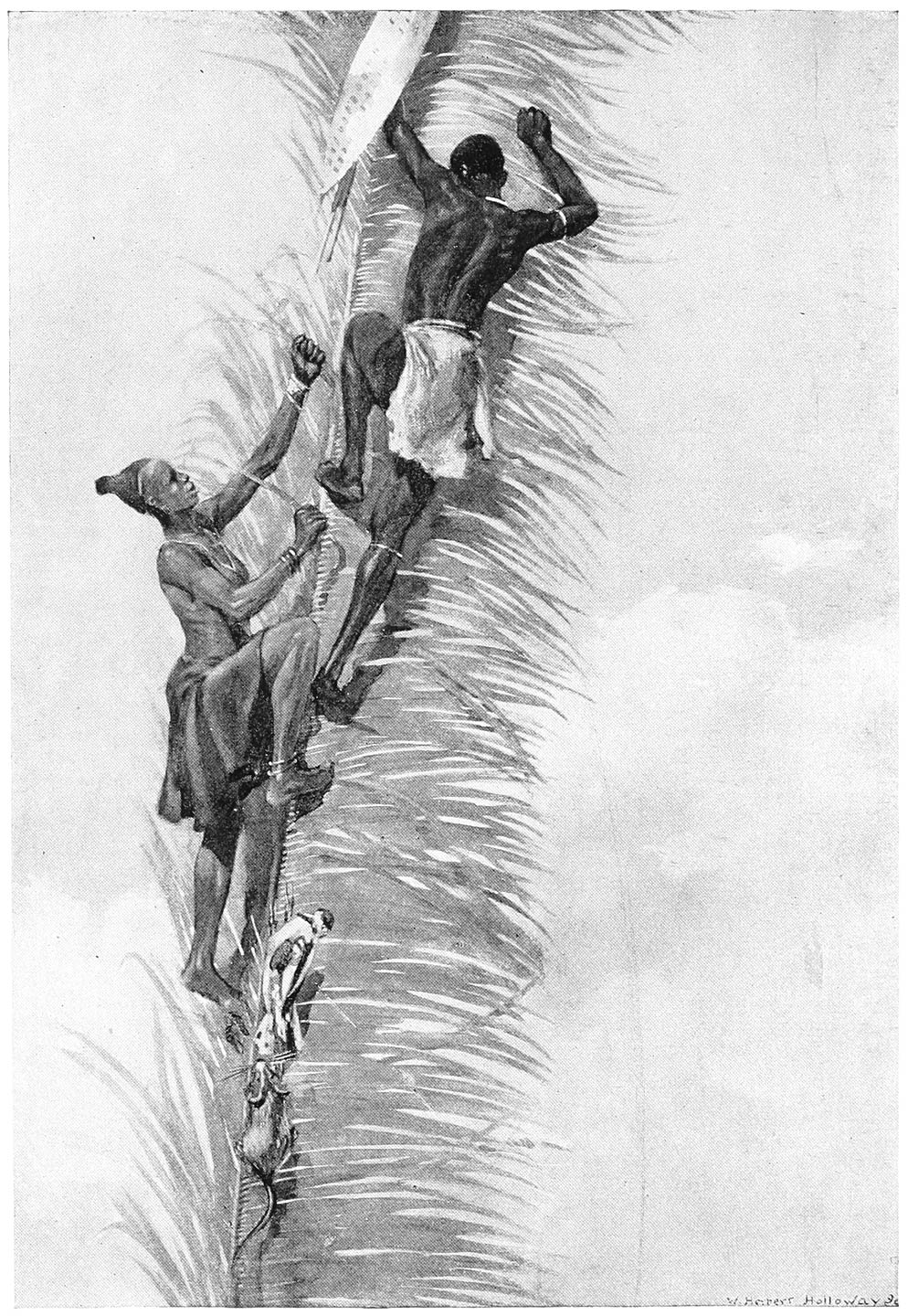
Rabbit Prince in human form climbing the feather ladder, Holloway 1908
The prince climbs above the princess, Mouse and Woodpecker on the immense feather. This scene depicts his human form after the princess’s transformation, rather than his earlier rabbit body.
Overview
The Rabbit begins as the Duyker’s farming companion, secretly stealing his crops. Their bird trap catches a long-winged bird, whose exceptional feather the Rabbit removes. A human princess appears and cannot return to her cloud home without the feather. As she comes to admire the Rabbit, she asks to see it, then throws it at him. He becomes a handsome human prince. His ensuing killing of the Duyker to acquire its land is retained as a narrated betrayal, not softened into a reward for kindness.
The prince and princess agree to marry secretly. Her bird relatives seek his death, consulting the Mouse and Woodpecker, but she warns him against their poisoned food. The two advisers later become devoted to him. A feather-grown ladder carries all four to cloudland, where the princess’s parents reject an earth-born husband. The Mouse discovers poison in the welcome feast and warns him; the Woodpecker shields him from an arranged hailstorm and prepares charms against murderous spears during a royal hunt.
After these attempts they leave cloudland permanently, descending another feather ladder. The Woodpecker explains that her three charm bags can grant wishes. With their aid the prince obtains furnished homes, attendants and a wise woman for his wife, then conquers another king’s forces and cattle. He establishes a kingdom and rewards the Mouse and Woodpecker with princely titles. The narrator expressly forgets the Mouse’s later adventures; those absent events are not supplied as invented sequels.
Origins & earliest records
Sarah F. Bourhill and Beatrice L. Drake collected and arranged the English children’s retelling. No individual episode narrator is named. Preface community claims and chapter labels are retained as evidence about the publication, not substituted for current community self-description.
Records & interpretation
Complete V. The Rabbit Prince, printed pp. 43–57, read through the ending; title, preface and chapter label checked.
Selected bibliography
Documented works and useful reading. This is not a list of every appearance.
- 01
Fairy Tales from South Africa
V. The Rabbit Prince, pp. 43–57; published English literary arrangement for children.
Family & connections
A source-supported family tree or inspiration record has not yet been compiled for this profile. Related reading below indicates a connection in subject matter, not a proven lineage or creative influence.
Located primary passages
Specific passages supporting details in this entry, grouped by their published witness.
Primary source witness
Sarah F. Bourhill (Mrs. E. J. Bourhill) and Beatrice L. Drake (Mrs. J. B. Drake), Fairy Tales from South Africa, London: Macmillan, 1908; selected original title page and complete headed tales in PG75833. Arranged for children; introduction pp.v–xi attributes principally Swazi, also Zulu and border-region contributions, with Shining Princess attributed to Mapoch. Individual narrators for these selected tales unnamed. Historical colonial framing is not current community consensus.
- Rabbit cultivates land with Duyker but steals the latter’s crop. Their trap catches a bird whose special feather turns her into a princess. She uses the feather to change Rabbit into a man; he then kills Duyker and eats him with the princess, appropriating his land. The killing is explicit and is not rewritten as a harmless trick.
V The Rabbit Prince, pp.43–48; theft, princess and moral violence
- Mouse and Woodpecker protect the couple against poisoned food, hail and arranged hunting attacks in the princess’s parental realm. The couple withdraws to earth, where protective gifts grant resources and conquest. Rabbit rewards the companions with princely titles; the narrator explicitly does not supply Mouse’s later adventures.
Selected historical arrangement, not unmediated original-language oral testimony. Individual contributor not named; no separate manuscript inspected. Original facsimile not visually inspected in this batch.
References
Sources supporting this profile. Linked pages have their own scope and editorial standards.
- Collected historical tale in an English literary retellingBourhill and Drake — V. The Rabbit PrinceResearch access: 2026-10-05
Image credits
Historical illustrationRabbit Prince in human form climbing the feather ladder, Holloway 1908
The prince climbs above the princess, Mouse and Woodpecker on the immense feather. This scene depicts his human form after the princess’s transformation, rather than his earlier rabbit body.