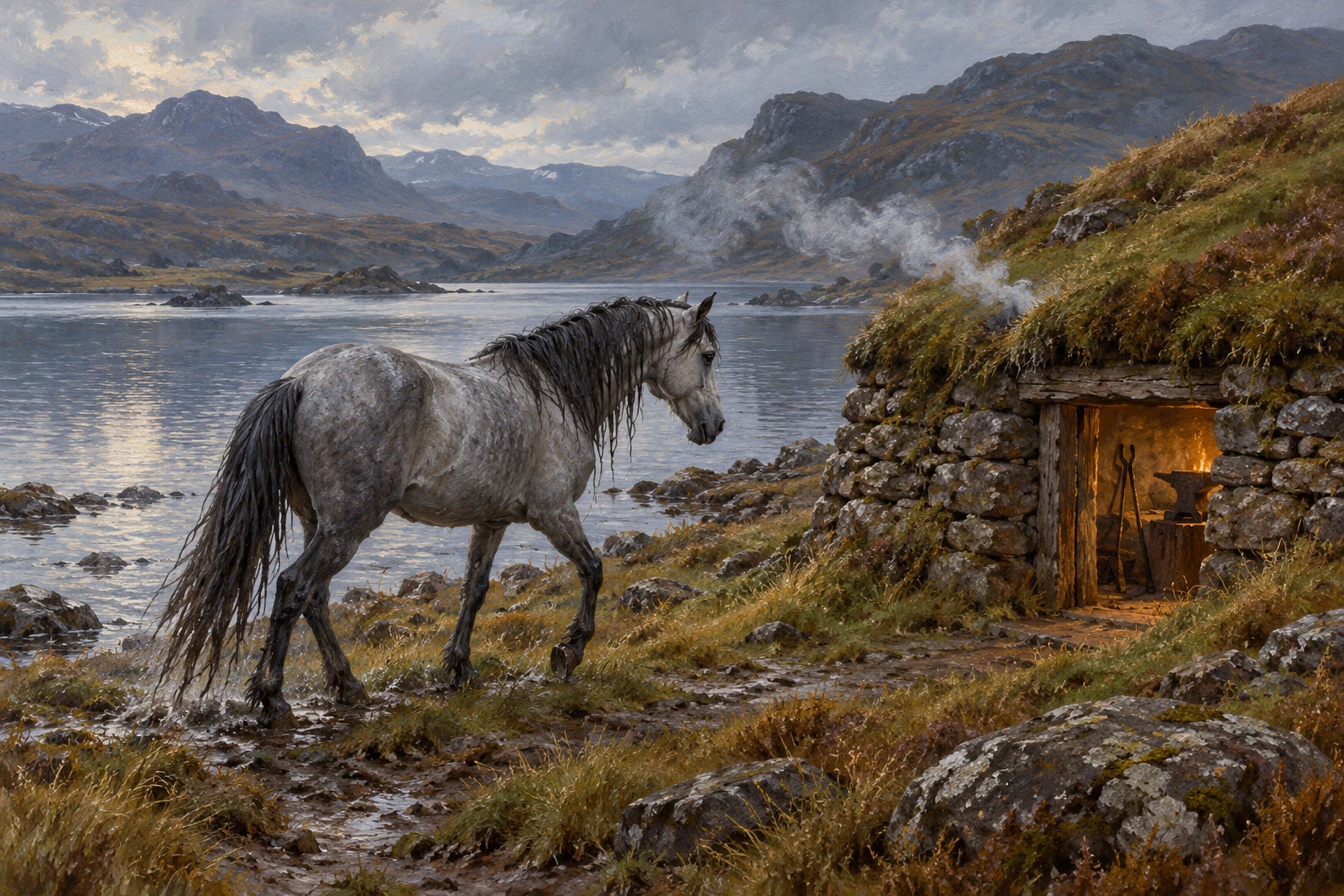
AI-generated interpretation of Campbell’s Raasay Water-horse tale before the smith’s attack. The ordinary horse form follows the chapter introduction; grey coat, hut, tools and landscape are artistic choices, not an exact historical reconstruction. Campbell distinguishes this lake Each Uisge from the Kelpie.
The illustration presents the lure and approach without inventing the abducted woman’s fate or choosing between the tale’s alternative remains.
Overview
John Gregorson Campbell’s Killing the Raasay Water-horse connects a dangerous lake creature with the name of the Woman’s Loch, Loch na Mna, near Dùn Can on Raasay. The collected account says that a Water-horse abducted a woman there. It does not tell her subsequent fate. A neighbouring smith, called An Gobha Mòr, resolves to kill the creature; his success is said to earn him the name Alastair na Béisde, glossed as Alexander of the monster.
The smith builds a hut near the loch, leaving a narrow opening facing the water. He waits for a favourable wind, then kills and roasts a wether-sheep inside. The smell travels towards the loch and draws the Water-horse through the opening. With his irons already heating in the fire, the smith rushes at it and kills it. The ending supplies alternative accounts of the remains: grey turves, or a soft mass compared to jellyfish. These alternatives should remain separate rather than become successive stages of one transformation.
This is a compact local narrative in Campbell’s 1900 collection, not an eyewitness report authenticated here. Its Water-horse belongs to his Each Uisge chapter. Campbell expressly distinguishes that lake creature from the Kelpie of streams and torrents. The tale gives no bodily colour, detailed anatomy, date for the event, named informant or rescue of the abducted woman.
Origins & earliest records
John Gregorson Campbell, Superstitions of the Highlands & Islands of Scotland, collected entirely from oral sources; Glasgow: James MacLehose and Sons, 1900. Chapter V, Killing the Raasay Water-horse, pp.209–210. The general oral-source claim is the collector’s stated method; no individual narrator is named for this tale.
Records & interpretation
Complete selected heading and paragraph read to both alternative endings; no attached footnote marker. Full chapter introduction and separate Kelpie distinction read, with title, editor’s note and preface. No older manuscript or oral performance independently collated.
Selected bibliography
Documented works and useful reading. This is not a list of every appearance.
- 01
Superstitions of the Highlands & Islands of Scotland
Chapter V, Killing the Raasay Water-horse, pp.209–210; Kelpie distinction p.215.
Family, evolution & connections
Kelpie
Campbell expressly distinguishes the lake Each Uisge from the stream or torrent Kelpie. His Raasay smith’s trap is a particular Water-horse encounter, with alternative turf or jellylike remains. This comparison preserves his distinction rather than treating the names as synonyms or identifying either account as a source consulted by a modern creator.
References
Sources supporting this profile. Linked pages have their own scope and editorial standards.
- Historical collected folkloreCampbell 1900, retained Project Gutenberg 61730 transcriptionResearch access: 2026-10-26
Image credits
Modern interpretation of a historical literary accountAI-generated interpretation of Campbell’s Raasay Water-horse tale before the smith’s attack. The ordinary horse form follows the chapter introduction; grey coat, hut, tools and landscape are artistic choices, not an exact historical reconstruction. Campbell distinguishes this lake Each Uisge from the Kelpie.
The illustration presents the lure and approach without inventing the abducted woman’s fate or choosing between the tale’s alternative remains.