A sourced illustration has not yet been added. This gap is included in the coverage record.
Overview
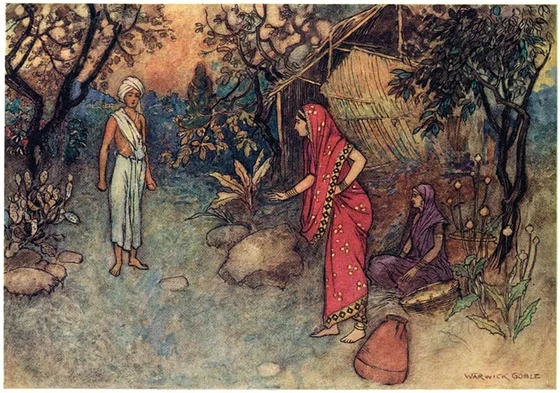
Beyond the ocean, a Rakshasi keeps the princess Pushpavati in a palace among the gardens guarded by seven hundred Rakshasas. She kills the girl before leaving to hunt and revives her on returning, using gold and silver sticks. The moon-marked youth finds the apparently sleeping captive and accidentally revives her when the golden stick touches her feet. Later he deliberately touches her head with it to conceal his visit. Thus this witness’s operation cannot be reduced to a simple rule that gold always revives and silver always kills.
Pushpavati conceals the visitor beneath a heap of flowers and elicits the Rakshasi’s secret by pretending to fear being left alone after her protector’s death. She tells the youth about the submerged box containing their life-dependent bees. After he destroys them, she returns with him and reveals the twins’ earlier history to their father. Her knowledge is stated without an explanation of its source. She is distinct from Keshavati in Day’s fourth tale, despite the related captivity and bee motifs.
Origins & earliest records
Bengali oral storytelling translated by Lal Behari Day
Records & interpretation
Complete relevant tale, attached notes,1883 preface and1912 edition credits directly read.
Selected bibliography
Documented works and useful reading. This is not a list of every appearance.
- 01
Folk-Tales of Bengal
XIX, The Boy with the Moon on his Forehead, pp. 227–247 and three notes
Family & connections
A source-supported family tree or inspiration record has not yet been compiled for this profile. Related reading below indicates a connection in subject matter, not a proven lineage or creative influence.
Primary records and illustrations
Lal Behari Day, Folk-Tales of Bengal (Macmillan,1912; first edition1883)
XIX. XIX, The Boy with the Moon on his Forehead, pp. 227–247 and three notes
Complete XIX through closing formula and all three notes directly read. Gold-stick head/feet distinction retained; XIX wooden-box and blood conditions not merged with IV. Original paraphrase; no source-image inspection claimed.
References
Sources supporting this profile. Linked pages have their own scope and editorial standards.
- Historical translated oral narrative and collector notesDay, Folk-Tales of Bengal (1912), XIX, The Boy with the Moon on his Forehead, pp. 227–247 and three notesResearch access: 2026-10-05
Image credits
A sourced illustration has not yet been added. This gap is included in the coverage record.