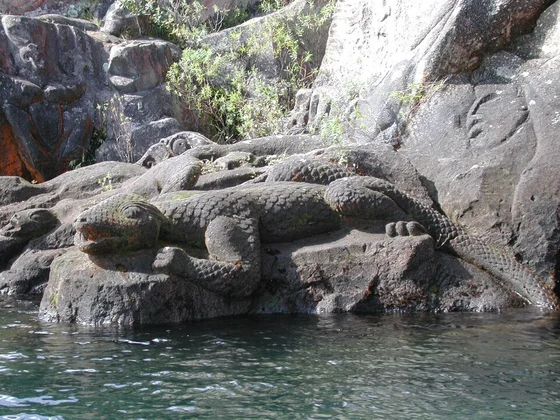
A sourced illustration has not yet been added. This gap is included in the coverage record.
Overview
The Ngāpuhi rūnanga account describes Puhi Moana Āriki crossing and recrossing the great waves ahead of two voyaging waka. This motion warns Nukutawhiti of dangers, and earns the name Puhi Te Āewa, the surfer. The guardian accompanies the passage towards Hokianga, then is sent back to Hawaiki with another companion to report that the travellers have arrived safely. The story describes purposeful movement rather than a fixed monstrous anatomy.
The 1993 Ngawha Geothermal Resource Report records related testimony using Puhimoanaariki and Puhiteaewa. In that witness the guardian is female and surfs to avoid Kahukura's nets while leading Ngātokimatawhaorua. The report explicitly acknowledges multiple traditions concerning Ngāpuhi origins. Its name discussions therefore cannot be flattened into one exclusive derivation, nor should this taniwha automatically be identified with every human ancestor bearing Puhi or Puhimoanaariki.
Origins & earliest records
The selected dated documentary witness is the Waitangi Tribunal's Ngawha Geothermal Resource Report, 1993, printed pages 13–14. The Ngāpuhi rūnanga's public narrative provides a continuing community account. These are attestations of transmission and testimony, not dates for an original voyage or the beginning of oral tradition.
Records & interpretation
The report attributes its canoe narrative and name discussion to testimony, while the iwi website independently publishes the wave-crossing escort episode. Both document ancestral knowledge and its public transmission. Neither provides a zoological specimen or sufficient anatomy to assign an animal species; the named human ancestors in other contexts remain distinct.
Selected bibliography
Documented works and useful reading. This is not a list of every appearance.
- 01
Ngawha Geothermal Resource Report
Printed pp. 13–14 / PDF pp. 24–25: taniwha escort, testimony references B25(a), and distinct name-origin traditions.
- 02
Te Iwi: The three sacred waves of Nukutawhiti
Public escort and return-to-Hawaiki narrative.
- 03
Ko Ngāpuhi Te Iwi — The three sacred waves of Nukutawhiti
Public local account, exact named page/section read; no print pagination invented.
Family & connections
A source-supported family tree or inspiration record has not yet been compiled for this profile. Related reading below indicates a connection in subject matter, not a proven lineage or creative influence.
Located primary passages
Specific passages supporting details in this entry, grouped by their published witness.
Te Iwi: The three sacred waves of Nukutawhiti
Public local account, exact named page/section read; no print pagination invented.
- Puhi Moana Āriki moves before the two canoes across the waves and gives early warnings to Nukutawhiti. The account links that protective motion with the name Puhi Te Āewa and subsequent names of communities.
- After the harbour is calmed, Nukutawhiti sends Puhi Moana Āriki and Rangi Uru Hinga back to Hawaiiki to report the voyagers’ safe arrival to Kupe.
Specific public narrative retained with named local authorship. No ritual or karakia text reproduced; no claim that local variants are interchangeable or that this account establishes a general zoological type.
Encyclopedia background
An additional attributed reference, separate from the editorial profile above.
Read the open encyclopedia overview
In Māori mythology, taniwha (Māori pronunciation: [ˈtaniɸa]) are large supernatural beings that live in deep pools in rivers, dark caves, or in the sea, especially in places with dangerous currents or deceptive breakers (giant waves).
They may be considered highly respected kaitiaki (protective guardians) of people and places, or in some traditions as dangerous, predatory beings, which for example would kidnap women to have as wives.
Text from Wikipedia contributors, “Taniwha”. CC BY-SA 4.0. Extracted introduction; formatting changed. Retrieved 5 October 2026. The source article may have changed since retrieval.
References
Sources supporting this profile. Linked pages have their own scope and editorial standards.
- Primary textWaitangi Tribunal: Ngawha Geothermal Resource ReportResearch access: 2026-10-05
- CommunityNgāpuhi: Te IwiResearch access: 2026-10-05
Image credits
A sourced illustration has not yet been added. This gap is included in the coverage record.