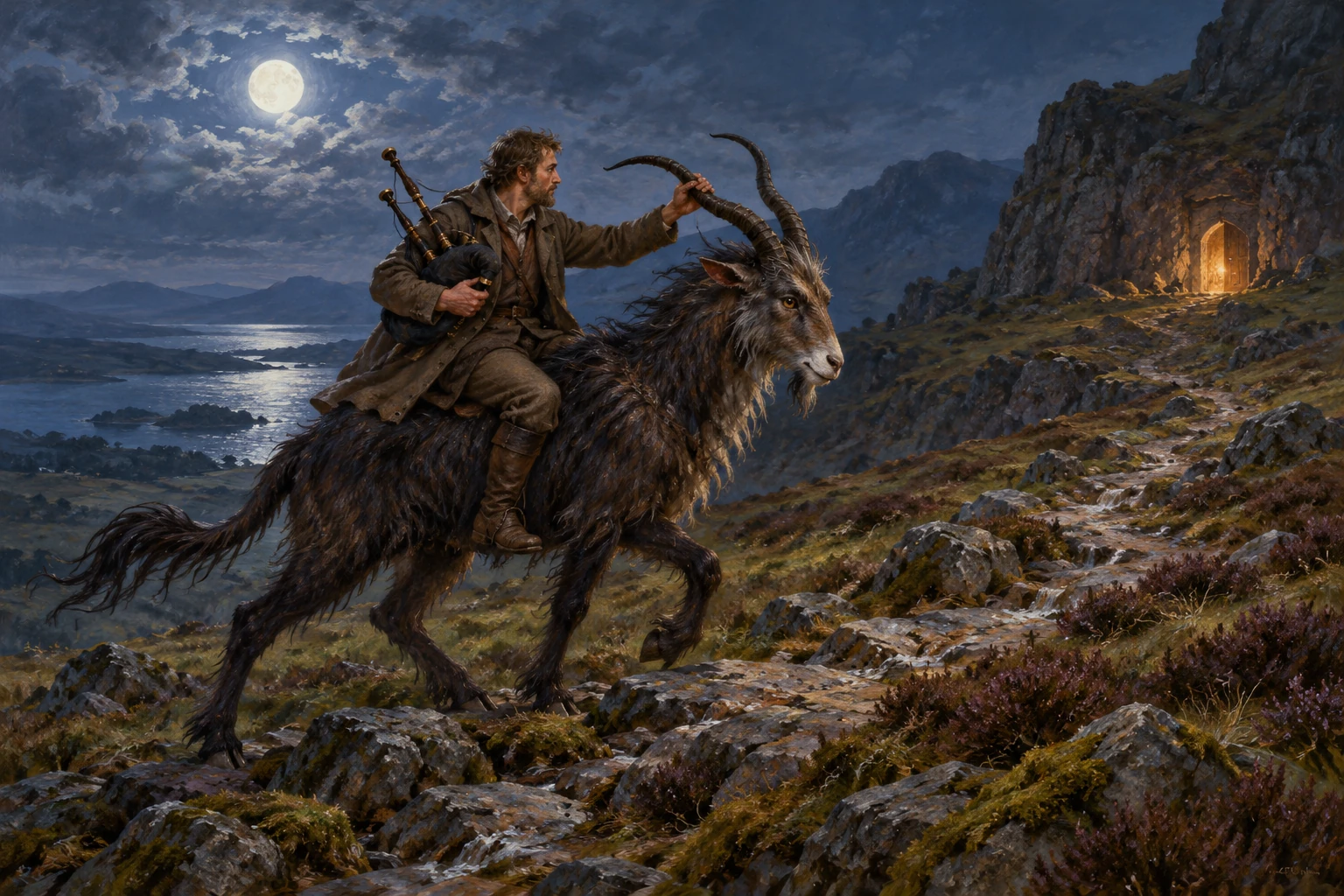
AI-generated interpretation of the journey in Hyde’s Piper and the Puca. Long horns, the carried piper and a mountain doorway follow the tale; this animal body, coat, clothes, pipes and landscape are artistic choices. The text does not assign this Puca a fixed species or colour.
A story-specific imaginative illustration, not ethnographic evidence or a model for every Puca tradition.
Overview
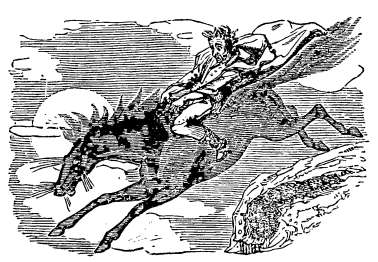
The Piper and the Puca follows an unnamed musician from Dunmore in County Galway who initially knows only the Black Rogue. The retained Yeats volume credits Douglas Hyde and describes the English text as a literal translation from the Irish of Leabhar Sgeulaigheachta. One night, after a dance, the piper plays near a bridge by his mother’s house. A Púca throws him onto its back, and he grips its long horns. The creature makes him play a tune he does not know, giving him a musical ability that surprises him.
The Púca carries him across difficult country to Croagh Patric, where it says there is a feast in the Banshee’s house. Three blows of its foot open a door into a room with a golden table and hundreds of old women. They welcome the Púca of November. A white gander appears, although the piper says that he and his mother had eaten that bird after he stole it from a priest. The gander clears the table, and the musician plays while the company dances. The women reward him with apparent gold, and the gander gives him new pipes before he leaves.
The Púca returns him to the original bridge and says he now has sense and music. The ending separates those gifts from the apparent riches. At home, the new pipes sound like shrieking geese, while his old instrument produces beautiful music. By morning the supposed gold has become plant leaves. The priest initially dismisses the story, but the piper demonstrates both sets of pipes. The narrative closes by saying that nobody in County Galway surpasses his playing for the rest of his life. The acquired skill lasts even though the payment and new instrument fail him.
This particular encounter gives the Púca speech, horns, transporting power and a teaching role; it supplies no fixed bodily species or colour. The story’s humorous treatment of drinking, theft and the piper’s abilities belongs to its narrated frame, not a diagnosis or a claim about Irish people generally. The preceding editorial introduction discusses different shapes and speculates about Puck and waterhorses, but those comparisons do not turn every form into this individual. No modern fantasy identity or creator consultation is established by the selected tale.
Origins & earliest records
The retained volume is Fairy and Folk Tales of the Irish Peasantry, edited and selected by W. B. Yeats, published by the Walter Scott Publishing Co., Ltd., London and Felling-on-Tyne. The selected title gives no verified print year. The byline credits Douglas Hyde and calls the tale a literal Irish translation from Leabhar Sgeulaigheachta; the underlying Irish text, original publication date and narrator have not been independently collated.
Records & interpretation
Complete named tale and byline, pp. 95–97, read through the piper’s lifelong musical outcome. Complete preceding Pooka editorial introduction read separately. No attached tale note marker or separate tale footnote found in this retained heading block.
Selected bibliography
Documented works and useful reading. This is not a list of every appearance.
- 01
Fairy and Folk Tales of the Irish Peasantry: The Piper and the Puca
Complete pp. 95–97 tale and preceding Pooka introduction. Underlying Leabhar Sgeulaigheachta text not collated; no first oral origin or exact translation date inferred.
Family, evolution & connections
Púca
Hyde’s credited piper tale adds a particular horned carrier, a supernatural feast and lasting musical skill to the historical Púca accounts. Its false gold and failed new pipes distinguish it from the other collected encounters; its body and actions are not rules for every Púca, and no modern author’s consultation is inferred.
References
Sources supporting this profile. Linked pages have their own scope and editorial standards.
- Historical attributed folktale translation in an edited collectionYeats volume, Douglas Hyde credited: The Piper and the Puca, complete taleResearch access: 2026-10-26
Image credits
Modern interpretation of a historical literary accountAI-generated interpretation of the journey in Hyde’s Piper and the Puca. Long horns, the carried piper and a mountain doorway follow the tale; this animal body, coat, clothes, pipes and landscape are artistic choices. The text does not assign this Puca a fixed species or colour.
A story-specific imaginative illustration, not ethnographic evidence or a model for every Puca tradition.