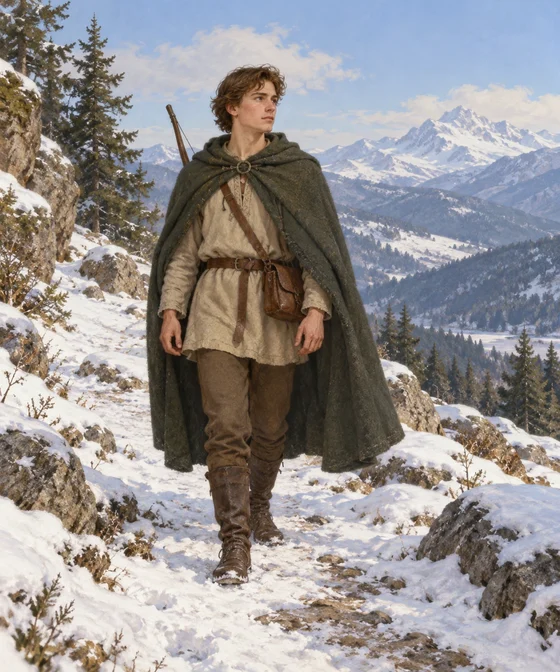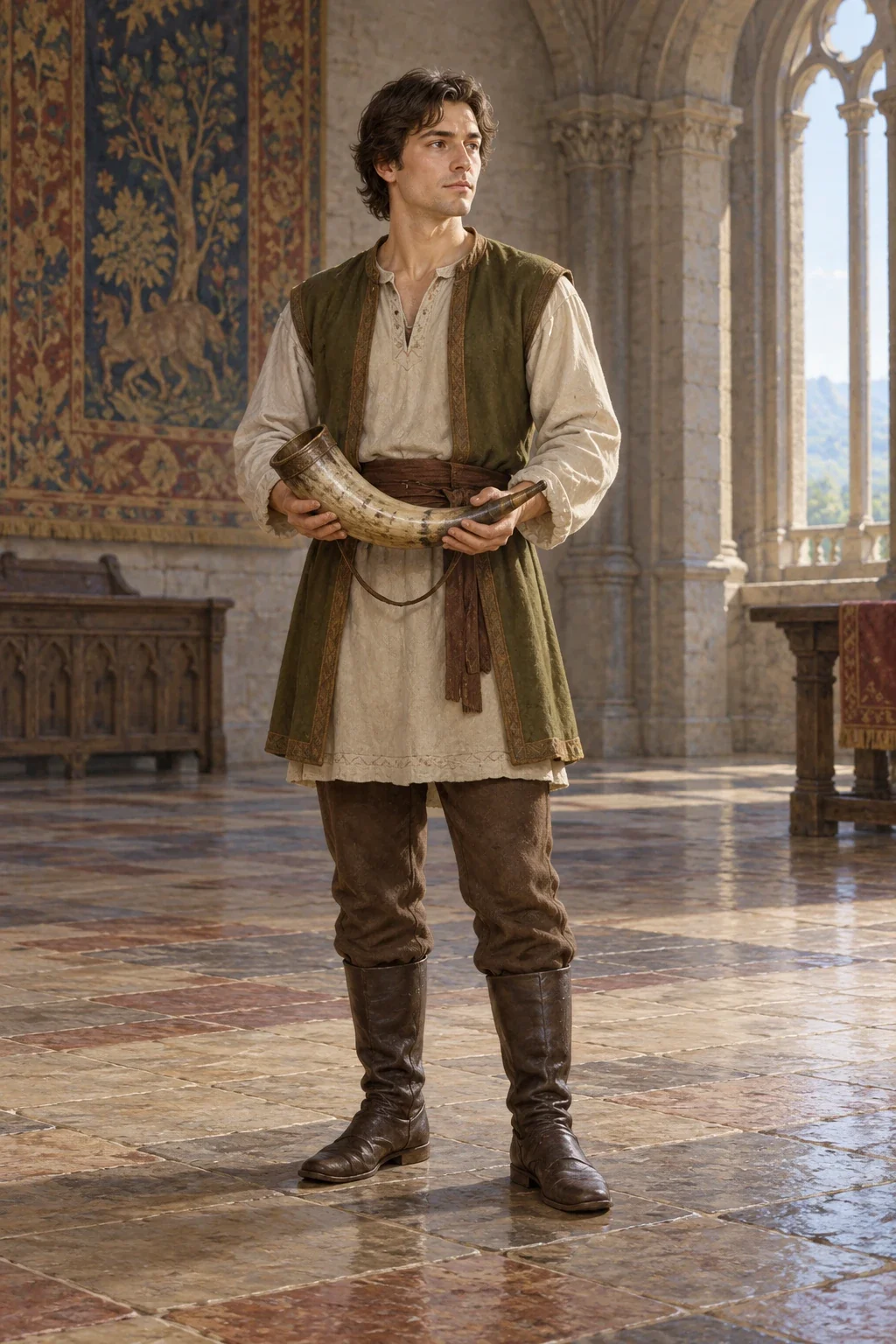
Portrayal of Prince Mirkó (Kriza’s Tale).
Portrayal selects the grown human prince holding the recovered horn before summoning the stud. Appearance, clothes and horn construction are interpreted; no horse, battle, later silver bottle, petrification or authenticated historical uniform.
Overview
Prince Mirkó is the youngest of three sons in tale XIII of Jones and Kropf’s collection, whose notes identify Kriza XIII as its source. The opening explicitly allows the princes to grow up after their unsuccessful schooling. Their father grieves over their apparent inability to govern, while hoping for the return of his old comrade Knight Mezey. Mirkó earns an explanation by dodging a sword thrown at him and returning it rather than fleeing. He then undertakes to reach Mezey, who cannot leave his silken meadow while enemies continually attack it. The tale’s distant kingdoms and extraordinary times are not mapped to a documented campaign or modern national frontier.
An old witch advises him to summon his father’s golden-haired stud with a long-disused horn and choose the crooked-legged, shaggy mare that arrives last. After being fed grain and burning cinders, she becomes a beautiful golden-haired animal. Her breath renews old tack, a sword and pistols into gold. She speaks, carries Mirkó at impossible speed and navigates a glass mountain. At Mezey’s camp the two knights respect each other’s sleep before joining forces. Following their attackers below ground, Mirkó finds a witch manufacturing soldiers by weaving. He destroys her, retaining diamond horseshoe nails she offered, and uses those nails to help Mezey’s horse descend the glass rock. The old comrade can finally return to his waiting friend.
Mirkó next challenges Doghead. Doghead’s daughter first turns prince and mare to stone, then restores them and explains how he can take her father’s strength-giving wine in an uncorked silver bottle. She agrees to marry him if he spares her father. Mirkó nevertheless kills Doghead after their combat, then offers an explanation and renews his marriage promise; the princess becomes reconciled. She reduces her diamond castle, with herself inside, to a golden apple which he carries home and expands again. His father relinquishes the throne, and the couple marry. This ending retains the broken promise rather than turning Mirkó into an uncomplicated model of chivalry. Comparative horses, swords and heroes mentioned in the notes remain distinct figures, and no different animal shape or extra limbs are imported into his own mare.
Origins & earliest records
Complete tale XIII, attributed to Kriza XIII in the 1889 English comparative notes. No independent Hungarian collation or individual oral teller identification.
Records & interpretation
Complete English narrative and all selected comparative notes/footnotes read; full original title/preface and relevant collection/translation discussion read. Original PDF retained but no new native-page inspection or whole-book claim.
Selected bibliography
Documented works and useful reading. This is not a list of every appearance.
- 01
The Folk-Tales of the Magyars
Complete selected narrative, pp. 59-76; full corresponding comparative notes, pp. 344-354. London: Folk-Lore Society, Elliot Stock. Series designation 1886 is distinct from title-page 1889.
Family & connections
A source-supported family tree or inspiration record has not yet been compiled for this profile. Related reading below indicates a connection in subject matter, not a proven lineage or creative influence.
References
Sources supporting this profile. Linked pages have their own scope and editorial standards.
- Historical primary English translation with comparative editorial notesJones and Kropf 1889 English edition, selected complete Kriza taleResearch access: 2026-10-07
Image credits
AI-generatedPortrayal of Prince Mirkó (Kriza’s Tale).
Portrayal selects the grown human prince holding the recovered horn before summoning the stud. Appearance, clothes and horn construction are interpreted; no horse, battle, later silver bottle, petrification or authenticated historical uniform.