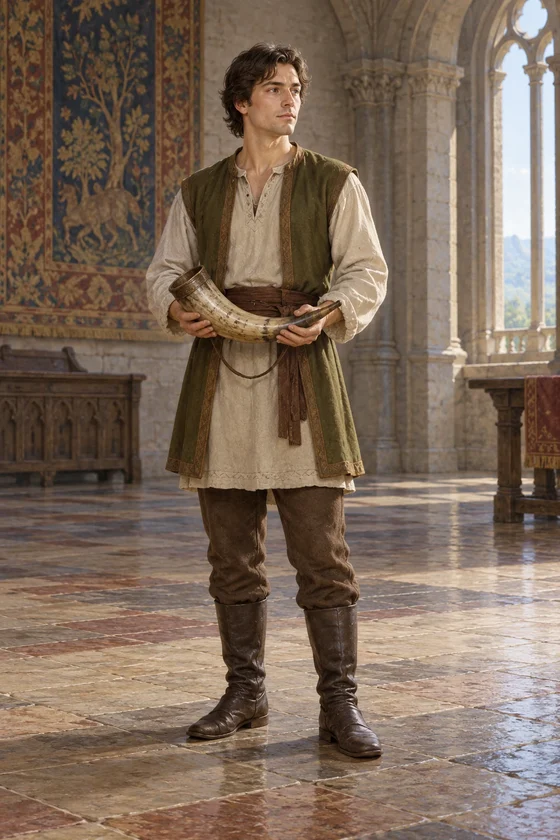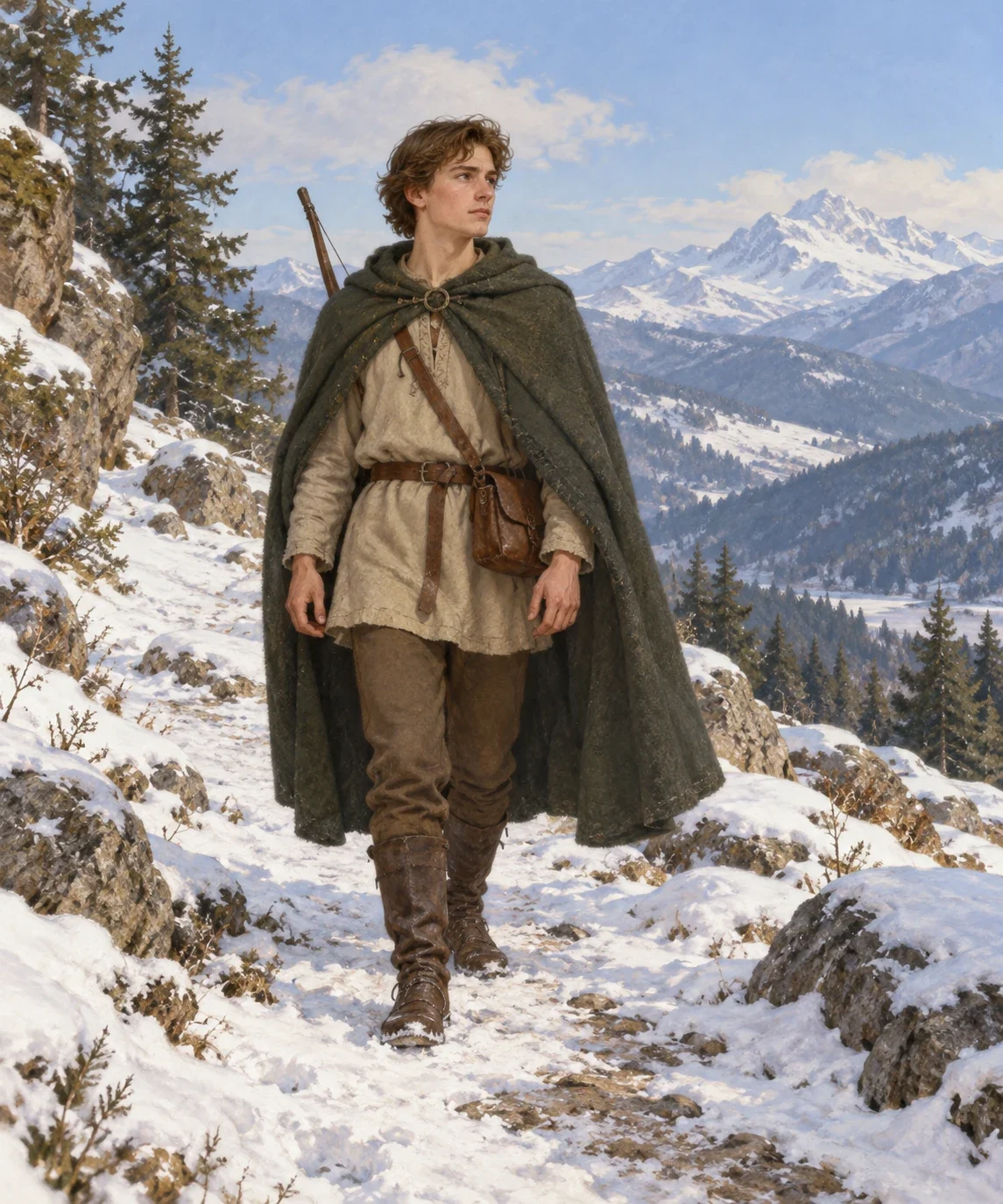
Portrayal of Knight Rose (Kriza’s Tale).
Portrayal selects the young adult prince travelling before his first encounter with the giants. Human appearance, clothes and equipment construction are imagined; no wounds, later radiance, snake anatomy or authenticated historical costume.
Overview
Knight Rose is the youngest of three royal brothers in tale XII of Jones and Kropf’s English collection, attributed in its notes to Kriza VI. Their father dies when an enemy occupies his kingdom. The princes escape with three horses, travel to a snow-covered mountain and separate where the road branches. They fix a white handkerchief to a pole in a tall tree as a danger signal: if it becomes bloody, the brother who sees it must search for the others. Rose takes the left-hand road. The narrative presents a travelling human prince and huntsman, not a flower spirit or a person with rose-like anatomy.
He reaches a castle occupied by seven enormous giants. They discover him and kill him. A snake with a young woman’s head gathers his remains, restores them with healing grass and water of life and death, and brings him back stronger. The sequence occurs three times, with Rose gaining strength while she gradually sheds her serpent skin. She finally reveals herself as the dispossessed daughter of the castle’s former ruler. Her snake condition was undertaken with a nurse’s help and a vow connected to vengeance. Rose defeats the giants and secures the castle. The English edition’s comparative notes discuss other resurrection and snake-bride narratives; their details do not supply extra powers, anatomy or origins for Rose.
Seeing the danger signal stained with blood, Rose leaves his promised bride to search for his brothers, carrying weapons and the means of restoration. He finds their dogs beside a hut. A witch tries to neutralise them with a hair, but he burns it. She is the giants’ mother and has already killed the older princes. During the struggle his sword becomes wood; blood drawn by the dogs restores it. Rose forces her to reveal the burial place, defeats her and brings his brothers back to life. He sends the eldest home to their recovered kingdom, invites the other to share government of the liberated country, and returns to marry the princess. Its healing substances are narrative devices; the source does not establish a usable medical preparation or an independently verified plant identification.
Origins & earliest records
Complete tale XII, attributed to Kriza VI; named English translation character. No individual oral teller or precise modern locality established here.
Records & interpretation
Complete English narrative and all selected comparative notes/footnotes read; full original title/preface and relevant collection/translation discussion read. Original PDF retained but no new native-page inspection or whole-book claim.
Selected bibliography
Documented works and useful reading. This is not a list of every appearance.
- 01
The Folk-Tales of the Magyars
Complete selected narrative, pp. 54-58; full corresponding comparative notes, pp. 339-344. London: Folk-Lore Society, Elliot Stock. Series designation 1886 is distinct from title-page 1889.
Family & connections
A source-supported family tree or inspiration record has not yet been compiled for this profile. Related reading below indicates a connection in subject matter, not a proven lineage or creative influence.
References
Sources supporting this profile. Linked pages have their own scope and editorial standards.
- Historical primary English translation with comparative editorial notesJones and Kropf 1889 English edition, selected complete Kriza taleResearch access: 2026-10-07
Image credits
AI-generatedPortrayal of Knight Rose (Kriza’s Tale).
Portrayal selects the young adult prince travelling before his first encounter with the giants. Human appearance, clothes and equipment construction are imagined; no wounds, later radiance, snake anatomy or authenticated historical costume.