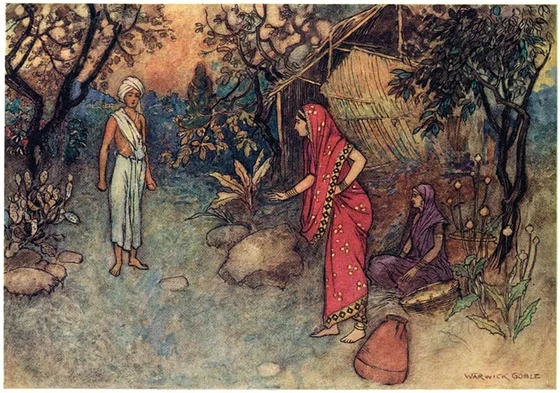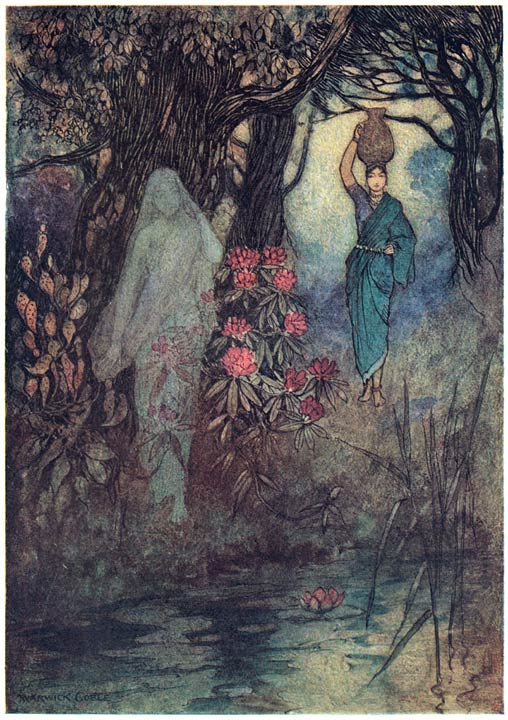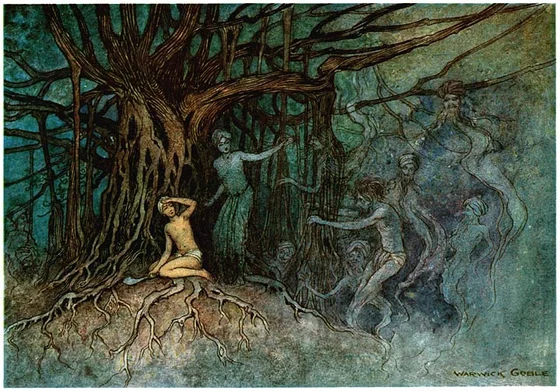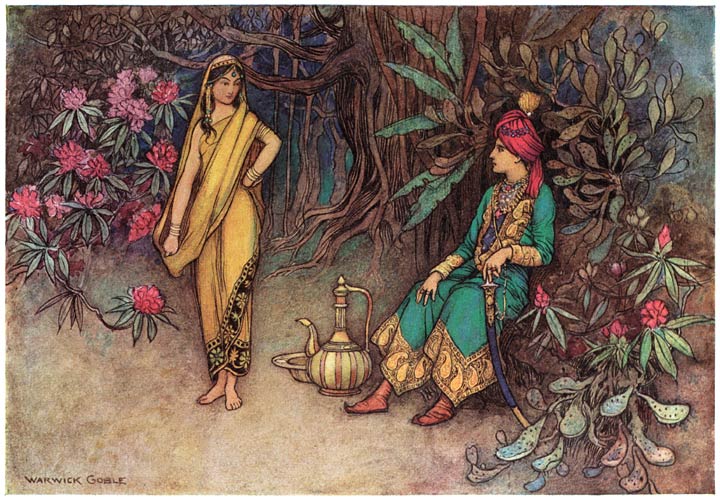
Postomani in human form speaks with the king beside the forest hut, Warwick Goble, 1912
The former mouse appears as the beautiful human Postomani during her encounter with the king. This belongs to The Origin of Opium in Day’s collection. Her earlier animal transformations and later poppy form are not shown.
Overview
A rishi living beside the Ganga grants speech to the mouse in his hut. At its successive requests he changes it into a cat, dog, ape, boar and elephant, each new form promising a better life but bringing another discontent. The elephant admires the affection shown to a queen and asks for her position. The sage can only make a beautiful woman, whom he names Postomani, glossed as the poppy-seed lady.
She marries the king after giving him a royal-orphan story attributed to the sage. The narrative’s actual origin remains the transformed mouse; the supposed royal parents are not added as her biological genealogy. Her happiness ends when she becomes dizzy beside a well and falls to her death. The sage orders the well filled and foretells a poppy growing from her body, giving a narrative origin for opium.
The concluding animal comparisons explain the drug’s supposed effects through Postomani’s earlier forms. They are the tale’s moral and etiological associations, not botanical or medical evidence. Day’s footnote gives this story a special source: a female storyteller using the pseudonym “An Inmate of the Calcutta Lunatic Asylum.” That self-designation is retained as provenance, without inferring an actual institutional residence or diagnosis.
Origins & earliest records
Bengali oral storytelling translated by Lal Behari Day
Records & interpretation
Complete relevant tale, attached notes,1883 preface and1912 edition credits directly read.
Selected bibliography
Documented works and useful reading. This is not a list of every appearance.
- 01
Folk-Tales of Bengal
IX, The Origin of Opium, pp.132–139, notes1–2; first edition1883, illustrationsWarwickGoble
Family & connections
A source-supported family tree or inspiration record has not yet been compiled for this profile. Related reading below indicates a connection in subject matter, not a proven lineage or creative influence.
Primary records and illustrations
Lal Behari Day, Folk-Tales of Bengal (Macmillan,1912; first edition1883)
IX. IX, The Origin of Opium, pp.132–139, notes1–2
Complete IX132–139 and both notes read; specific pseudonymous female teller recorded. Royal-orphan story not accepted as actual parentage. Transformation-to-poppy is etiological narrative, not botany or medical guidance.
References
Sources supporting this profile. Linked pages have their own scope and editorial standards.
- Historical translated oral narrative and collector notesLal Behari Day, Folk-Tales of Bengal (1912), IX, The Origin of Opium, pp.132–139, notes1–2Research access: 2026-10-05
Image credits
Historical illustrationPostomani in human form speaks with the king beside the forest hut, Warwick Goble, 1912
The former mouse appears as the beautiful human Postomani during her encounter with the king. This belongs to The Origin of Opium in Day’s collection. Her earlier animal transformations and later poppy form are not shown.