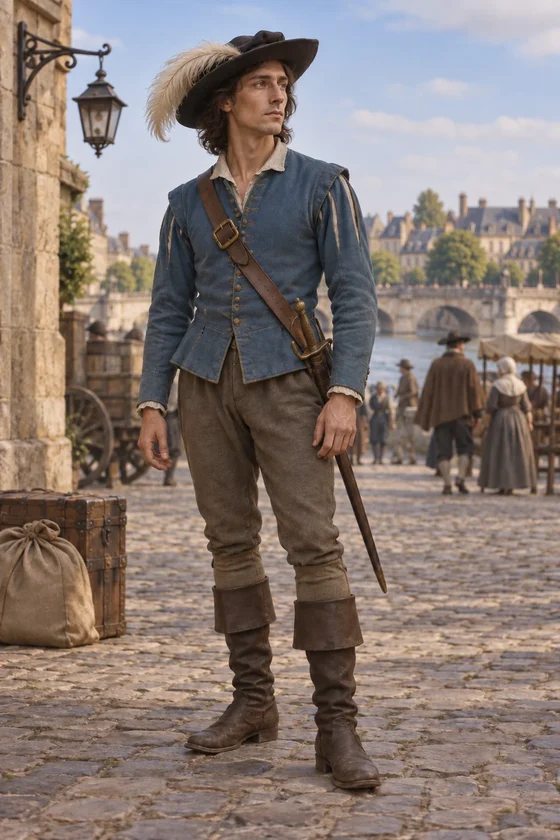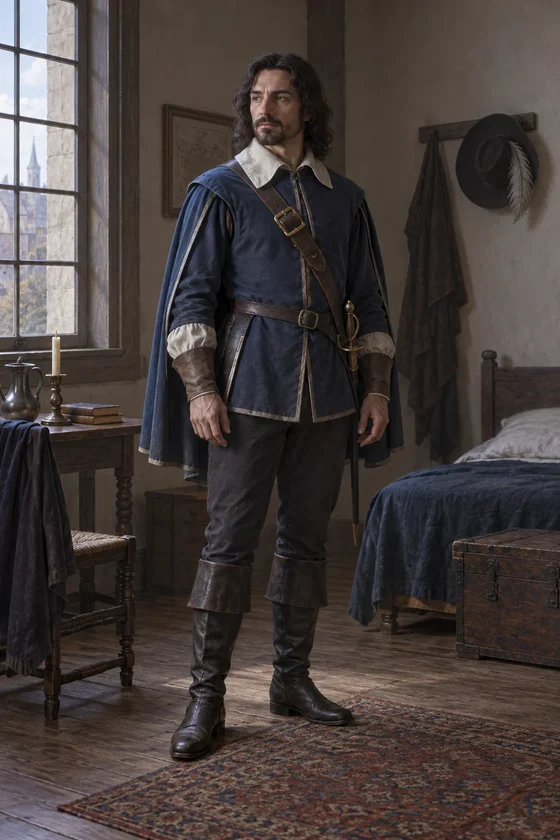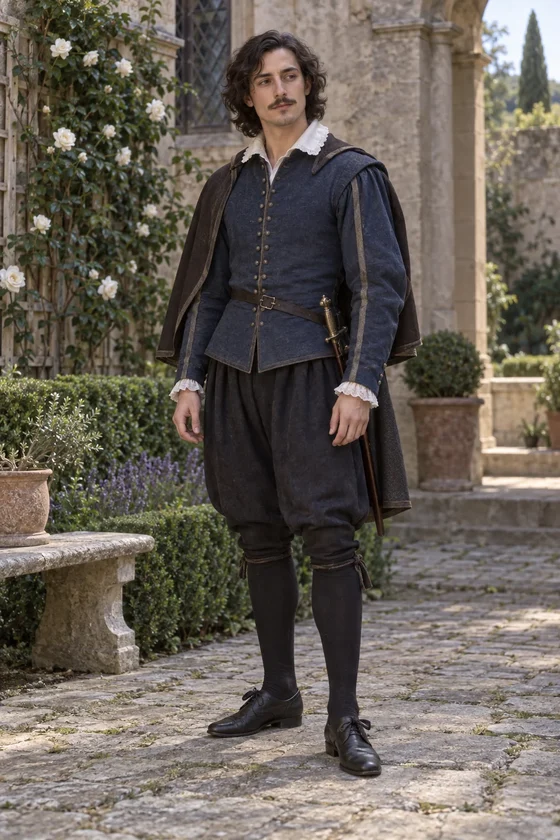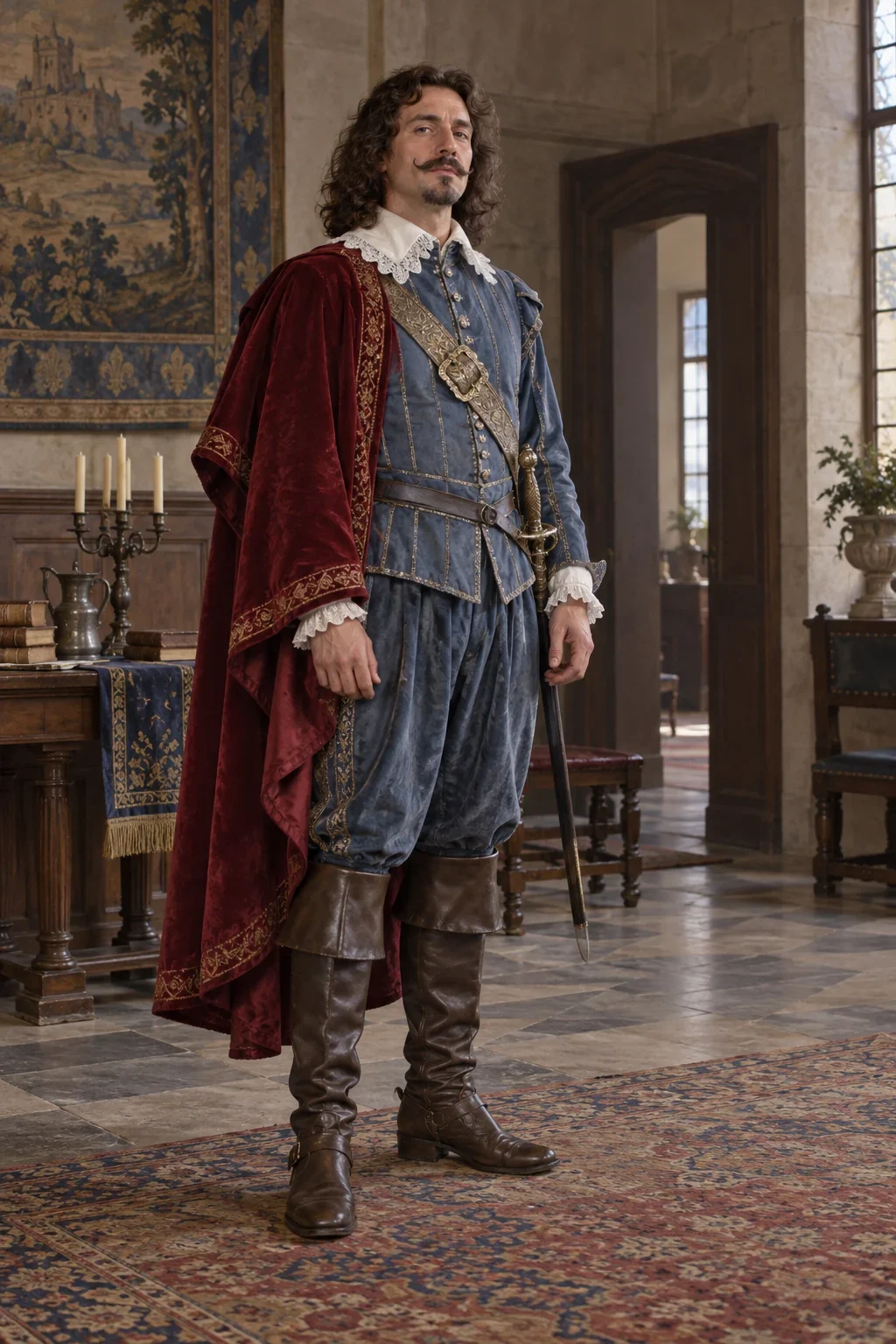
Imagined Porthos in a quiet full-body first-novel portrait.
Unofficial AI interpretation. Porthos pauses in Tréville’s antechamber. Exact portrait, unmentioned clothing and scene arrangement are imagined from the first novel, without an adaptation likeness claim. Full-frame display derivative; no upscaling.
Overview
Porthos is the tall, conspicuous Musketeer whose appetite for display supplies much of the comedy in The Three Musketeers. D’Artagnan first notices his faded blue doublet, crimson velvet cloak and glittering baldric. The apparent magnificence conceals an embarrassing economy: the decorated part faces outward while the hidden part is ordinary. D’Artagnan’s accidental discovery offends him and produces a duel appointment. When the cardinal’s men interrupt the meeting, Porthos joins the fight beside the other Musketeers and the young Gascon. His vanity coexists with demonstrated courage; it is not evidence that his friendship is only a performance.
The household account contrasts his loud conversation with Athos’s reserve. He enjoys talking about himself and cultivating the appearance of wealth and influential lovers. His large-looking lodging and liveried servant are part of that presentation, although friends do not inspect its supposed riches. Mousqueton, originally called Boniface, receives clothes and lodging rather than an ordinary wage and uses time of his own to provide for other needs. Their arrangements expose the gap between outward splendour and practical means. Porthos also finds Planchet for D’Artagnan, making his social resourcefulness useful beyond his own display.
On the journey to recover the queen’s ornaments, a quarrel over drinking the cardinal’s health separates Porthos from the party. D’Artagnan later finds him recovering at an inn, where his confident version of the adventure and his outstanding expenses complicate the reunion. Mousqueton’s ability to obtain provisions supports his master’s comfort. Porthos’s further attempts to secure military equipment lead to the procurator’s wife, Madame Coquenard. His account of a more exalted mistress disguises this relationship, and the dinner in the lawyer’s household exposes disappointed expectations about wealth and hospitality. The comedy depends on bargaining and concealment rather than on a bottomless fortune.
Despite these habits, Porthos participates in the friends’ dangerous collective work. He accompanies the La Rochelle campaign, shares the exposed meal at the bastion and helps in the pursuit of Milady after Constance Bonacieux’s poisoning. His presence at her private trial and execution belongs to the same morally contested action as his companions’ participation. At the close he declines the lieutenant’s commission that D’Artagnan offers him and leaves the service to marry Madame Coquenard, whose circumstances have changed. He is admiring his embroidered wedding clothes when the offer arrives. This endpoint belongs to the first novel. The later titles, estates, immense feats and final fate associated with Porthos in the continuing series are not imported into this account.
First appearances & development
The Three Musketeers establishes this fictional identity through the narrated adventures of the four companions. This profile follows the selected first-novel text and does not equate the fictional biography with a documented historical life.
Canon & continuity
Original narrative.
Selected bibliography
Documented works and useful reading. This is not a list of every appearance.
- 01
The Three Musketeers
Original.
Family & connections
A source-supported family tree or inspiration record has not yet been compiled for this profile. Related reading below indicates a connection in subject matter, not a proven lineage or creative influence.
References
Sources supporting this profile. Linked pages have their own scope and editorial standards.
- PrimaryThe Three MusketeersResearch access: 2026-10-11
Image credits
Unofficial modern AI interpretationImagined Porthos in a quiet full-body first-novel portrait.
Unofficial AI interpretation. Porthos pauses in Tréville’s antechamber. Exact portrait, unmentioned clothing and scene arrangement are imagined from the first novel, without an adaptation likeness claim. Full-frame display derivative; no upscaling.