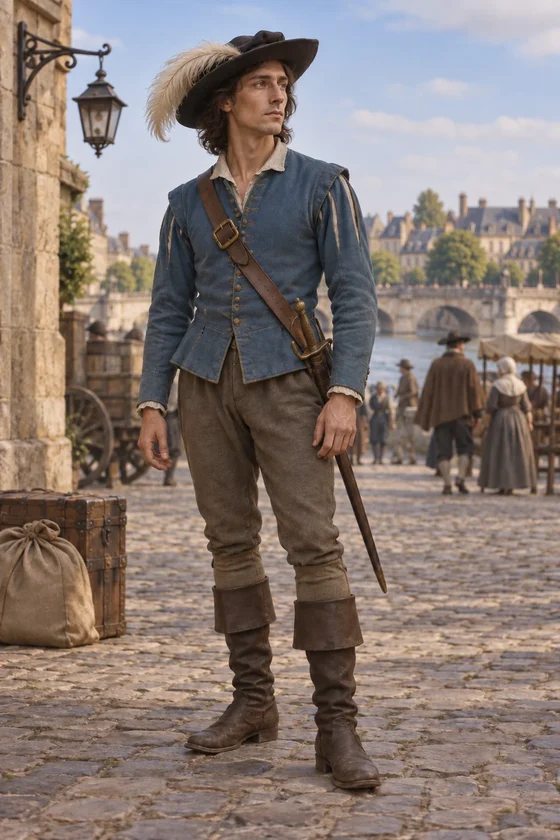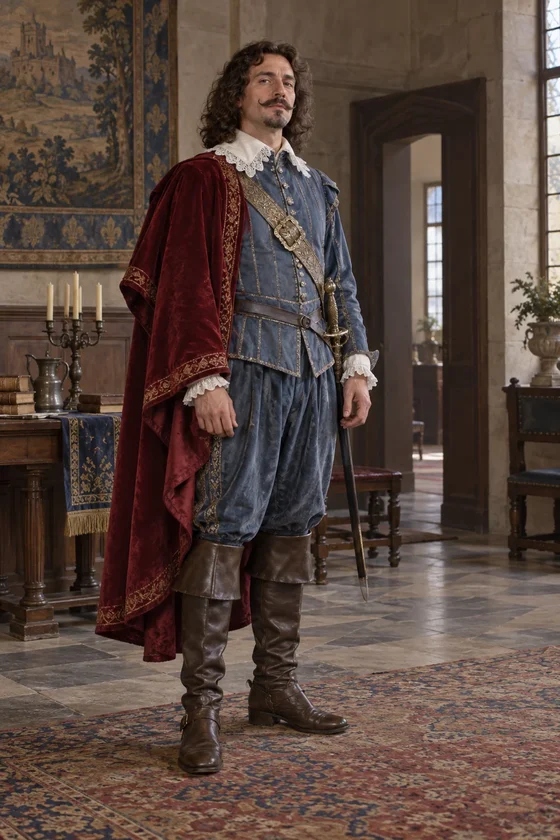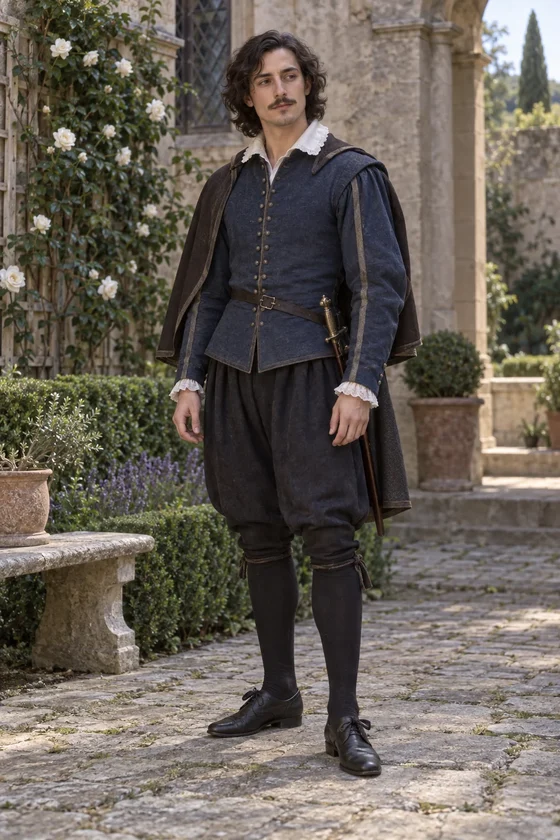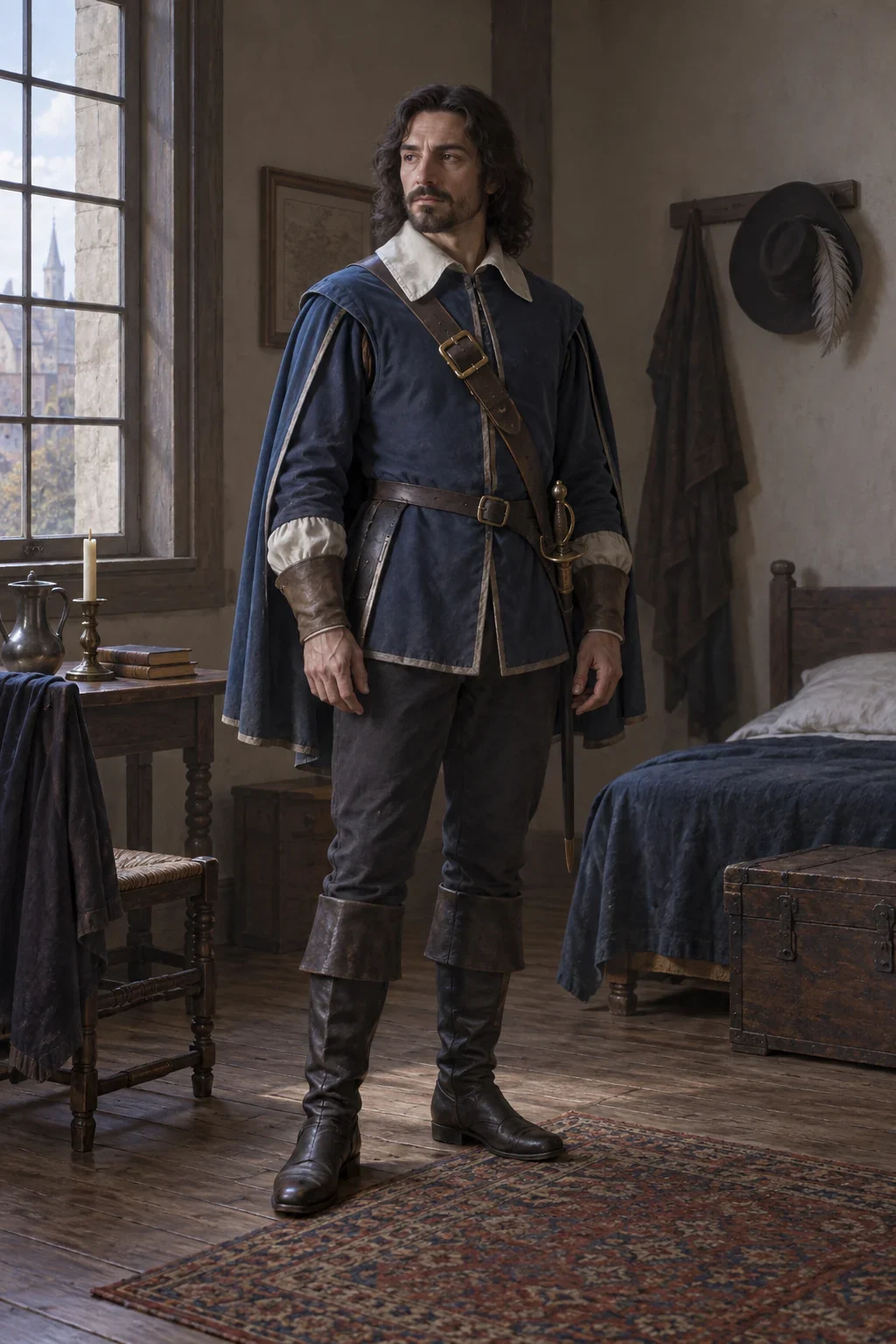
Imagined Athos in a quiet full-body first-novel portrait.
Unofficial AI interpretation. Athos pauses in his modest lodging. Exact portrait, unmentioned clothing and scene arrangement are imagined from the first novel, without an adaptation likeness claim. Full-frame display derivative; no upscaling.
Overview
Athos is the reserved Musketeer whose composure and concealed history distinguish him among D’Artagnan’s three friends. Early in the novel he suffers from an injured shoulder, and D’Artagnan’s collision with him leads to a duel appointment. The confrontation becomes an alliance when the cardinal’s Guards arrive. Athos appreciates the newcomer’s courage and increasingly serves as his adviser. The narrator describes him as scarcely thirty at the introductory household survey, although his silence and bitterness make him seem older. His noble bearing has greater effect than Porthos’s showy clothes, and his identity cannot be reduced to the group’s stern older father figure.
His lodging contains objects suggestive of an aristocratic past: an ornate ancestral sword, a portrait and a valuable casket of papers. He refuses to part with the sword even when money is scarce. Grimaud, his servant, has been trained to respond to signs rather than ordinary conversation. The account includes punishment when that system fails, so discipline is not merely an attractive trait. Athos’s attachment to his companions exists beside isolation, heavy drinking and an aversion to speaking about women. His behaviour at the inn during the English mission also creates practical difficulties that friendship must absorb.
The history of his marriage emerges through a story told while drinking. He describes a nobleman who married a young woman and discovered a criminal brand on her shoulder. The husband attempted to hang her; Athos initially narrates this as another man’s experience, and the later encounter with Milady connects that history to himself. His identity as the Comte de la Fère and her survival explain their recognition. The scene records his suspicion, violence and anguish, rather than establishing a neutral account in which every accusation automatically justifies punishment. D’Artagnan receives both important information and the effects of his friend’s embittered perspective.
Athos becomes a decisive planner against Milady during the La Rochelle episodes. After overhearing her exchange with Richelieu at the Red Dovecot, he confronts her and obtains the cardinal’s written authorization. He later gives that paper to D’Artagnan as protection. At the bastion he helps turn a conspicuous military exploit into an opportunity to discuss warnings and countermeasures. Following Constance’s death, he participates in the pursuit, accusation and private condemnation of Milady. The novel’s own later question about unlicensed punishment remains relevant to this conduct. Athos supports D’Artagnan’s promotion but does not become a father of Raoul within this book’s narrated account; the later family and political story is outside the selected scope.
First appearances & development
The Three Musketeers establishes this fictional identity through the narrated adventures of the four companions. This profile follows the selected first-novel text and does not equate the fictional biography with a documented historical life.
Canon & continuity
Original narrative.
Selected bibliography
Documented works and useful reading. This is not a list of every appearance.
- 01
The Three Musketeers
Original.
Family & connections
A source-supported family tree or inspiration record has not yet been compiled for this profile. Related reading below indicates a connection in subject matter, not a proven lineage or creative influence.
References
Sources supporting this profile. Linked pages have their own scope and editorial standards.
- PrimaryThe Three MusketeersResearch access: 2026-10-11
Image credits
Unofficial modern AI interpretationImagined Athos in a quiet full-body first-novel portrait.
Unofficial AI interpretation. Athos pauses in his modest lodging. Exact portrait, unmentioned clothing and scene arrangement are imagined from the first novel, without an adaptation likeness claim. Full-frame display derivative; no upscaling.