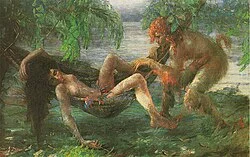
A sourced illustration has not yet been added. This gap is included in the coverage record.
Overview
Ambrosetti records a Corrientes Pombero called Cuarahú Yara: a tall, thin man with an enormous straw hat and a cane. He patrols the woodland during the siesta, protecting birds and taking away children who hunt them. Another account, attributed to the Chaco, makes him an invisible companion who can be befriended, guarding a person against danger and appearing as a person, a log or floating vegetation when needed. Quiet speech and tobacco left outside at night accompany this relationship.
The Corrientes witness is specifically a communication from national surveyor Juan Queirel to Ambrosetti. The account connects the bird guardian’s midday patrol to household conduct: children remain near their homes rather than hunting while adults rest. The following Chaco companion account has no separately named speaker. Ambrosetti proposes that Pombero modifies Yasy Yateré, but this is his comparative hypothesis; the two names do not become interchangeable solely because they appear together in his chapter.
Misiones' tourism interpretation instead emphasizes a hairy, bearded nocturnal figure, honey, tobacco and misleading birdlike calls. Those details belong to a modern regional presentation rather than cancelling the older daytime form. Forest paths, the household edge and the resting hour all provide settings where the being regulates human behaviour. A guardian who protects someone can also frighten or abduct; reducing Pombero to either a friendly helper or an invariably malicious monster loses that ambivalence.
Origins & earliest records
The inspected 1917 collection names surveyor Juan Queirel as a source for the Corrientes account and separates it from a Chaco description. This is a dated written witness to circulating stories, not their first occurrence. The source's proposal that Pombero derives from Yasy Yateré remains Ambrosetti's hypothesis rather than an established genealogy. The complete printed pp. 97–98 explicitly name Juan Queirel for Corrientes; the Chaco paragraph does not name its informant.
Records & interpretation
Ambrosetti's printed pages 97–98 support the contrasting daytime bird guardian and invisible companion. Misiones supplies a contemporary public account of the hairy night wanderer. Neither makes every regional description interchangeable. The historical collector's wider racial assumptions are excluded, and supernatural pregnancy or disability claims in later retellings are not adopted as explanations of real people.
Selected bibliography
Documented works and useful reading. This is not a list of every appearance.
- 01
Supersticiones y leyendas: Región misionera–Valles Calchaquíes–Las Pampas
Collector-mediated historical witness, printed pp. 97–98; racial hierarchies and speculative explanations excluded.
- 02
Mitos y leyendas misioneras — El Pombero
Contemporary institutional regional presentation; selected appearance and reception only.
Family & connections
A source-supported family tree or inspiration record has not yet been compiled for this profile. Related reading below indicates a connection in subject matter, not a proven lineage or creative influence.
References
Sources supporting this profile. Linked pages have their own scope and editorial standards.
- Primary textAmbrosetti: Pombero, pp. 97–98Research access: 2026-10-05
- ReferenceMisiones: PomberoResearch access: 2026-10-05
Image credits
A sourced illustration has not yet been added. This gap is included in the coverage record.