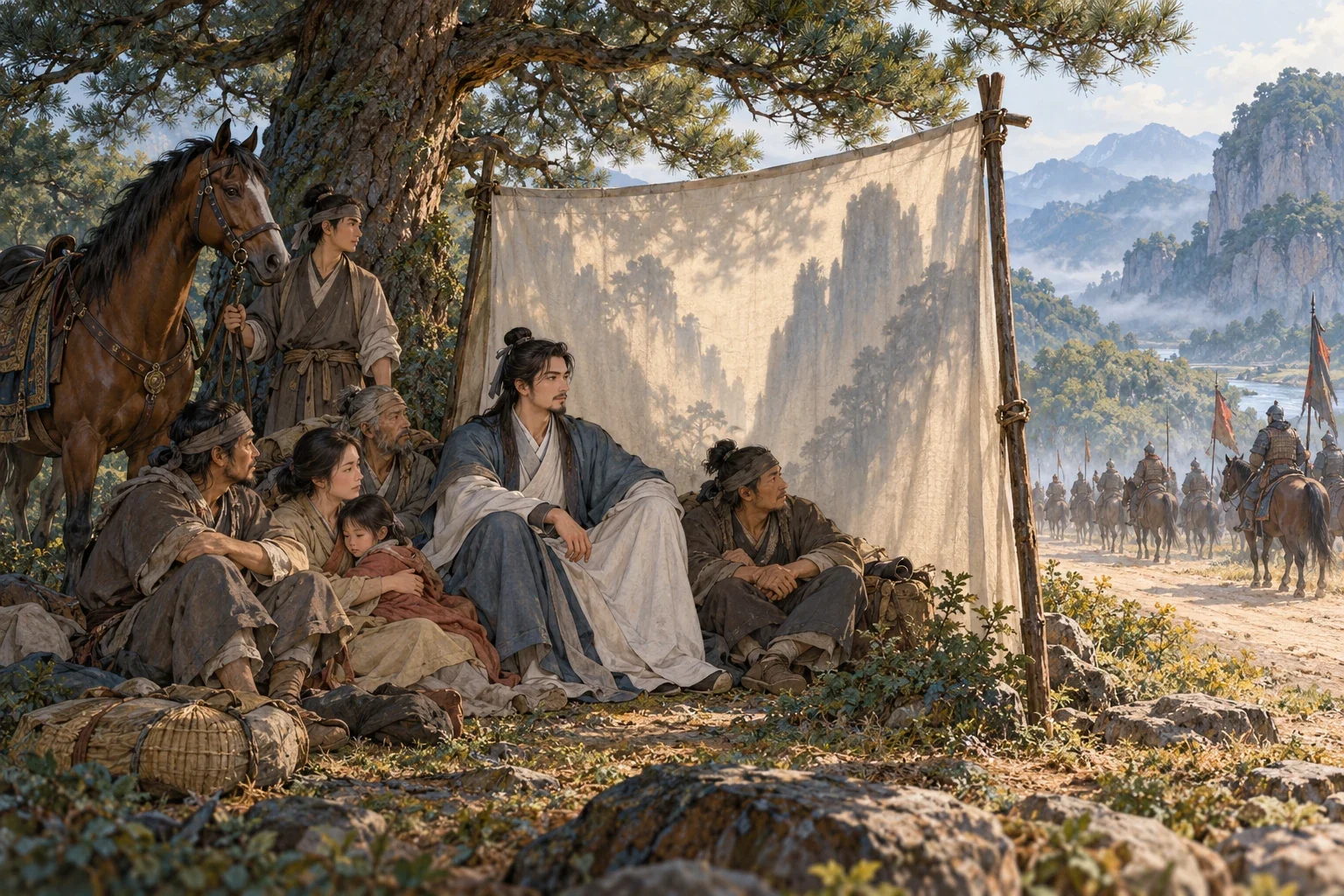
AI-generated interpretation of ChapterXIII shelter beneath the pine; cliff-like shadows interpret the soldiers’ different perception. The faces, garments, travelers’ ages and family grouping, landscape, shadow motif and military equipment are artistic choices. The secondary horse is partly outside the generated composition; the protector, cloth and travelers are clear. This is not an authenticated historical image or ethnographic evidence.
AI-generated interpretation of ChapterXIII shelter beneath the pine; cliff-like shadows interpret the soldiers’ different perception. The faces, garments, travelers’ ages and family grouping, landscape, shadow motif and military equipment are artistic choices. The secondary horse is partly outside the generated composition; the protector, cloth and travelers are clear. This is not an authenticated historical image or ethnographic evidence.
Overview
The unnamed stranger in The Man on the Road appears during a flight from Seoul in the war dated 1636 by the account. A party of refugees encounters mounted enemy soldiers and believes escape impossible. Just ahead, a man sits calmly beneath a pine beside the main road. His servant holds his horse, and several yards of cotton cloth hang before him like a screen against dust. The mundane arrangement becomes a refuge when he invites the frightened people to sit beside him and watch the troops pass.
The contrast between what the refugees see and what the soldiers perceive drives the episode. The soldiers pass the sheltered group without apparently noticing anyone there, although the narrative describes violence against others along their route. The people remain beside the stranger throughout the day, within the army’s reach, yet suffer no harm. The text does not say that the travellers have become immaterial or that a physical fortress has been built around them. Their protection is explained only after the procession has gone.
When the danger ends, the refugees bow to their benefactor and ask his name and home. He gives no answer. Instead, he mounts his fine horse and rides away too quickly for anyone to catch him. The next day the survivors meet a man who had been captured by the army and escaped. Asked about the place where they had waited, he remembers great walls and precipitous rocks that the soldiers could not approach. The narrator then explains that this was how the few yards of cotton had appeared to the passers-by.
The complete account identifies a protective magician through his conduct and a sharply defined alteration of perception, not through a supplied personal name, lineage or creature anatomy. His silence at the end preserves the mystery of his identity. The story attributes the account to Im Bang, in Gale’s 1913 English translation, and locates it within a wartime setting without independently verifying the reported encounter. A comparison with concealment stories elsewhere may be useful, but the cotton screen and the later captive’s testimony are the particular evidence here. No modern fictional character’s documented dependence on this tale is established.
Origins & earliest records
Korean Folk Tales: Imps, Ghosts and Fairies, translated by James S. Gale (London: J. M. Dent; New York: E. P. Dutton,1913), chapter XIII; account signed Im Bang. Korean manuscript not independently collated.
Records & interpretation
Complete chapter opening, action and ending read from preserved PG51002 HTML. Complete edition/title/preface framing also read; no attached footnotes occur inside the selected chapters.
Selected bibliography
Documented works and useful reading. This is not a list of every appearance.
- 01
Korean Folk Tales, chapterXIII
Complete historical English narrative witness; narrator’s dates retained with qualification.
Family & connections
A source-supported family tree or inspiration record has not yet been compiled for this profile. Related reading below indicates a connection in subject matter, not a proven lineage or creative influence.
References
Sources supporting this profile. Linked pages have their own scope and editorial standards.
- Historical literary translation, public domainGale1913, chapterXIIIResearch access: 2026-10-27
Image credits
AI-generated interpretationAI-generated interpretation of ChapterXIII shelter beneath the pine; cliff-like shadows interpret the soldiers’ different perception. The faces, garments, travelers’ ages and family grouping, landscape, shadow motif and military equipment are artistic choices. The secondary horse is partly outside the generated composition; the protector, cloth and travelers are clear. This is not an authenticated historical image or ethnographic evidence.
AI-generated interpretation of ChapterXIII shelter beneath the pine; cliff-like shadows interpret the soldiers’ different perception. The faces, garments, travelers’ ages and family grouping, landscape, shadow motif and military equipment are artistic choices. The secondary horse is partly outside the generated composition; the protector, cloth and travelers are clear. This is not an authenticated historical image or ethnographic evidence.