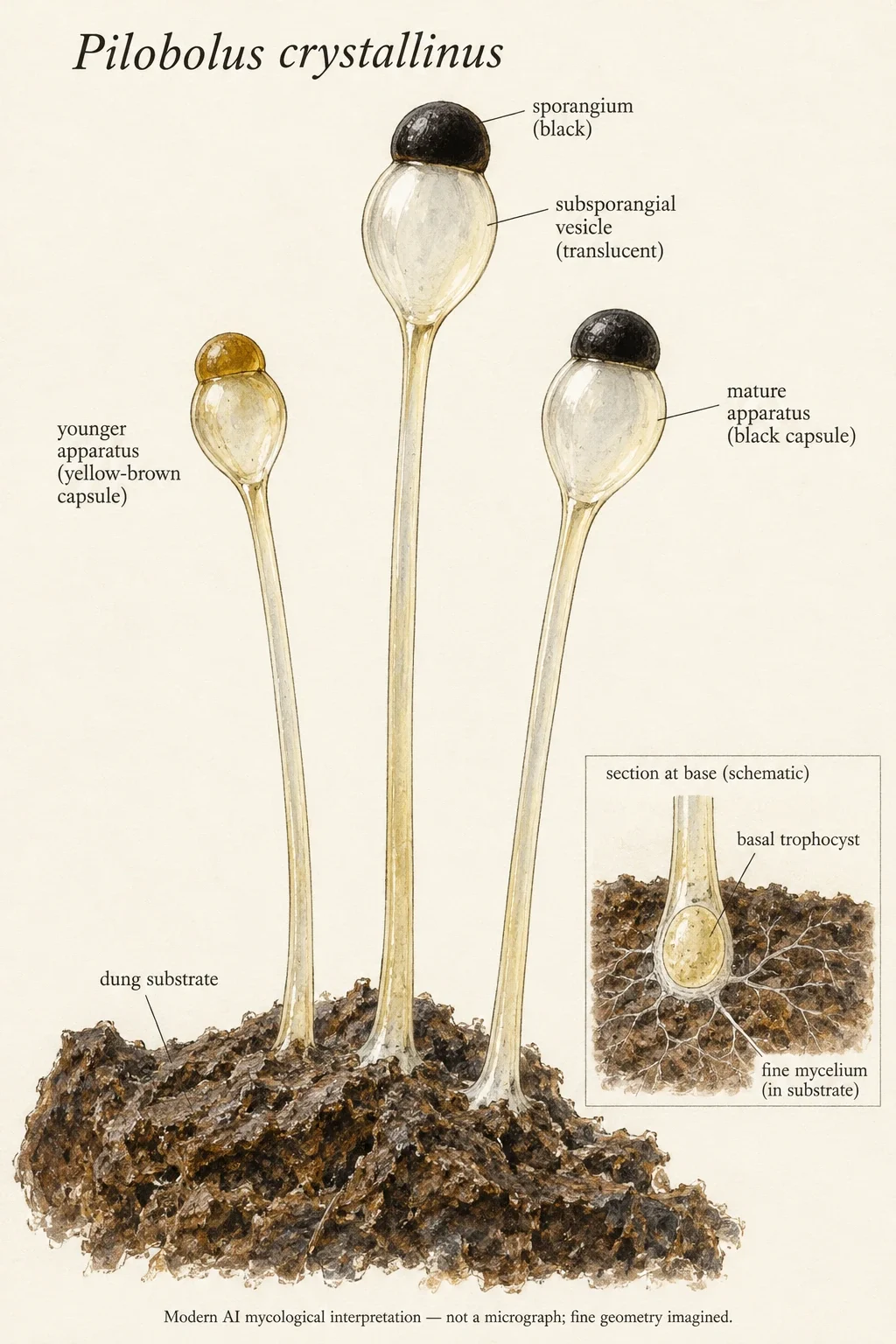
AI Pilobolus apparatus with vesicles and sporangia.
Modern AI mycological interpretation; basal inset schematic, not a micrograph.
Overview
Translucent stalks bear swollen subsporangial vesicles and dark capsules; basal trophocysts anchor them in dung.
Foos and Royer recovered this fungus from 15 Wayne County locations in their 1985 report, from several herbivores’ dung. Their isolates had clear to pale-yellow 1–5 mm stalks and pale elliptical spores. Regional measurements are not universal species limits; no measured P. kleinii launch speed is transferred.
A 2018 Korean study identified a fecal isolate as P. crystallinus using morphology together with internal-transcribed-spacer and large-subunit ribosomal DNA sequences. Its textual figure description records yellow and black sporangia, vesicles, trophocysts and rhizoidal extensions. The use of both appearance and sequence evidence matters because a dark capsule on a swollen stalk is not by itself a complete species diagnosis.
Foos and colleagues’ 2011 analysis of three ribosomal regions found that traditional morphological traits alone were inadequate for separating Pilobolus species. Spore size was the visible character most closely associated with molecular clades. Separately, a 1998 experiment on P. crystallinus reported gravity responses only at particular mature stages; the response should not be attributed equally to every developing stalk.
Origins & earliest records
Established Pilobolus taxon identified in the cited regional studies; no evolutionary age is inferred from its small apparatus.
Evidence & interpretation
Regional anatomy, 2018 identification and 2011 phylogeny remain distinct evidence. No kleinii-specific speed or pressure is transferred; this is not a measured strain.
Selected bibliography
Documented works and useful reading. This is not a list of every appearance.
- 01
- 02
- 03
- 04
Family, evolution & connections
Taxonomic classification
A hierarchy of classified groups, not a chain of direct ancestors.
Source note: Order and identification follow the 2018 primary study; 2011 molecular work cautions that morphology alone does not delimit all species. Historical zygomycete terminology is not adopted as a newly resolved phylum.
- OrderMucorales
- GenusPilobolus
- SpeciesPilobolus crystallinus
References
Sources supporting this profile. Linked pages have their own scope and editorial standards.
- Primary textSource recordResearch access: 2026-10-11
- Primary textSource recordResearch access: 2026-10-11
- Primary textSource recordResearch access: 2026-10-11
- Primary textSource recordResearch access: 2026-10-11
Image credits
AI-generated interpretationAI Pilobolus apparatus with vesicles and sporangia.
Modern AI mycological interpretation; basal inset schematic, not a micrograph.