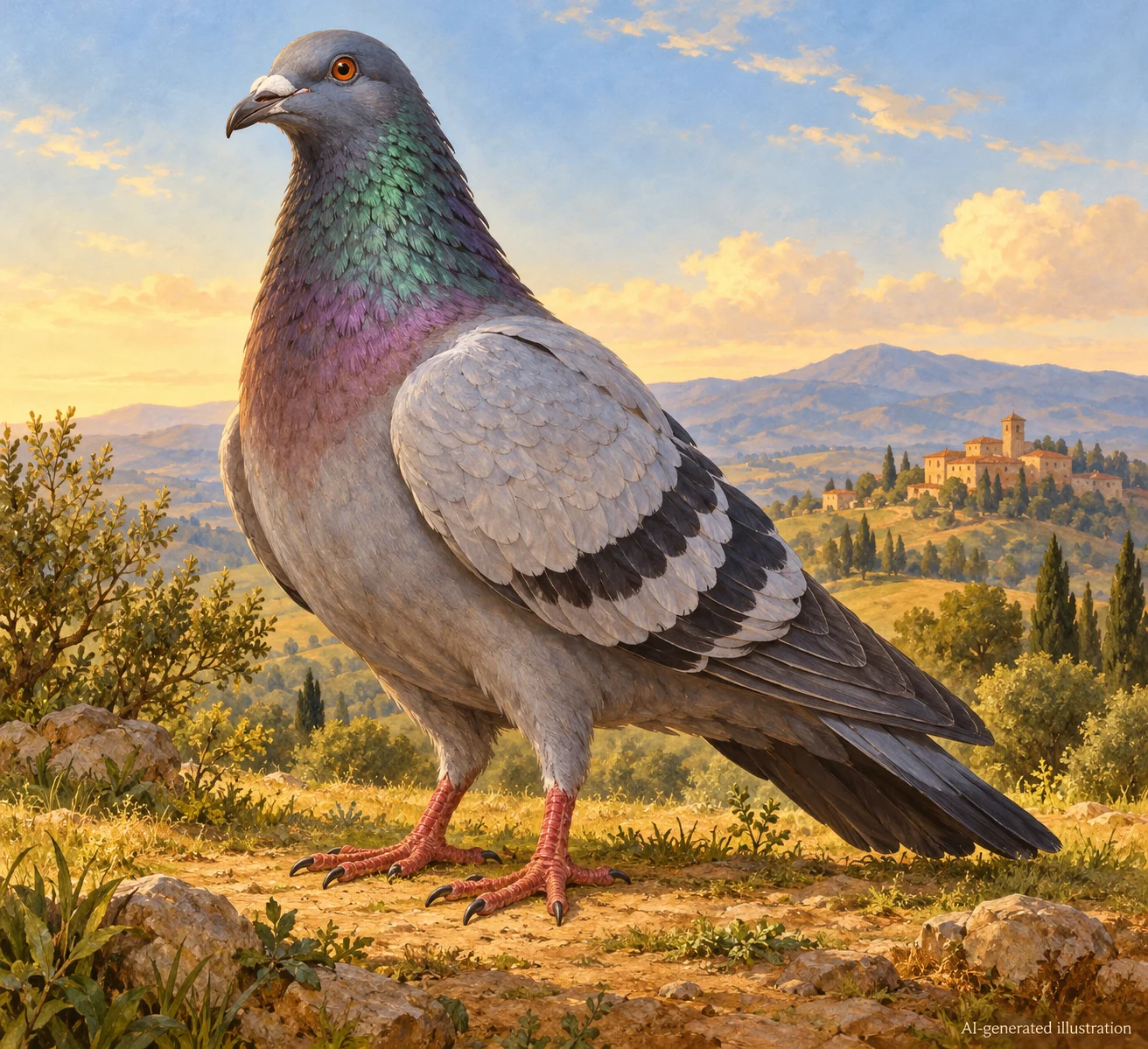
An imagined large pigeon stands after landing, with its wings folded and full tail visible.
The Pigeon (Collodi) — an imagined scene from Collodi’s original Italian narrative. Unspecified animal colours and staging are illustrative choices, not an authenticated historical illustration or adaptation design.
Overview
In chapter XXIII, Pinocchio returns to the place where the Fairy’s house stood and finds a memorial describing the blue-haired child as dead. His prolonged grief is interrupted by a large Pigeon flying overhead. The bird asks what he is doing and whether he knows a puppet named Pinocchio. Once the puppet identifies himself, the Pigeon descends and lands; the narrator specifies that he is larger than a turkey. He knows Geppetto because he left him on the seashore three days earlier, building a small boat. His report is bounded information from an encounter, rather than an assertion of omniscience.
The shore is more than a thousand kilometres away. When the puppet wishes for wings, the Pigeon offers his own back as transport, first asking whether the passenger is heavy. Pinocchio mounts astride and the bird rises almost to the clouds. The height frightens the passenger, who clings to the feathered neck. After travelling all day they stop at an empty dovecote containing water and a basket of vetch seed. Pinocchio, formerly fastidious about the food, eats eagerly. The Pigeon explains that real hunger makes plain food welcome; the scene combines the marvellous journey with the novel’s recurring attention to ordinary bodily needs.
They resume the journey and reach the shore the next morning. The Pigeon sets the puppet down and immediately flies away, unwilling even to wait through the bother of being thanked for a good deed. The rescue therefore brings Pinocchio to a chance of finding his father, but does not itself complete their reunion: the turbulent sea and Geppetto’s threatened boat belong to what follows. The bird is a single speaking helper, not an identified real pigeon species, a general class of giant birds or an embodied form of the Fairy. The chapter gives size, feathers, wings, neck and flight, while leaving plumage colour and finer anatomy undescribed.
First appearances & development
The complete original Italian chapter XXIII, printed pages 137–146 in the 1902 edition, supplies the Pigeon’s encounter, flight, rest and departure.
Canon & continuity
The entire chapter was read continuously, including the grief before the arrival and the shore episode after the bird leaves. No claim that the memorial gives the Fairy’s final fate is added; the novel elsewhere continues her story. The image can select the initial landing without depicting the separately held protagonist.
Selected bibliography
Documented works and useful reading. This is not a list of every appearance.
- 01
Le avventure di Pinocchio: Storia di un burattino
Complete chapter XXIII, pp 137–146 in the inspected Italian edition.
Family & connections
A source-supported family tree or inspiration record has not yet been compiled for this profile. Related reading below indicates a connection in subject matter, not a proven lineage or creative influence.
References
Sources supporting this profile. Linked pages have their own scope and editorial standards.
- Primary literary textCollodi: complete Pigeon journey, chapter XXIIIResearch access: 2026-10-18
Image credits
Original literary interpretation. Unspecified coat or plumage colour and staging are illustrative choices; no historical artwork or adaptation design copied.An imagined large pigeon stands after landing, with its wings folded and full tail visible.
The Pigeon (Collodi) — an imagined scene from Collodi’s original Italian narrative. Unspecified animal colours and staging are illustrative choices, not an authenticated historical illustration or adaptation design.