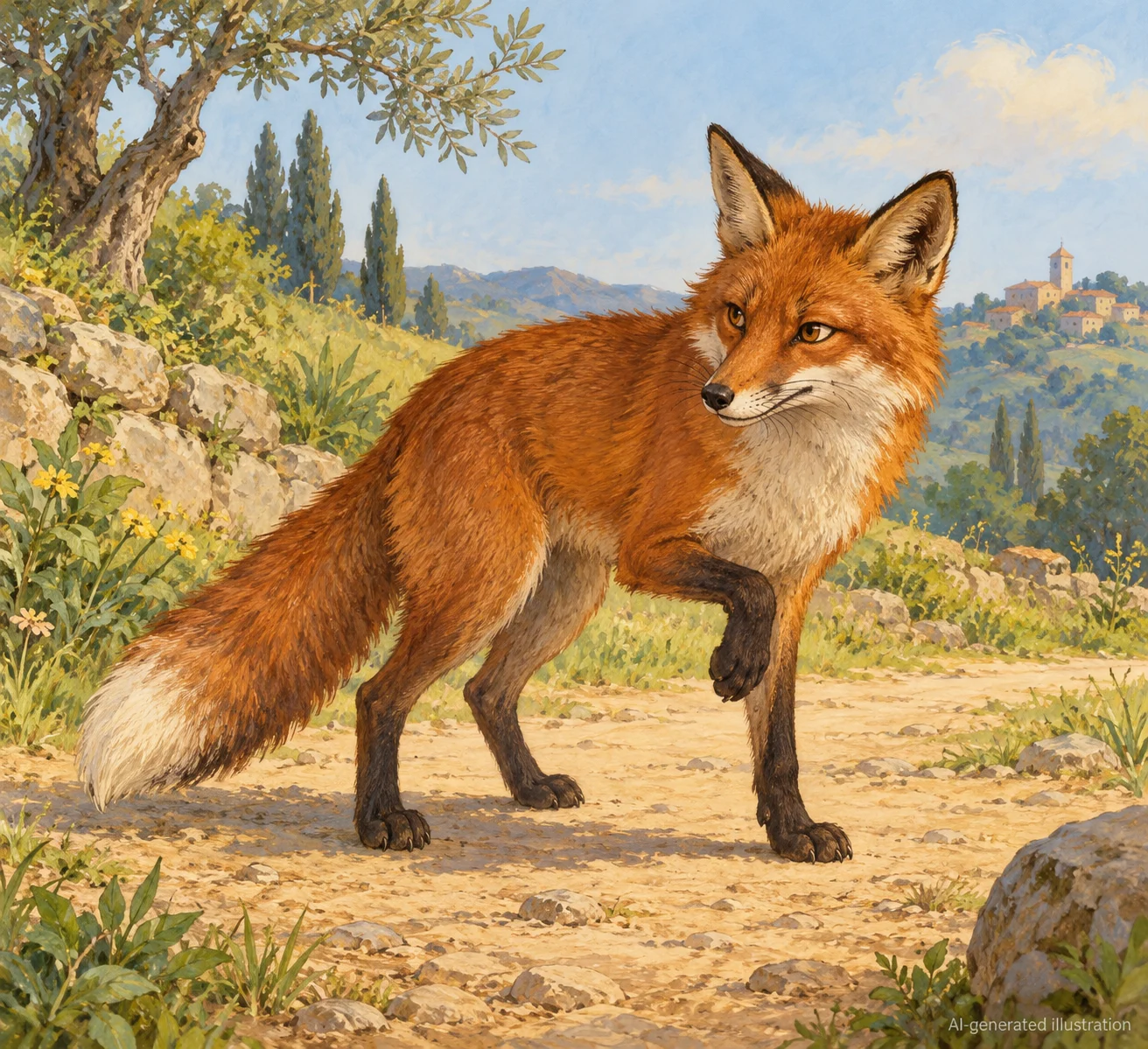
An imagined intact fox favours one leg beside a quiet road.
The Fox (Collodi) — an imagined scene from Collodi’s original Italian narrative. Unspecified animal colours and staging are illustrative choices, not an authenticated historical illustration or adaptation design.
Overview
The Fox first approaches Pinocchio on the road after the puppet receives five gold coins from Mangiafoco. She appears lame in one foot and leans on the supposedly blind Cat, while guiding him in return. The sight and sound of money briefly break both performances: the Fox straightens the leg that seemed disabled and the Cat opens his eyes. Claiming to know Geppetto, the Fox draws out the puppet’s plans, then argues against schooling and offers an apparently easier route to wealth. Her explanation is precise enough to sound practical: bury a coin in the Field of Miracles, cover it with earth, water it and wait for a tree laden with money. The precision serves the fraud; no magical money tree is shown to exist.
At the Red Crayfish inn, the Fox’s supposed lack of appetite accompanies an extravagant meal. She arranges sleeping rooms, departs with the Cat before midnight and leaves the puppet to pay for all three. Two attackers subsequently pursue Pinocchio, concealed in coal sacks. The smaller loses a cat’s forepaw when bitten, and the repeated speech of the pair recalls the companions’ earlier exchange. In the later reunion, the Fox supplies a false charitable explanation for the Cat’s missing paw, claiming he gave it to a starving wolf. The disguise and the fabricated explanation connect the friendly swindlers with the night’s violence; the tale’s irony depends on Pinocchio failing to recognize the pattern.
The Fox then invents a deadline: the field has supposedly been sold and will soon close to new investors. She and the Cat lead the puppet through Acchiappacitrulli to an ordinary-looking field, direct him to bury his remaining four coins and send him away. A Parrot later reports that the pair returned, dug up the money and fled. At the novel’s end the Fox is genuinely impoverished, old and ill, and has sold her once-beautiful tail to a travelling dealer for use as a fly whisk. Pinocchio refuses her renewed appeal. The closing condition must be distinguished from the earlier intact-tailed, falsely lame trickster.
First appearances & development
The profile follows the original Italian narrative in the 1902 Bemporad edition, chapters XII–XV, XVIII–XIX andXXXVI. The text’s grammatical feminine Volpe is retained in this account; no separate screen-adaptation identity or costume is imported.
Canon & continuity
Complete selected chapters and original title context read continuously in cached Italian text. English prose is a fresh paraphrase, not a quotation from a modern or historical English translation. The text gives a fox’s identity and tail but no fixed coat colour, clothing or humanlike hands.
Selected bibliography
Documented works and useful reading. This is not a list of every appearance.
- 01
Le avventure di Pinocchio: Storia di un burattino
Complete chapters XII–XV, XVIII–XIX, XXXVI; original Italian witness.
Family & connections
A source-supported family tree or inspiration record has not yet been compiled for this profile. Related reading below indicates a connection in subject matter, not a proven lineage or creative influence.
References
Sources supporting this profile. Linked pages have their own scope and editorial standards.
- Primary literary textCollodi: Fox episodes in the original Italian narrativeResearch access: 2026-10-18
Image credits
Original literary interpretation. Unspecified coat or plumage colour and staging are illustrative choices; no historical artwork or adaptation design copied.An imagined intact fox favours one leg beside a quiet road.
The Fox (Collodi) — an imagined scene from Collodi’s original Italian narrative. Unspecified animal colours and staging are illustrative choices, not an authenticated historical illustration or adaptation design.