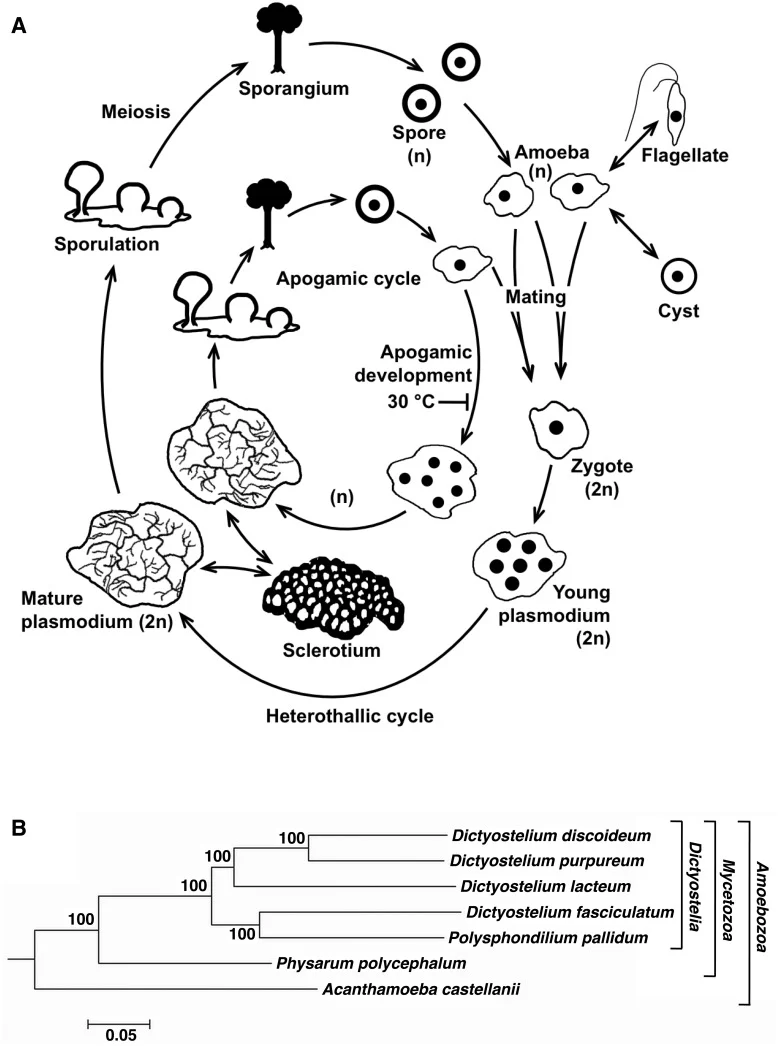
Physarum polycephalum life-cycle schematic and comparative amoebozoan phylogeny from Schaap and coauthors, figure 1
Panel A diagrams the species’ different cellular stages and contrasts mating-based and apogamic development. Panel B places Physarum among selected amoebozoans in the study’s gene-based tree. The drawn cells and arrows explain a life cycle; they are not specimen photographs or representations to scale. The published figure is reproduced unchanged.
Overview
Physarum polycephalum is a slime mould within Amoebozoa, rather than a fungus. Its best-known growing stage is a plasmodium: one large cell containing many nuclei. This is a different arrangement from the interacting individual cells of the social amoeba Dictyostelium discoideum. The plasmodium can extend over substantial distances, while its nuclei divide in synchrony. Pieces separated from the same plasmodium can retain that synchrony, making the organism useful for experiments on cell-cycle timing and differentiation.
Its life cycle includes much smaller forms. A germinating spore releases a single-nucleate amoeba, which can divide, become a flagellated swimming cell or form a resistant cyst. In the sexual cycle, compatible amoebae fuse and their nuclei unite, producing a diploid cell that develops into a plasmodium. Under drying conditions the plasmodium can form a resistant sclerotium. A starving plasmodium can instead produce spore-bearing structures after an appropriate light or heat stimulus. The genome paper also describes particular laboratory strains that form haploid plasmodia without mating; that alternative is not assumed to apply to every isolate.
The organism senses its environment through a varied molecular toolkit. Schaap and colleagues identify candidate light-sensitive proteins belonging to several different families, including cryptochrome-like, phototropin-like and phytochrome proteins. Their similarities to proteins previously studied in animals, plants and bacteria do not turn Physarum into any of those organisms. Sequence similarity and predicted protein domains suggest possible functions, while the physiological role of individual candidate receptors still requires testing.
The 2015 genome report combines DNA sequencing with RNA information from different stages of the life cycle. Long repetitive stretches made the genome difficult to assemble, leaving numerous gaps. An initial prediction of more than 47,000 protein-coding gene models consequently overcounted fragments. Combining overlapping predictions with transcripts reduced this to 34,438 proposed gene loci; approximately half lacked transcript support, and the authors warn that many unsupported predictions could be false positives. These figures describe that study’s assembly, rather than an exact and permanently settled number of genes in the species.
The same study compares Physarum with other amoebozoans to investigate the evolution of cellular signaling. Shared molecular machinery may preserve ancient features that other lineages subsequently lost. Physarum remains a living, evolving species, not an unchanged ancestor of animals or a miniature multicellular animal. Its value lies in the unusual combination of an experimentally accessible life cycle, a giant single-cell stage and diverse mechanisms for responding to environmental conditions.
Origins & earliest records
Schaap and colleagues published their genome study online in November 2015, in Genome Biology and Evolution volume 8(1), 109–125 (2016 issue). The sequenced DNA came from axenic haploid amoebae of strain LU352; genome accession ATCM00000000.3 and reference transcriptome GDRG01000000 identify the reported data, not a species holotype.
Evidence & interpretation
The primary study supplies the life-cycle diagram, genomic assembly methods, transcript-supported annotation and comparative protein-domain analyses. Receptor functions inferred from sequence are distinguished from established physiological responses. Draft assembly gaps and unsupported gene predictions constrain the reported gene counts.
Selected bibliography
Documented works and useful reading. This is not a list of every appearance.
- 01
The Physarum polycephalum Genome Reveals Extensive Use of Prokaryotic Two-Component and Metazoan-Type Tyrosine Kinase Signaling
Genome Biology and Evolution 8(1), 109–125; Introduction and life-cycle caption, complete main assembly/annotation Methods, genome properties and photoreceptor sections, Conclusions. Original adaptation of CC BY 4.0 article. https://creativecommons.org/licenses/by/4.0/.
- 02
Habituation in non-neural organisms: evidence from slime moulds
Proceedings of the Royal Society B 283(1829):20160446; 27 April 2016; DOI 10.1098/rspb.2016.0446.
Family, evolution & connections
Taxonomic classification
A hierarchy of classified groups, not a chain of direct ancestors.
- Major groupAmoebozoa
- GenusPhysarum
- SpeciesPhysarum polycephalum
Dictyostelium discoideum
Figure 1B places Physarum beside the sampled dictyostelid clade in a 30-gene maximum-likelihood analysis. This is a selected Amoebozoa hypothesis, not a direct ancestor relationship; Entamoeba was excluded, and Physarum’s multinucleate plasmodium differs from Dictyostelium’s aggregating cells.
Located primary passages
Specific passages supporting details in this entry, grouped by their published witness.
Habituation in non-neural organisms: evidence from slime moulds
2016
- Repeated quinine or caffeine exposure reduced avoidance; another repellent still elicited response. Quinine response recovered after two days, caffeine incompletely. Authors interpret these controls as habituation; proposed mechanisms and associative learning remain unresolved.
No supplement, reanalysis or replication. Habituation does not establish consciousness; cited earlier studies were not independently read.
References
Sources supporting this profile. Linked pages have their own scope and editorial standards.
- ResearchSchaap et al. primary genome and life-cycle studyResearch access: 2026-10-05
Image credits
Scientific life-cycle diagramPhysarum polycephalum life-cycle schematic and comparative amoebozoan phylogeny from Schaap and coauthors, figure 1
Panel A diagrams the species’ different cellular stages and contrasts mating-based and apogamic development. Panel B places Physarum among selected amoebozoans in the study’s gene-based tree. The drawn cells and arrows explain a life cycle; they are not specimen photographs or representations to scale. The published figure is reproduced unchanged.