Penghou / Hōkō
Image associated with the exact linked encyclopedia article; consult credited file description for its interpretation.
Overview
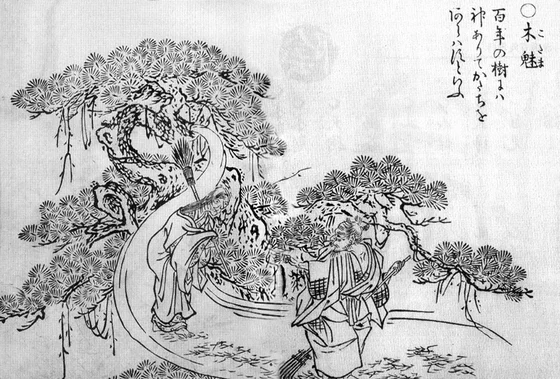
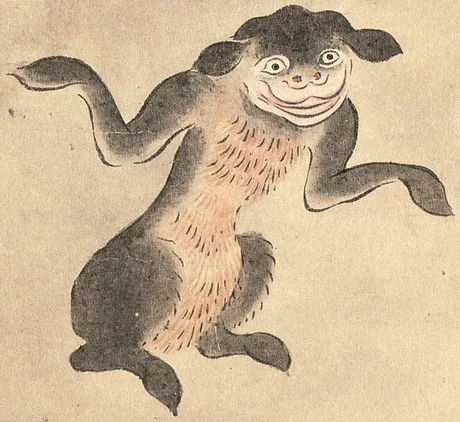
Penghou is a tree-associated spirit in Chinese strange-tale traditions, described in relevant accounts as a dark dog-like being without an ordinary tail. A story of a camphor tree links the creature's appearance with cutting wood, locating the supernatural inside material that people use. Sekien later represents the subject under the Japanese reading hōkō, making the connection between Chinese textual learning and Japanese monster illustration particularly visible.
Contextual references identify versions in the Baize material and the Soushenji, but their survival and transmission differ. The profile therefore does not declare one intact ancient book to be the complete source for every later image. It follows the tree, the dog-like form and the movement between textual and visual traditions. An illustration or tale documents an imagined encounter, while the species of an actual tree or animal requires independent identification.
Origins & earliest records
The selected work or object is a witness to this representation. Its date is not asserted to be the beginning of the tradition; textual layers and regional variants need separate review.
Records & interpretation
The linked source and contextual bibliography support the stated motifs. Material objects document iconography; narratives document imagined encounters. Neither alone is zoological confirmation.
Selected bibliography
Documented works and useful reading. This is not a list of every appearance.
- 01
Soushenji; Sekien's Konjaku Gazu Zoku Hyakki
Selected reading or object; bibliography is not exhaustive. Secondary links identify primary passages where a direct primary edition was not verified.
Family & connections
A source-supported family tree or inspiration record has not yet been compiled for this profile. Related reading below indicates a connection in subject matter, not a proven lineage or creative influence.
Primary records and illustrations
Konjaku Hyakki Shūi
Volume 1; Smithsonian Libraries digitized copy. IIIF canvas index 15 (zero-based); HyakkishuYiV1Tori_0016.jp2
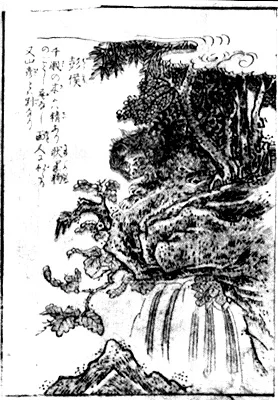
Printed label 彭侯; a hairy human-faced animal is set into an old tree over a waterfall. This is Sekien's Japanese pictorial reception of the Chinese Penghou. Illustration directly inspected; no complete transcription of cursive explanatory text is claimed.
Encyclopedia background
An additional attributed reference, separate from the editorial profile above.
Read the open encyclopedia overview
The Penghou (Chinese: 彭侯; pinyin: Pénghóu; Wade–Giles: P'eng-hou, pronounced [pʰə̌ŋ.xǒʊ]; literally: "drumbeat marquis") is a tree spirit from Chinese mythology and folklore. Two Chinese classics record similar versions of the Penghou myth.
The (c. 3rd century) Baize tu (白澤圖, "Diagrams of the White Marsh"), named after the Baize "White Marsh" spirit recorded in the Baopuzi, is no longer fully extant, but is identified with a Dunhuang manuscript (P2682). It describes the Penghou:
A creature that has evolved from the essence of wood is called Penghou. It looks like a black dog with no tail and its meat can be prepared as food. The essence of a 1,000-year-old tree may evolve into a spirit called Jiafei. It looks like a pig. Its meat tastes like dog meat. (tr. Luo 2003: 4132)
The (c. 4th century) Soushenji (搜神記, "In Search of the Supernatural") has a story about "The Penghou in the Camphor Tree":
During the Wu Kingdom (Three Kingdoms Period, 220–280) Jing Shu felled a big camphor tree. Then the wood bled and inside there was an animal that was similar to a dog but with a human face. Jing Shu said this was a Penghou. So he stewed the animal and ate it, which tasted like dog meat. (tr. Luo 2003: 4132, cf. DeWoskin and Crump 1996: 215–216)
Li Shizhen's (1578) Bencao Gangmu ("Compendium of Materia Medica") lists Penghou under Chapter 51, which primarily describes medicinal uses for monkeys. The entry quotes the Baize tu and Soushenji and describes Penghou meat as "sweet, sour, warm, and nontoxic" (tr. Luo 2003: 4132).
The Japanese pronunciation of Penghou is Hōkō (彭侯). This tree spirit is included in the Konjaku Hyakki Shūi, one of Toriyama Sekien's collections of monster illustrations. Sekien quoted the Soushenji and added the Baize tu 1,000-year-old tree description.
Text from Wikipedia contributors, “Penghou”. CC BY-SA 4.0. Extracted introduction; formatting changed. Retrieved 5 October 2026. The source article may have changed since retrieval.
References
Sources supporting this profile. Linked pages have their own scope and editorial standards.
- Primary Japanese illustration / library recordSoushenji; Sekien's Konjaku Gazu Zoku HyakkiResearch access: 2026-10-05
- Secondary referencePenghou / Hōkō — contextual bibliographyResearch access: 2026-10-05
- Primary illustrated plate / institutional digitizationKonjaku Hyakki Shūi — directly inspected IIIF canvas index 15 (zero-based); HyakkishuYiV1Tori_0016.jp2Research access: 2026-10-05
Image credits
Historical illustrationPenghou / Hōkō
Image associated with the exact linked encyclopedia article; consult credited file description for its interpretation.