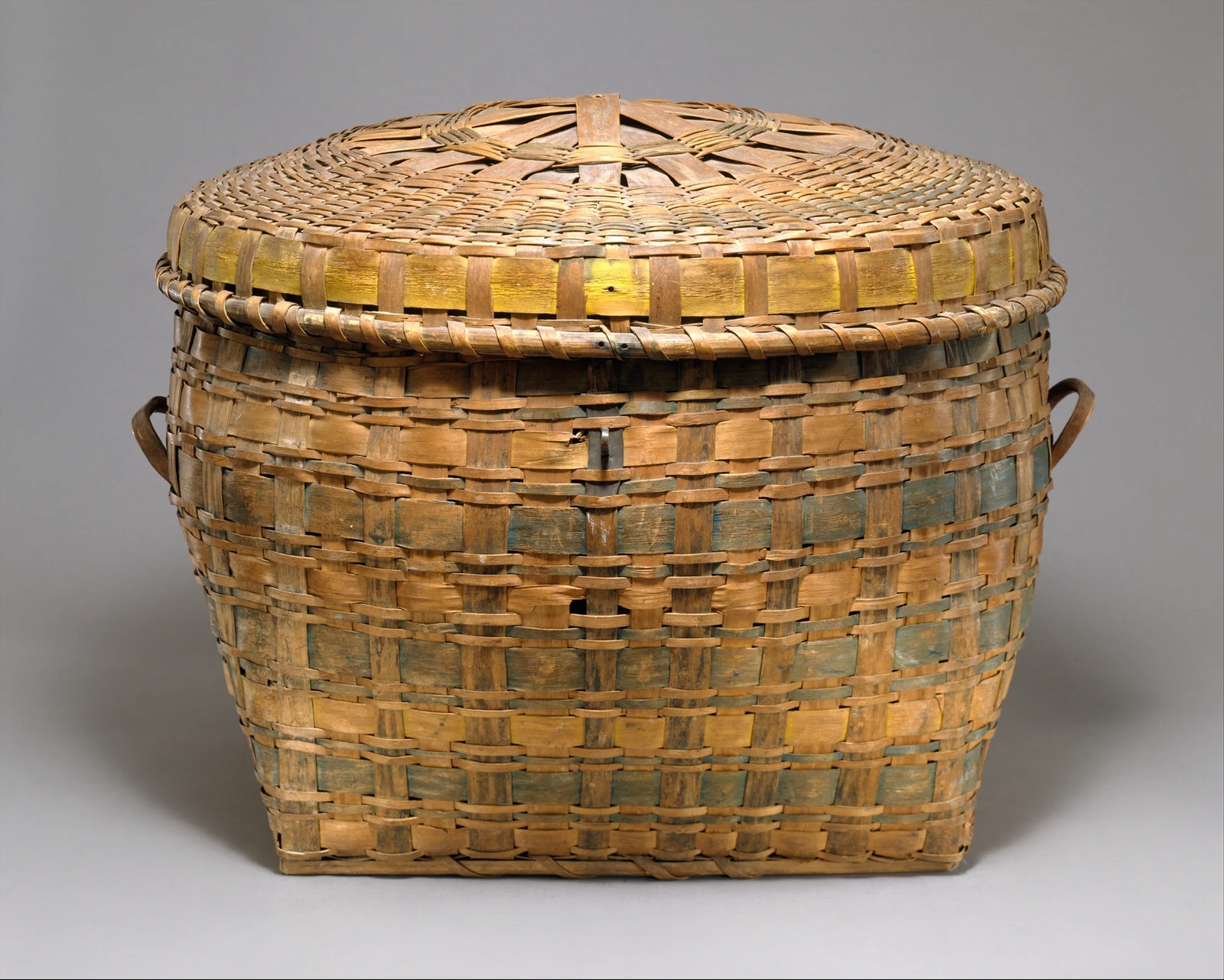
Oval lidded woven basket with faded green and yellow bands and two side handles; attributed uncertainly to Passamaquoddy makers, circa1840.
Lidded storage basket, circa1840, Maine. The Met records its maker culture as Passamaquoddy (?), retaining uncertainty. Ash splint, wood and pigment; a particular historical object, not a representation of all contemporary Passamaquoddy practice.
Overview
The Passamaquoddy, also named Peskotomuhkati, are a living people whose homeland crosses the present United States–Canada border. Sipayik’s government describes three self-governing communities: Pleasant Point and Indian Township in Maine, and a community at St. Andrews in New Brunswick. Their separation by geography coexists with political, social and family connections. This regional identity should not be reduced to residence in one reservation or treated as a single administrative jurisdiction.
Sipayik’s own history emphasizes the importance of Passamaquoddy Bay, marine resources and the peninsula’s connections to inland waterways. It also describes colonial encroachment and environmental degradation as pressures that forced economic adaptation. Indian Township’s published mission sets out a different kind of contemporary evidence: civic services, education, health, economic opportunity and environmental custodianship are stated governmental priorities. A mission statement documents commitments rather than proving that every intended outcome has been achieved.
The Peskotomuhkati Nation at Skutik locates its history in the St. Croix watershed and Passamaquoddy Bay. Its account challenges the assumption that all Peskotomuhkati people moved to the United States. It describes families remaining in New Brunswick and maintaining cross-border connections despite loss of land and official exclusion. The Council’s 2007 Peskotomuhkati Journey is identified as a community-produced history. The webpage’s discussion of negotiations culminates in January 2016 commitments; it is not evidence that every proposed recognition measure was subsequently completed.
Language collaboration has produced the Peskotomuhkati-Wolastoqey Language Portal, which connects a dictionary with recordings of speakers’ conversations and activities. Its publication notice identifies David A. Francis, Robert M. Leavitt and Margaret Apt with the dictionary’s second edition, published in 2026 after decades of collaboration among speakers, educators and linguists. A shared language resource connects communities without making their political identities interchangeable. Here the portal and publication notice are described; the recordings and complete dictionary have not been reviewed.
The Dawnland Voices archive describes Donald Soctomah and Stephanie Francis selecting tribal newsletters for digitization from the Passamaquoddy Cultural Heritage Museum. Publications include the 1971 Sibayik Newsletter, edited by Erne Yarmal and Veronica Moore. This selection foregrounds community print production, self-government and everyday institutional work. The introductory exhibit was read; individual newsletter issues remain separate sources requiring their own inspection.
History & identity
Community government histories, a collaborative language portal and a tribally selected archival exhibit.
Sources & representation
Complete Sipayik and Skutik history bodies, full portal notice and archive exhibit, retained complete indexed Indian Township welcome/mission. Native Township web open timed out; no linked books, newsletters, legal texts or recordings inspected.
Selected bibliography
Documented works and useful reading. This is not a list of every appearance.
- 01
Peskotomuhkati-Wolastoqey Latuwewakon: A Passamaquoddy-Maliseet Dictionary, second edition
Portal publication notice only.
- 02
Peskotomuhkati Journey
Named in community history; book not read.
- 03
Sibayik Newsletter, volume I, number 3
15 October1971; original cover and printed2–7.
Language & cultural connections
These connections link languages or specific cultural works and institutions; they do not establish biological ancestry or ethnic identity.
Wolastoqiyik
The Portal combines a collaborative dictionary and speaker recordings for language learning.
Located primary passages
Specific passages supporting details in this entry, grouped by their published witness.
Sibayik Newsletter, volume I, number 3
1971 issue
- Published minutes discuss basket-cooperative organisation, development employment and school-board elections. Community news places these decisions alongside local voluntary activity. The issue provides dated evidence of community print communication and governance; proposals and reported votes do not establish subsequent implementation.
Complete seven-page scan; printed2–3 council minutes,4–5 news,6–7 council/governor reports.
Scan reverses printed2/3. No private details, artwork or quotation reproduced; no current legal-status claim or independent event corroboration.
References
Sources supporting this profile. Linked pages have their own scope and editorial standards.
- Community or collaborative institutional sourceSipayik About UsResearch access: 2026-10-05
- Community or collaborative institutional sourcePeskotomuhkati PersistenceResearch access: 2026-10-05
- Community or collaborative institutional sourceLanguage PortalResearch access: 2026-10-05
- Community or collaborative institutional sourcePassamaquoddy Cultural Heritage Museum exhibitResearch access: 2026-10-05
- Community or collaborative institutional sourceIndian Township welcome and missionResearch access: 2026-10-05
Image credits
Contextual cultural object photograph with qualified attributionOval lidded woven basket with faded green and yellow bands and two side handles; attributed uncertainly to Passamaquoddy makers, circa1840.
Lidded storage basket, circa1840, Maine. The Met records its maker culture as Passamaquoddy (?), retaining uncertainty. Ash splint, wood and pigment; a particular historical object, not a representation of all contemporary Passamaquoddy practice.