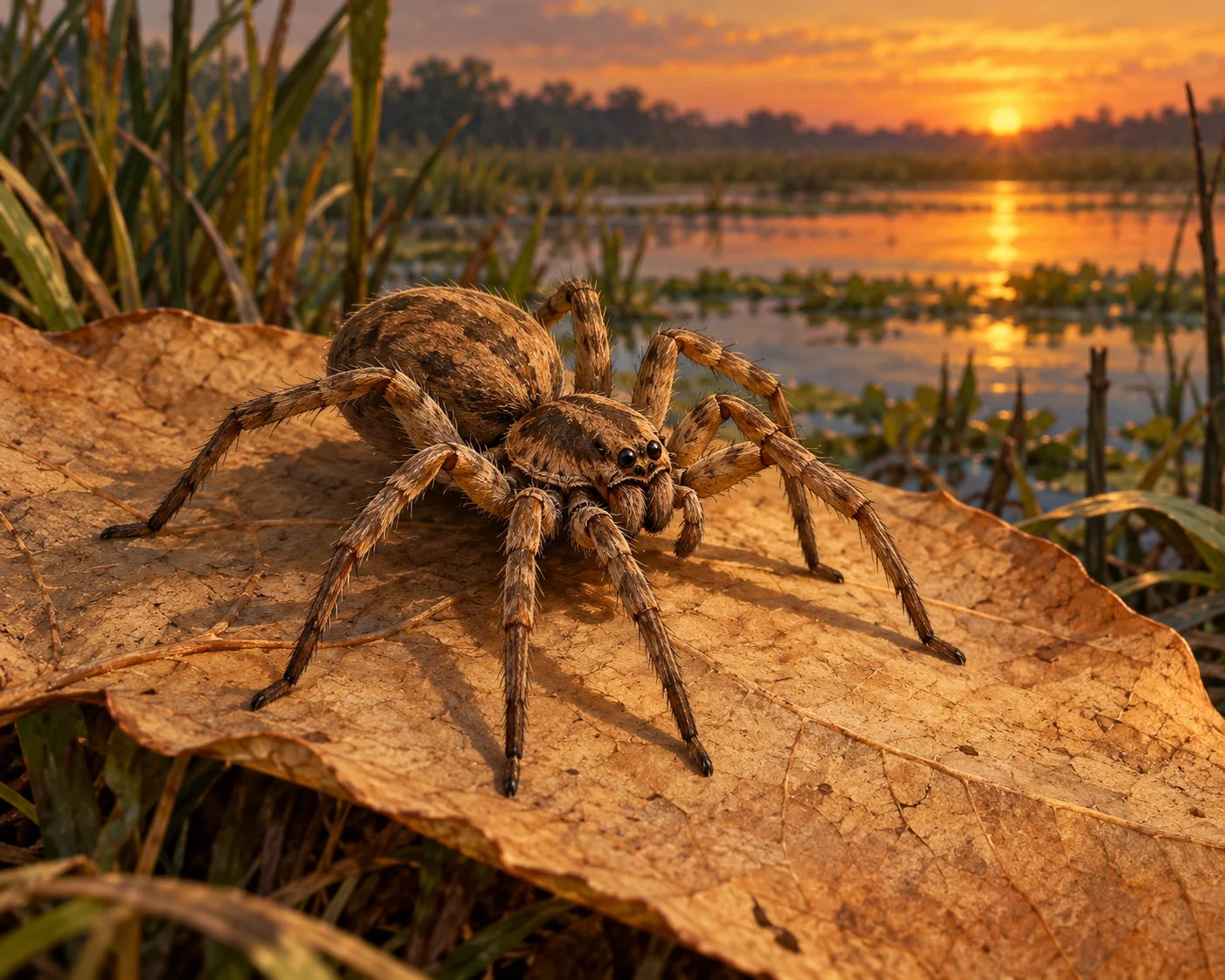
The spider alone near a marsh; ordinary arachnid anatomy, colouring and scale imagined.
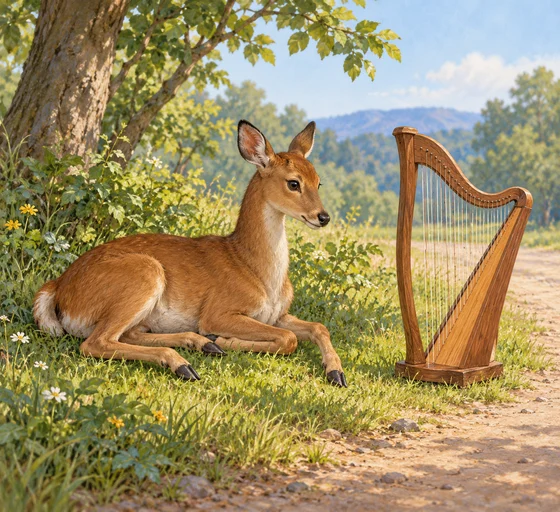
Original narrative illustration; species, colours, proportions, instrument design and setting interpreted, not authenticated Vei iconography or modern national origin.
Overview
The spider in Koelle’s Spider-Fable faces a famine with his wife and a hundred children. Instead of accepting his wife’s offer that they work, he pretends to be dying and asks to be buried upright beneath boards. Once the family has covered him, he leaves the hole at evening and visits a wealthy woman-chief who has plentiful rice and cassava but no children. He promises medicine that will enable her to give birth, in exchange for food and agricultural wealth. After eating, he covers her eyes, prepares a bowl and secretly jumps into it as she drinks. The supposed baby she later bears is the spider himself, now fed from her abundant stores.
A cunning deer visits the woman and recognises the spider in the child she presents. The deer returns with a switch, exposes and strikes the impostor, who runs away. The spider then goes back to his first wife, whose household now has ripe rice, fowls and meat. He interrupts her meal and claims that he died long ago and has returned. A child identifies him as the father, but his wife repeatedly insists that her husband died. The final narrator’s judgment again calls him an impostor; the tale does not grant him an accepted homecoming. The source’s Vei heading uses Pakenna for the spider figure, while the English telling gives him no separate personal name.
Origins & earliest records
Chapter VIII, § 20, V: Pakenna a Terimu, translated under the heading Spider-Fable. Koelle’s preface explains his collection and translation method but supplies no individual narrator attribution for this particular fable.
Records & interpretation
Complete Vei text and English translation, printed pp. 69–72, retained with complete preface and original PDF. Every selected narrative page viewed.
Selected bibliography
Documented works and useful reading. This is not a list of every appearance.
- 01
Outlines of a Grammar of the Vei Language, together with a Vei-English Vocabulary, and an Account of the Discovery and Nature of the Vei Mode of Syllabic Writing
Chapter VIII, § 20, V, printed pp. 69–72; complete fable and preface.
Family & connections
A source-supported family tree or inspiration record has not yet been compiled for this profile. Related reading below indicates a connection in subject matter, not a proven lineage or creative influence.
References
Sources supporting this profile. Linked pages have their own scope and editorial standards.
- Original historical bilingual collection in a language grammarKoelle 1854: complete fable, pp. 69–72Research access: 2026-10-18
Image credits
AI-generatedThe spider alone near a marsh; ordinary arachnid anatomy, colouring and scale imagined.
Original narrative illustration; species, colours, proportions, instrument design and setting interpreted, not authenticated Vei iconography or modern national origin.