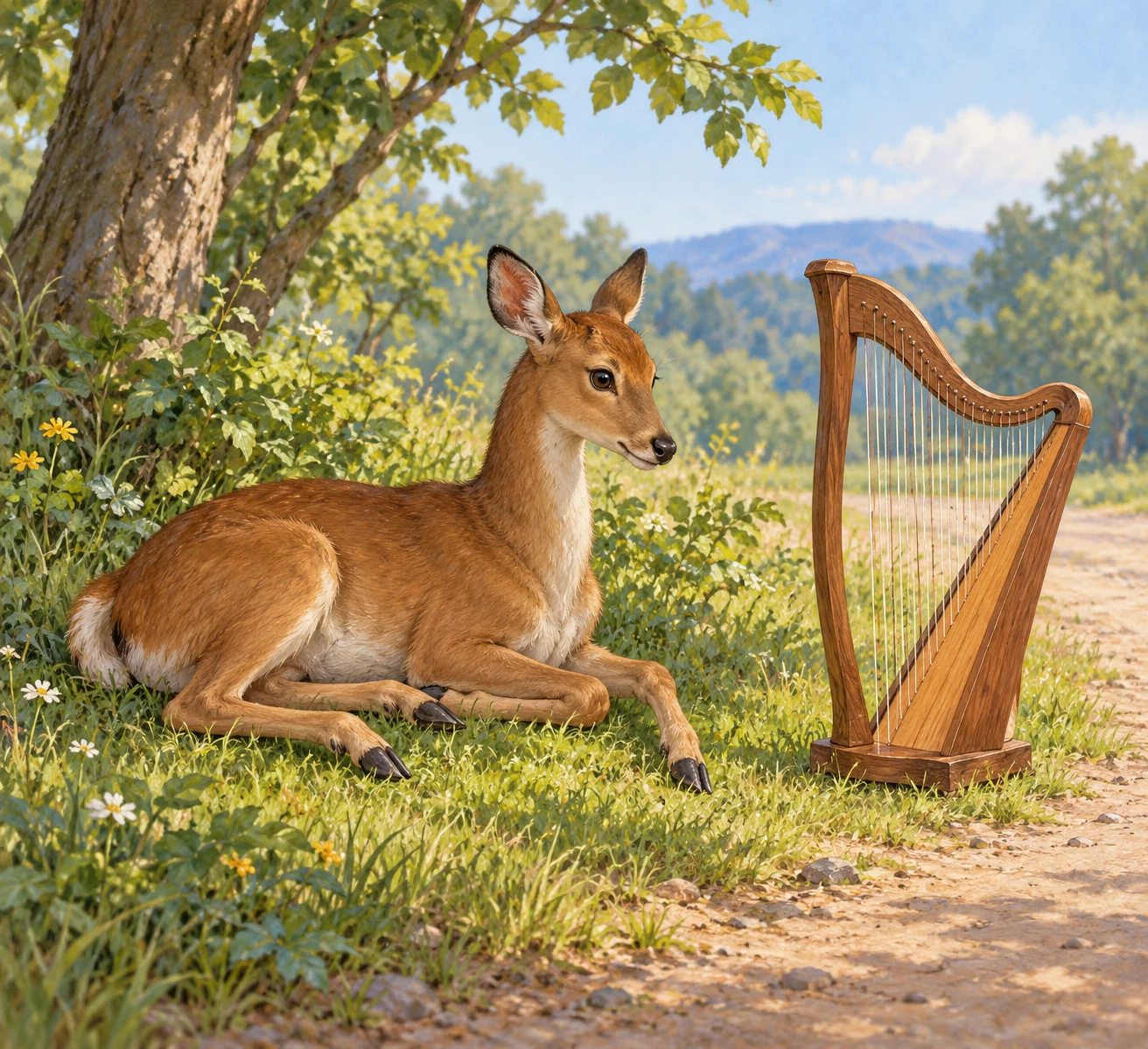
The deer beside an imagined harp; species, instrument design and resting pose interpreted.
Original narrative illustration; species, colours, proportions, instrument design and setting interpreted, not authenticated Vei iconography or modern national origin.
Overview
The deer in Koelle’s Elephant-Fable belongs to a company of animals going to work. He invites the others to come to his work, but Elephant refuses and demands that they go to his instead. The deer declares that he will spoil the work. He takes his harp and sits beside the road. At first the animals arrive and begin their labour, but after he has played for a while they leave the work and sit beside him. The day’s work is lost without any attack on Elephant or destruction of his tools.
When Elephant asks why the animals did not come and work, the deer reminds him of the earlier disagreement: he had invited them, Elephant had said no, and he has consequently spoiled Elephant’s work. Elephant acknowledges that this is true. The tale ends with no more work done that day, rather than reconciliation, punishment or a contest of musical magic. Koelle prints the short Vei narrative and his English translation as a specimen of figurative language. The deer has no individual name or specified biological species, and the translated word harp supplies no detailed description of the instrument.
Origins & earliest records
Chapter VIII, § 20, V: Kama-Teri, followed by the English heading Elephant-Fable. The fable’s heading names Elephant, but this profile follows the deer’s distinct action. The preface names several contributors without assigning this fable to one of them.
Records & interpretation
Complete Vei text and English translation, printed pp. 68, retained with complete preface and original PDF. Every selected narrative page viewed.
Selected bibliography
Documented works and useful reading. This is not a list of every appearance.
- 01
Outlines of a Grammar of the Vei Language, together with a Vei-English Vocabulary, and an Account of the Discovery and Nature of the Vei Mode of Syllabic Writing
Chapter VIII, § 20, V, printed pp. 68; complete fable and preface.
Family & connections
A source-supported family tree or inspiration record has not yet been compiled for this profile. Related reading below indicates a connection in subject matter, not a proven lineage or creative influence.
References
Sources supporting this profile. Linked pages have their own scope and editorial standards.
- Original historical bilingual collection in a language grammarKoelle 1854: complete fable, pp. 68Research access: 2026-10-18
Image credits
AI-generatedThe deer beside an imagined harp; species, instrument design and resting pose interpreted.
Original narrative illustration; species, colours, proportions, instrument design and setting interpreted, not authenticated Vei iconography or modern national origin.