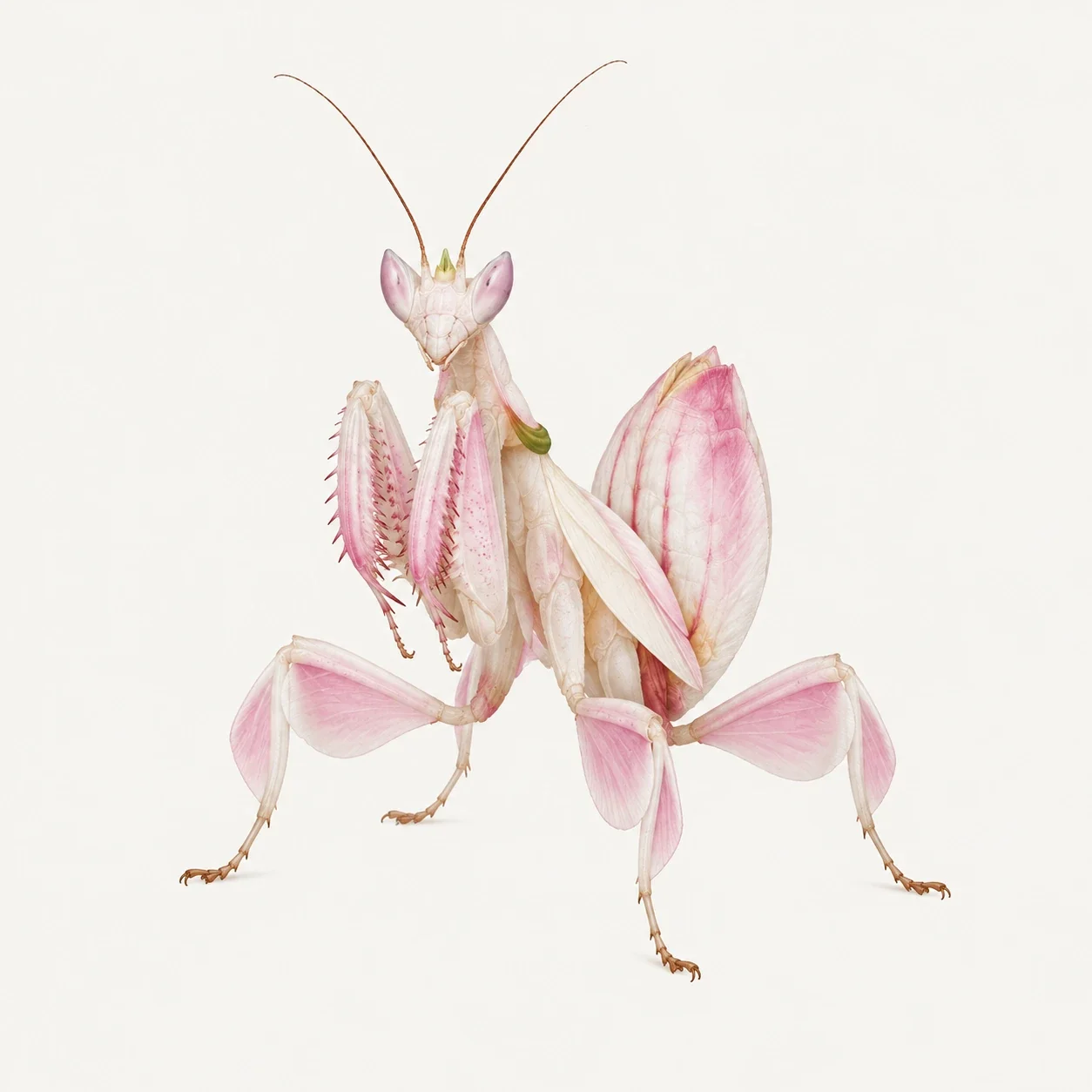
Orchid mantis - AI-generated scientific interpretation.
Modern AI-generated scientific illustration. Diagnostic features follow the selected zoological sources; pose, individual pattern and fine details are interpretive. Not specimen photography or independent evidence.
Overview
The orchid mantis is an insect predator with a triangular head, long antennae and grasping forelegs armed with spines. Its broad lobes on the walking legs and pale white or pink coloration produce a flower-like appearance. Six legs remain present: the two hunting forelegs have a different function and shape from the four walking legs.
Calling the animal an orchid mimic can conceal an important question: does it imitate one specific flower, or offer a more general floral signal? O’Hanlon and colleagues tested coloration and attraction in the field. Pollinating insects approached the mantises, supporting aggressive mimicry in which a predator draws prey toward itself. The results do not identify a single orchid species that every mantis must match.
The petal-like body outline can contribute to both concealment and attraction, depending on who sees the animal and the surrounding vegetation. Those functions are not mutually exclusive. A scientific illustration should not attach real petals to the body or replace raptorial forelegs with an extra pair of decorative limbs.
The generated illustration selects adult female form. Pose and individual coloration remain interpretive; the experimental study does not establish an exact standard colour pattern for every mantis.
Origins & earliest records
Hymenopus coronatus is an extant mantis. Its scientific description and modern behavioural experiments are milestones in documentation, not dates at which flower resemblance first evolved.
Evidence & interpretation
The 2014 experimental paper is the primary support for pollinator attraction. Museum-style anatomy and the indexed genomic account support identity and a bounded evolutionary context; attraction experiments do not establish identical outcomes in every habitat.
Selected bibliography
Documented works and useful reading. This is not a list of every appearance.
- 01
Pollinator Deception in the Orchid Mantis
Selected bibliography; bounded source account, not exhaustive coverage.
Family, evolution & connections
Taxonomic classification
A hierarchy of classified groups, not a chain of direct ancestors.
Source note: Flower mimicry describes a biological strategy, not a taxonomic rank. Genomic candidate associations are not treated as experimentally established causal mechanisms.
- kingdomAnimalia
- phylumArthropoda
- classInsecta
- orderMantodea
- familyHymenopodidae
- genusHymenopus
- speciesHymenopus coronatus
References
Sources supporting this profile. Linked pages have their own scope and editorial standards.
- ResearchPollinator Deception in the Orchid MantisResearch access: 2026-10-10
Image credits
AI-generated scientific interpretationOrchid mantis - AI-generated scientific interpretation.
Modern AI-generated scientific illustration. Diagnostic features follow the selected zoological sources; pose, individual pattern and fine details are interpretive. Not specimen photography or independent evidence.