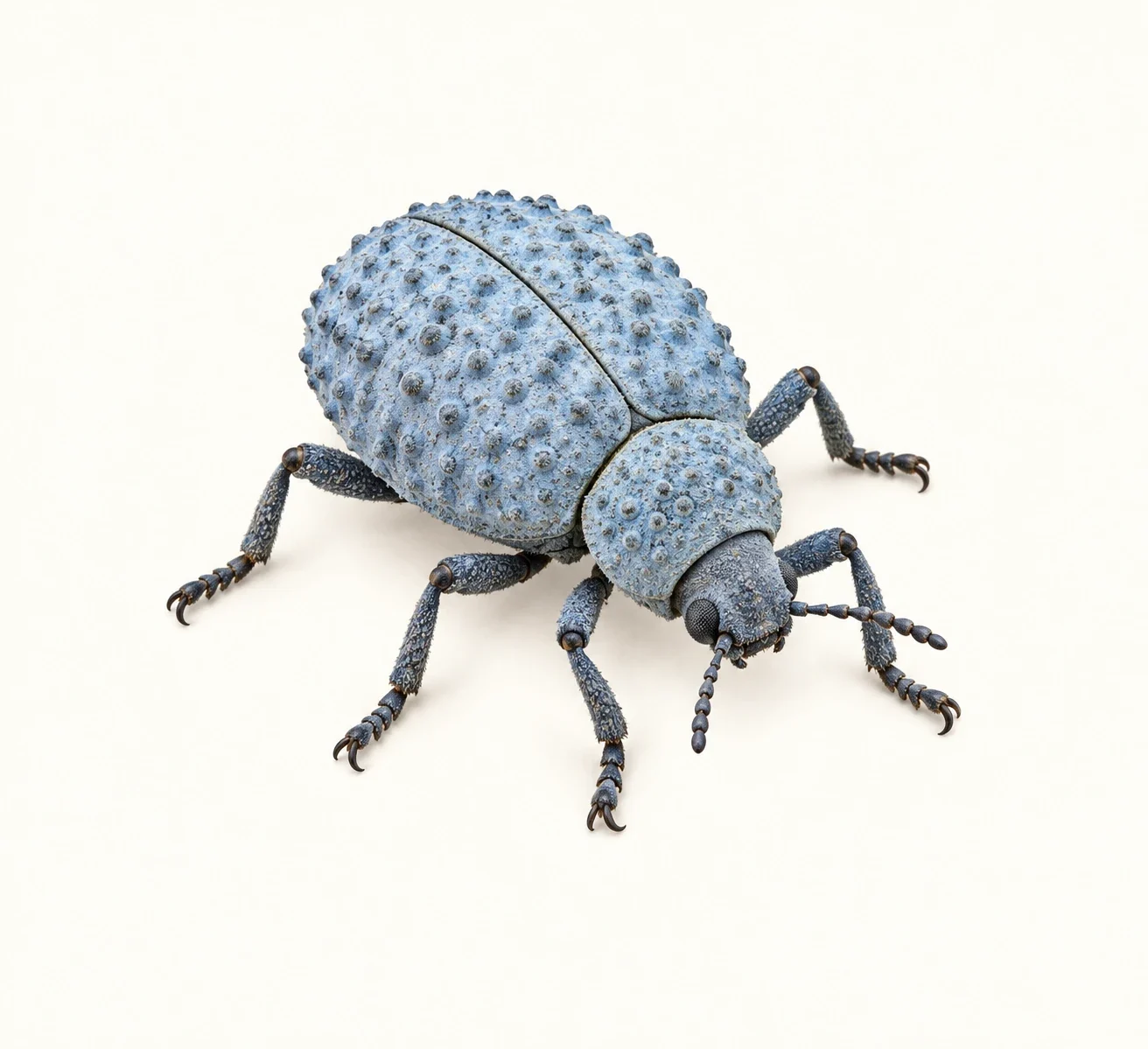
Blue death-feigning beetle - AI-generated scientific interpretation.
Modern AI-generated scientific illustration. Diagnostic features follow the selected zoological sources; pose, individual pattern and fine details are interpretive. Not specimen photography or independent evidence.
Overview
The blue death-feigning beetle has an oval, bumpy body, six legs and short segmented antennae. Its powdery blue appearance comes from a waxy covering rather than blue blood or painted pigment. Moisture can diminish the visible coating so that the underlying dark surface is more apparent; a darker individual is not automatically another species.
The wax is associated with reduced water loss in a desert setting. Institutional accounts locate the animal in the southwestern United States and northwestern Mexico, and describe feeding on mixed plant and animal material. Scavenging contributes to its ecology, but the beetle should not be portrayed as an obligate carnivore or as a predator equipped with a sting.
Its common name refers to tonic immobility: when disturbed, it may lie motionless with the legs tucked. The response is a defensive behaviour, not actual death followed by revival. Reported duration varies between accounts and conditions, so an exact universal countdown is not supplied here.
A regional Tenebrionidae checklist offers a different evidence type from zoo observations. Local records require reliable identification and locality documentation; a regional presence does not establish the beetle’s complete range or abundance. The generated illustration shows the normal standing form so the wax, body texture and leg count can be examined rather than hiding them in a defensive pose.
Origins & earliest records
Asbolus verrucosus is attributed to LeConte, 1851. It belongs to the darkling beetles; its conspicuous coating and defensive behaviour do not define a separate higher taxonomic group.
Evidence & interpretation
Oregon and Oakland zoo accounts supply morphology and behaviour. The regional primary checklist provides a taxonomic and occurrence context. No current species-wide abundance or conservation category is inferred from these bounded sources.
Selected bibliography
Documented works and useful reading. This is not a list of every appearance.
- 01
Blue death-feigning beetle
Selected bibliography; bounded source account, not exhaustive coverage.
- 02
Death-feigning beetle
Selected bibliography; bounded source account, not exhaustive coverage.
- 03
An updated checklist of Tenebrionidae of the Algodones Dunes
Selected bibliography; bounded source account, not exhaustive coverage.
Family, evolution & connections
Taxonomic classification
A hierarchy of classified groups, not a chain of direct ancestors.
Source note: Selected taxonomy follows the regional darkling-beetle checklist. Species occurrences are distinguished from abundance estimates and claims of range completeness.
- kingdomAnimalia
- phylumArthropoda
- classInsecta
- orderColeoptera
- familyTenebrionidae
- genusAsbolus
- speciesAsbolus verrucosus
References
Sources supporting this profile. Linked pages have their own scope and editorial standards.
- InstitutionalBlue death-feigning beetleResearch access: 2026-10-10
- InstitutionalDeath-feigning beetleResearch access: 2026-10-10
- ResearchAn updated checklist of Tenebrionidae of the Algodones DunesResearch access: 2026-10-10
Image credits
AI-generated scientific interpretationBlue death-feigning beetle - AI-generated scientific interpretation.
Modern AI-generated scientific illustration. Diagnostic features follow the selected zoological sources; pose, individual pattern and fine details are interpretive. Not specimen photography or independent evidence.