Oni
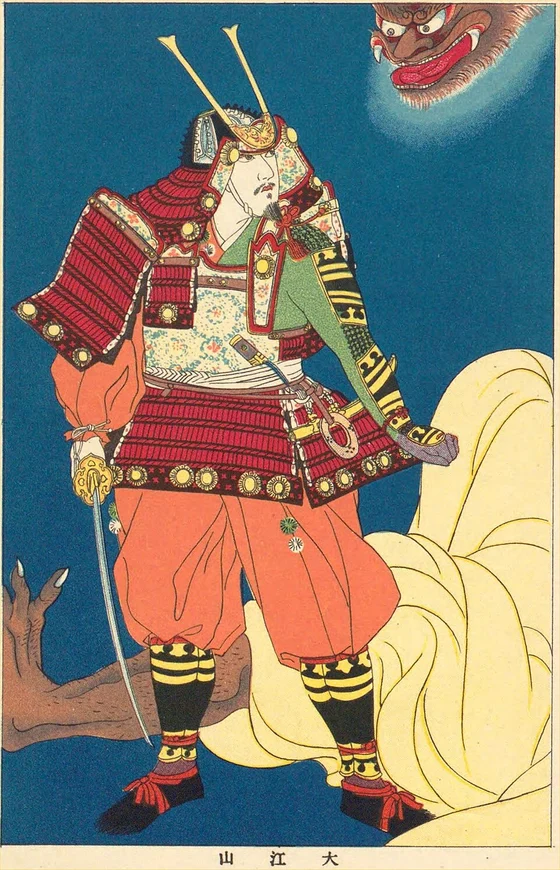
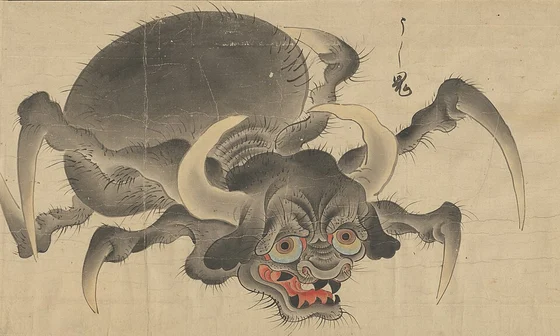
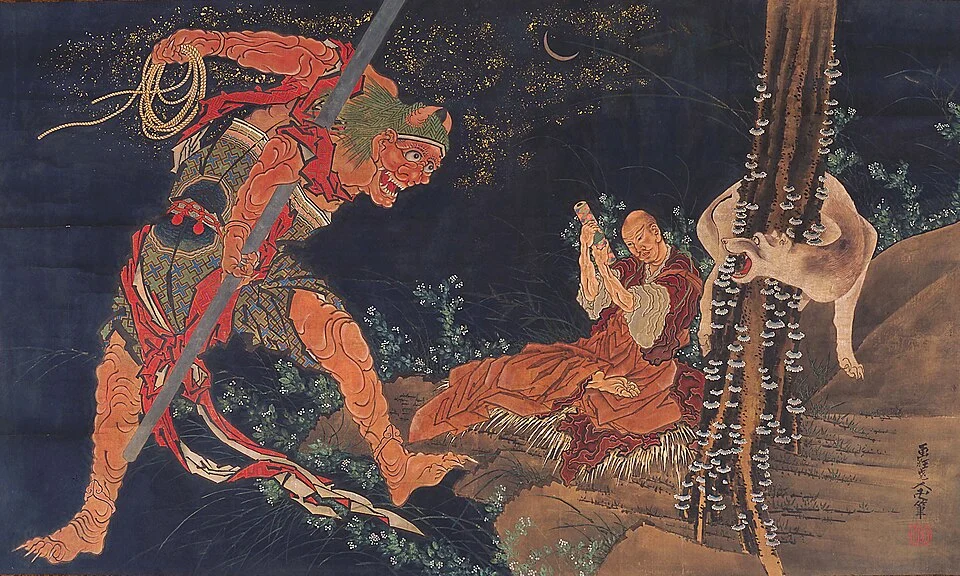
Image associated with the exact linked encyclopedia article; consult credited file description for its interpretation.
Overview
Oni appear in the selected narratives as formidable beings who can nevertheless be deceived, defeated or driven away. Griffis’s Momotarō adaptation describes horned and tusked island raiders, a cave castle and a giant leader. The illustrated submission scene gives them complete bodies, expressive faces and subordinate postures before the hero and his animal companions. That episode’s island community is one narrative setting, rather than the permanent dwelling assigned to every oni.
A different setting governs “Watanabe Cuts Off the Oni’s Arm,” printed pages 177–185. Tsuna keeps watch at Kyoto’s dangerous gate in a rainstorm. An oni waiting overhead attacks him, and he severs its hairy arm. The important supernatural event is then domestic deception: the creature assumes the appearance of his elderly aunt, persuades him to reveal the stored limb and recovers it. The story combines bodily injury, disguise and the breaking of an attempted containment.
“Daikoku and the Oni,” pages 88–92, supplies another role. A demonic subordinate is sent against Daikoku but is repelled by a rat carrying prickly holly. The tale describes oni in several colors and gives the dispatched creature a tiger-skin belt. It ends by connecting holly and scattered beans with keeping threatening beings away. This is the adaptation’s explanation of protective practice, not independent evidence that the practice originated in the narrated event.
These witnesses show why one inventory of horns, strength and aggression is insufficient. In one story oni organize a treasure stronghold; in another they manipulate family trust; in the third they participate in a supernatural hierarchy and become vulnerable to humble protective objects. The differences are part of the evidence, and should remain attached to their individual tales instead of being combined into a single encounter that no source describes.
The selected edition dates these English representations to 1887, with earlier preface material; it does not date the beginning of Japanese oni traditions. Modern games may borrow the name or visible traits while supplying their own rules. Ushi-oni and Shuten-dōji remain separately indexed named beings, allowing readers to compare traditions without treating every compound containing oni as an interchangeable creature.
Mitford’s “The Adventures of Little Peachling,” first collected in1871 and read here in the hosted1910 edition, offers a shorter island encounter with a different emphasis. The peach-born Momotarô declares that he intends to seize the ogres’ riches. With an ape, pheasant and dog recruited by sharing millet dumplings, he enters their castle: the bird flies over the gate, the ape climbs the wall, and the hero and dog force the entrance. The ogres are defeated and their king captured. They submit and bring out their treasures; the telling does not describe the extermination of the island population.
The treasure includes clothes that conceal their wearer and jewels that control tides, alongside valuable materials. These are properties of objects surrendered by the ogres, not innate powers attributed to every oni. Unlike Griffis’s elaborated island raiders, Mitford’s brief narrative does not first describe raids on the hero’s community or supply horns, tusks and body colours. Its English term is “ogres”; the comparison here rests on the named Momotarô episode rather than an independently supplied Japanese creature-name. The ending returns attention to his foster-parents, whom the riches support for the rest of their lives.
Origins & earliest records
Selected primary narrative witness: William Elliot Griffis, Japanese Fairy World: Stories from the Wonder-Lore of Japan, 1887 edition, “Peach-Prince, and the Treasure Island,” printed pages 64–70. This is not a claim of the earliest Japanese attestation.
Records & interpretation
The complete retelling was read at the exact horns-and-tusks paragraph (pp. 64–65) and surrender episode (pp. 68–69); the adjacent captioned illustration was inspected. English adaptation and Japanese traditions are distinguished.
In the literature
“inhabited by onis with horns in their heads, and big sharp tusks in their mouths,”
“Peach-Prince, and the Treasure Island”; paragraph beginning “Now there was an island far out in the ocean, inhabited by…” · William Elliot Griffis (translations and retellings)
The Momotarō retelling describes horned, tusked oni on the island.
“until he begged for his life and promised to give up all his treasures.”
“Peach-Prince, and the Treasure Island”; paragraph beginning “They quietly reached the door of the cave, and then Momotarō beat…” · William Elliot Griffis (translations and retellings)
The giant oni yields to Momotarō and his three animal companions.
Selected bibliography
Documented works and useful reading. This is not a list of every appearance.
- 01
Japanese Fairy World: Stories from the Wonder-Lore of Japan
“Peach-Prince, and the Treasure Island,” pp. 64–70; illustration “The Oni Submitting to Peach Prince” beside p. 70.
- 02
Japanese Fairy World: Stories from the Wonder-Lore of Japan
“Watanabe Cuts Off the Oni’s Arm,” pp.177–185; “Daikoku and the Oni,” pp.88–92.
- 03
Tales of Old Japan — The Adventures of Little Peachling
Completepp.152–154, notes53–54 and FairyTales framingpp.133–134.
Family & connections
A source-supported family tree or inspiration record has not yet been compiled for this profile. Related reading below indicates a connection in subject matter, not a proven lineage or creative influence.
Primary records and illustrations
Japanese Fairy World: Stories from the Wonder-Lore of Japan
William Elliot Griffis, 1887 edition; “Peach-Prince, and the Treasure Island”. Printed pp. 64–65 (horns and tusks), pp. 68–69 (defeat and surrender); captioned illustration beside p. 70
Narrative directly read and the illustration “The Oni Submitting to Peach Prince” directly inspected. Horned ogres kneel or crouch before the hero and his animal allies; treasure fills the middle of the composition. This is an English adaptation, not the earliest Japanese witness or an Ushi-oni depiction. Depth enrichment: named narrative sections directly read, with differences between witnesses retained. Complete MitfordPeachling152–154/notes53–54 and FairyTales source framing read: castle submission/treasure properties, no stated horns or prior raids. https://www.gutenberg.org/cache/epub/13015/pg13015-images.html
Located primary passages
Specific passages supporting details in this entry, grouped by their published witness.
Japanese Fairy World: Stories from the Wonder-Lore of Japan
Exact contiguous excerpt checked against the linked primary e-text on 2026-10-05; only whitespace normalized. London: Trübner, 1887 title-page edition; preface dated 1880.
- The Momotarō retelling describes horned, tusked oni on the island.
- The giant oni yields to Momotarō and his three animal companions.
The passage documents this literary version, not zoological existence, earliest attestation or a universal statement of living tradition.
References
Sources supporting this profile. Linked pages have their own scope and editorial standards.
- Primary literary adaptation / public-domain editionJapanese Fairy World — Momotarō narrative and primary illustrationResearch access: 2026-10-05
- Primary illustrated adaptationThe Oni Submitting to Peach Prince — inspected illustrationResearch access: 2026-10-05
- Primary literary adaptation / named sectionJapanese Fairy World — directly read named narrative witnessesResearch access: 2026-10-05
- Historical English retelling from printed Japanese pamphletsMitford, complete Little PeachlingResearch access: 2026-10-05
Image credits
Reference illustrationOni
Image associated with the exact linked encyclopedia article; consult credited file description for its interpretation.