
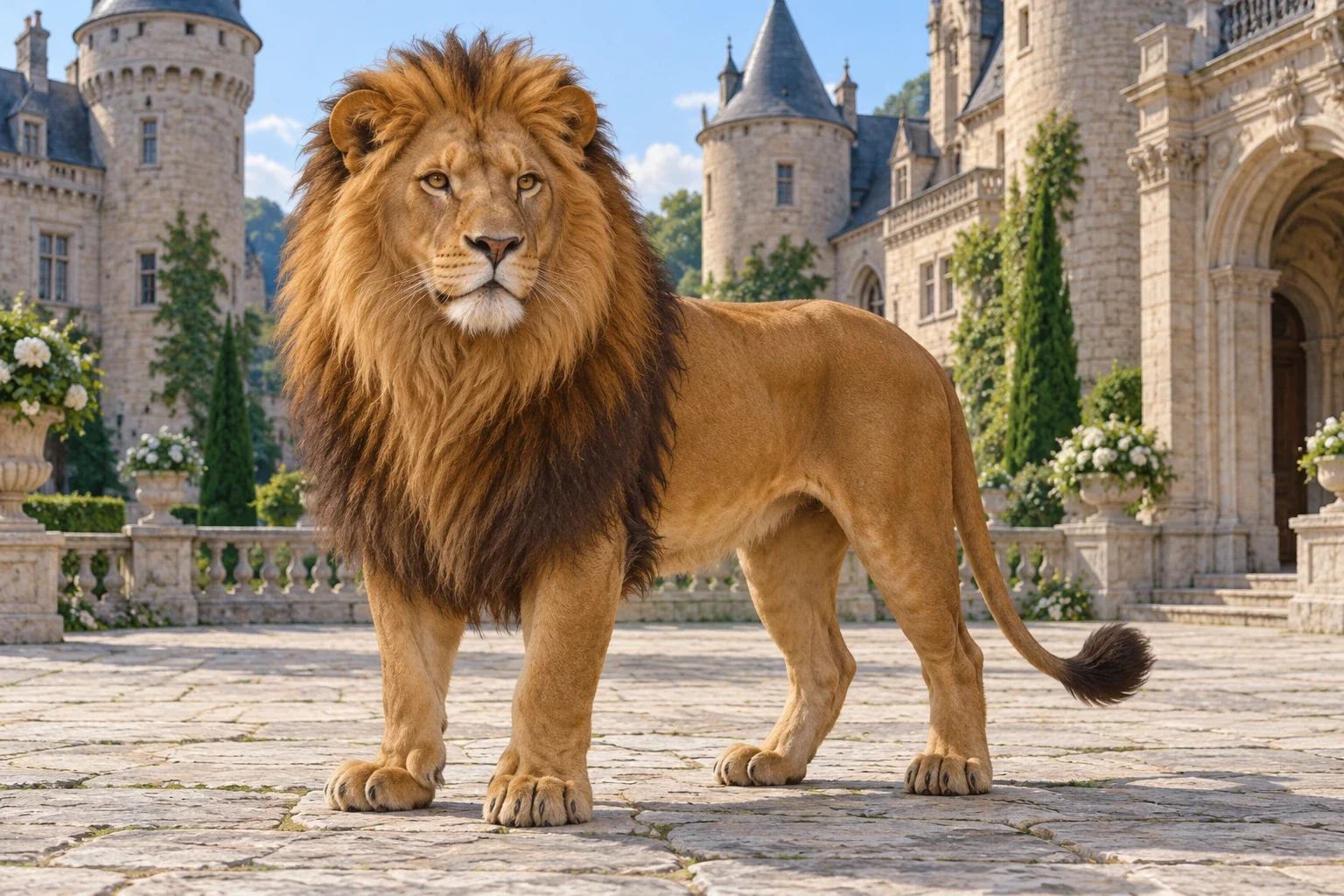
AI-generated interpretation of the ogre’s demonstrated lion form in Perrault’s Master Cat, following Welsh’s 1901 English translation. His natural ogre anatomy is unspecified; the castle design and individual appearance are imagined.
Selected demonstrated lion form only. The natural ogre body is not specified in the tale. Castle architecture, mane, colours and pose are artistic choices; not a zoological plate or game artwork.
Overview
The ogre in Perrault’s Master Cat tale is an unnamed owner of a stately castle and its extensive lands. Charles Welsh’s 1901 English translation calls him exceptionally rich. Before reaching the castle, the cat has threatened the people mowing and reaping those lands into telling the passing king that they belong to his invented Marquis of Carabas. The narrator subsequently identifies the property as the ogre’s. The apparent marquis’s wealth is therefore part of the cat’s deception, not an inheritance already belonging to him.
The cat has learned about the ogre and his abilities before requesting an audience. The host receives him with a degree of civility and offers him a seat. Asked about changing into other creatures, the ogre demonstrates by becoming a lion. The frightened cat scrambles into the gutter, hindered by the boots he wears on the roof tiles. He comes down only after the ogre has resumed his natural form. That form is not anatomically described: the passage does not specify a giant’s height, skin colour, horns or tusks.
The cat then pretends to doubt that such a powerful being can become a very small animal. The ogre answers by changing into a mouse and running across the floor. The cat immediately catches and eats him. The story thus demonstrates both lion and mouse forms, with a return to the natural form between them. An elephant and a rat are mentioned in the conversation, but neither is actually shown. The fatal trick depends on the small body the ogre voluntarily assumes.
The ending carries the deception into the castle. The cat welcomes the approaching king as though the buildings belong to the marquis. A magnificent meal prepared for the ogre’s expected friends serves the new visitors instead; those friends stay away because the king is present. The supposed marquis marries the princess that day, and the cat becomes a great lord. This account gives the ogre shapeshifting, possessions, hospitality and a definite death. It does not establish universal ogre anatomy, habitual cannibalism or kinship with unrelated beings given the same English label.
Origins & earliest records
Charles Perrault, The Master Cat, or Puss in Boots, in The Tales of Mother Goose, a new English translation by Charles Welsh, Boston, New York and Chicago: D. C. Heath & Co., copyright 1901, pp.45–53.
Records & interpretation
Complete selected tale and retained title/translation metadata read in the cached historical English text. The French original and other translations were not independently read. This is a literary fairy-tale witness, not a record of one named oral performance.
Selected bibliography
Documented works and useful reading. This is not a list of every appearance.
- 01
The Tales of Mother Goose: The Master Cat, or Puss in Boots
D. C. Heath & Co. edition, copyright 1901; complete selected tale pp.45–53. Introduction by M. V. O’Shea and artwork are not used as evidence for the ogre’s body.
Family, evolution & connections
Ogre (God of War)
In Perrault’s Master Cat, the unnamed rich ogre demonstrates lion and mouse transformations; the cat eats him in mouse form and claims his castle for the supposed Marquis of Carabas. This is a limited namesake context only; no shared anatomy, creature lineage or creator-consulted text is established.
Ogre (Destiny)
In Perrault’s Master Cat, the unnamed rich ogre demonstrates lion and mouse transformations; the cat eats him in mouse form and claims his castle for the supposed Marquis of Carabas. This is a limited namesake context only; no shared anatomy, creature lineage or creator-consulted text is established.
References
Sources supporting this profile. Linked pages have their own scope and editorial standards.
- Historical English literary translationPerrault, The Master Cat, or Puss in Boots, Charles Welsh’s 1901 English translationResearch access: 2026-10-24
Image credits
AI-generated literary interpretationAI-generated interpretation of the ogre’s demonstrated lion form in Perrault’s Master Cat, following Welsh’s 1901 English translation. His natural ogre anatomy is unspecified; the castle design and individual appearance are imagined.
Selected demonstrated lion form only. The natural ogre body is not specified in the tale. Castle architecture, mane, colours and pose are artistic choices; not a zoological plate or game artwork.