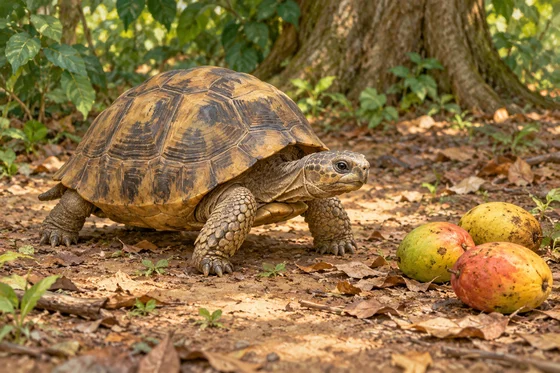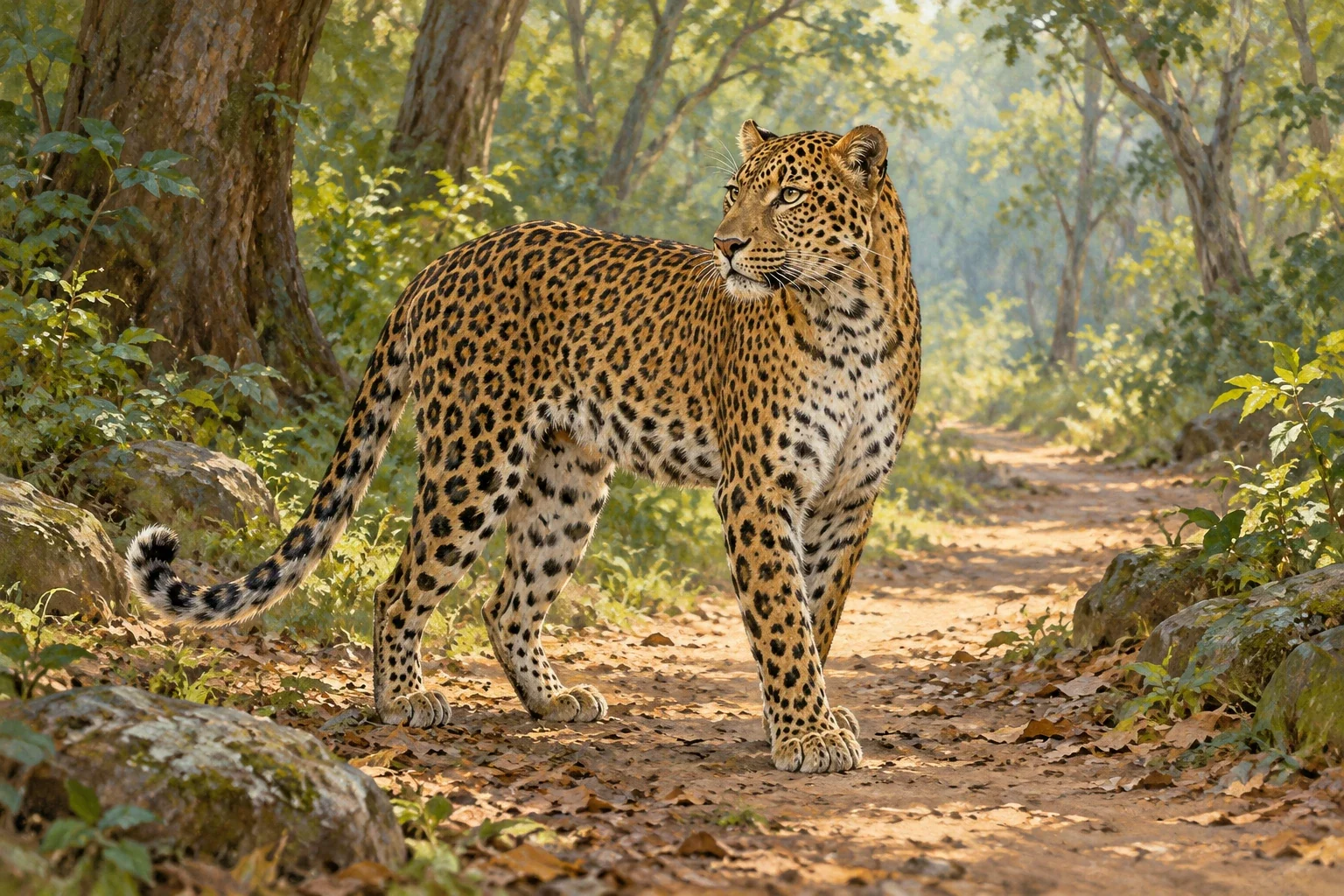
AI-generated narrative interpretation of Njâ as a leopard before the marriage journey. Body detail, coat and forest are artistic choices; no subspecies, exact place or ethnographic costume is authenticated.
Historical translated and arranged animal tale; narrator/Primer mediation preserved, no zoological, botanical or ethnographic authentication.
Overview
Njâ is the Benga designation for Leopard in Nassau’s collection. The selected Marriage Journey begins with his private agreement with the town chief Njambi: instead of ordinary marriage goods, he will bring animal bodies. He invites companions to escort him, first House-Rat, then Wild Goat and Antelope. On the road he persuades each to discard a knife while secretly keeping his own, then enjoys food that his unarmed companion cannot prepare. At the marriage town he feigns pain and sends the visitor away for bark while he eats most of the meal.
The guests later fall into a prepared pit and are handed to the townspeople as marriage payments. At home Njâ falsely explains their absence through attractions at the other town. Red Antelope undergoes further humiliations: a thorny climb, unsuitable fruit and a futile pursuit of a firefly mistaken for fire. A different pit kills him. Gazelle Ihĕli, suspicious because no companion returns, insists on travelling and watches the tricks closely. He keeps his knife, anticipates the bark errand and avoids the pits.
Njâ next tries to kill Gazelle at night. After evading the first attack, Gazelle secretly moves Njâ’s sleeping wife to his own mat and takes her place in the bed. Njâ kills her, mistaking her for the intended victim, and then prepares her body for a meal. Gazelle manipulates the handling of the bones so that Njâ is left with the incriminating pile. Neither this reversal nor the earlier successful deceptions removes the violence done to other characters.
As dawn approaches, Gazelle lets Njâ claim a travelling box as his hiding place, then secures it with a chain and weights. He escapes and alerts the woman’s relatives. They shoot Njâ in the box and burn his dead body. Gazelle returns with the explanation for the missing companions. The ending attributes the continuing hostility between leopard and gazelle groups to this betrayal and exposure. This is one located account of a recurring animal actor, not proof that all Leopard tales form a single chronological life.
Origins & earliest records
Nassau says that Part Second tales 1–4 were first written in Benga by missionaries Mackey and Clemens from Corisco dictation and printed as school Primer reading lessons. He translated them into English. Tale 4 was also retold to him at Batanga; he explicitly combined the differing versions. No exact individual narrator is named. This profile therefore uses a combined historical witness, not two independent biographies or a literal oral transcript.
Records & interpretation
Complete Part Second, tale 4, Leopard’s Marriage Journey, exact HTML container t2.4 through before t2.5, beginning p.85 and reaching p.95; full general preface/Benga foreword/pronunciation key.
Selected bibliography
Documented works and useful reading. This is not a list of every appearance.
- 01
Where Animals Talk: West African Folk Lore Tales
Richard G. Badger/The Gorham Press, Boston; original copyright 1912 line retained. Complete selected accounts, general preface, Benga foreword and pronunciation key read.
Family & connections
A source-supported family tree or inspiration record has not yet been compiled for this profile. Related reading below indicates a connection in subject matter, not a proven lineage or creative influence.
References
Sources supporting this profile. Linked pages have their own scope and editorial standards.
- Historical translated composite animal narrativeNassau 1912 — complete Benga tale 4 and original framingResearch access: 2026-10-23
Image credits
AI-generated narrative illustrationAI-generated narrative interpretation of Njâ as a leopard before the marriage journey. Body detail, coat and forest are artistic choices; no subspecies, exact place or ethnographic costume is authenticated.
Historical translated and arranged animal tale; narrator/Primer mediation preserved, no zoological, botanical or ethnographic authentication.