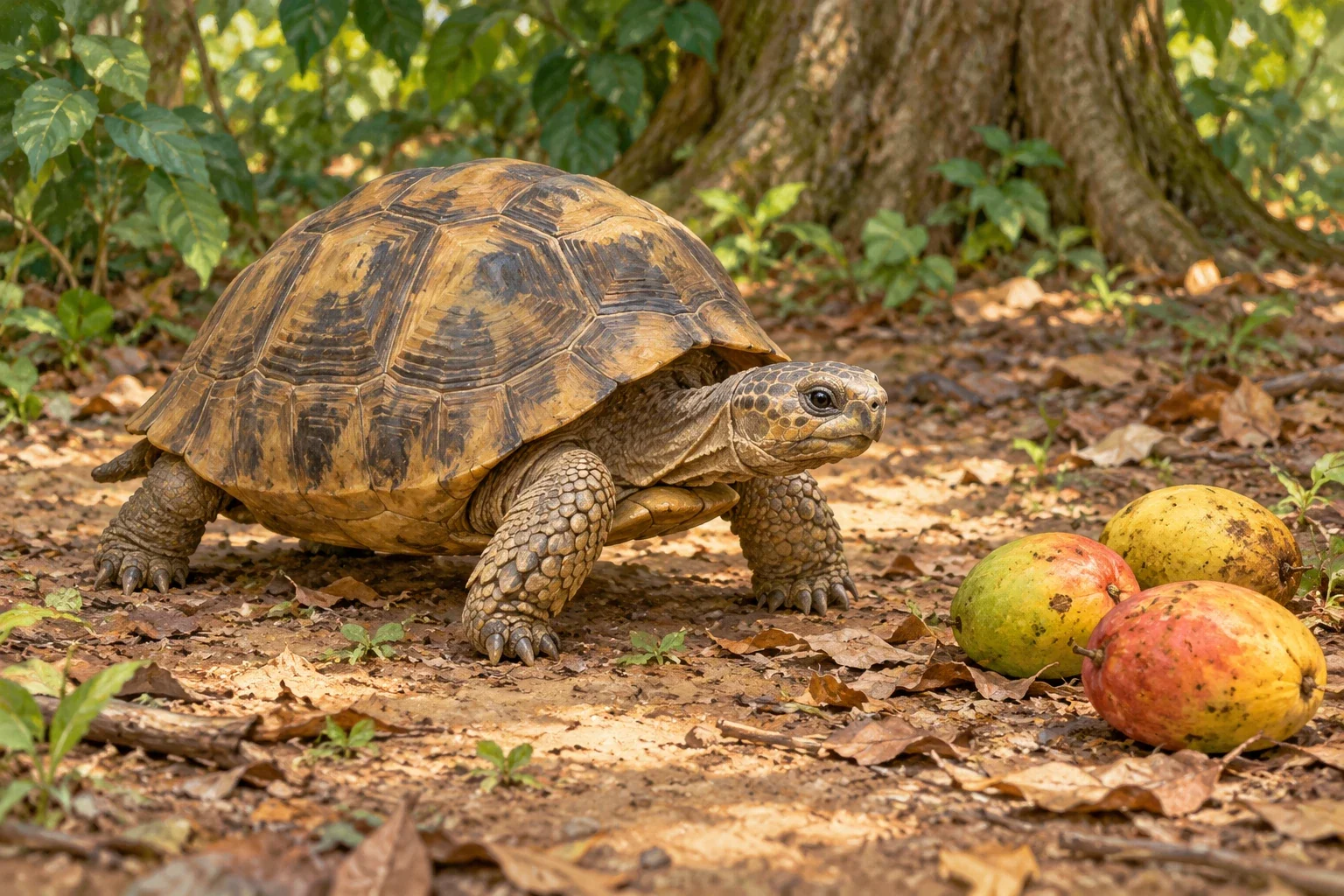
AI-generated narrative interpretation of Kudu as a tortoise beside fruit associated with the Bojabi account. Species, shell pattern, fruit shape and forest are artistic choices, not authenticated botanical or zoological identifications.
Historical translated and arranged animal tale; narrator/Primer mediation preserved, no zoological, botanical or ethnographic authentication.
Overview
Nassau’s cast names Kudu as Tortoise. In the selected Bojabi Tree account, famine strikes the Country of All-the-Beasts. A large tree bears promising fruit, but the animals do not know its name or whether it can be eaten. They send messengers by canoe to Mbâmâ, Boa Constrictor, who lives apart from them. Rat receives the name Bojabi and the fruit-name Njabi, but forgets while hauling his canoe ashore. Porcupine and Antelope also forget after their return journeys, and other large animals fail in turn.
When Kudu volunteers, the others beat and ridicule him until Gazelle argues that he should have a chance. He consults his mother and follows her advice to keep his journey uninterrupted. After sustained paddling he reaches Boa’s home, eats there and explains the problem. Boa identifies the fruit tree and discusses the leaves and water on which he lives. These are the provisions of an animal-story world, where the collector explicitly allows beasts to live and speak in human social arrangements.
On the way home Kudu repeatedly sings the tree’s name to preserve it in memory. A wave overturns his canoe, but he holds on, reaches shore, repairs the vessel and continues without losing the word. Another wave catches him near the landing. The waiting animals hear his refrain without understanding it and carry him and the canoe up the beach. He refuses to give his full report until they have taken him into the town.
Before announcing the answer, Kudu asks to take a share of the stored fruit. They agree, and he carries hundreds into his house. Only then does he deliver the name, after which the hungry crowd scrambles for fruit. The narrator observes that without this precaution he would have obtained none; his mother shares the benefit of her advice. The animals appoint Boa and Kudu as two kings at opposite ends of the country, distinguishing the one who knew the answer from the one whose diligence brought it home.
Origins & earliest records
The Benga foreword assigns the remaining thirty tales, including tale 14, to adult narrators at Batanga. Nassau says they spoke in what he called the Bapuku dialect of Benga; he made English notes and expanded the sentences the next morning. The specific teller of this account is not named. His editorial language classification and claims of preserved idiom are reported as his mediation, not independently verified field transcription.
Records & interpretation
Complete Part Second, tale 14, Tortoise and the Bojabi Tree, exact HTML container t2.14 through before t2.15, pp.129–133; original persons list, prefatory note, general preface/Benga foreword and pronunciation key.
Selected bibliography
Documented works and useful reading. This is not a list of every appearance.
- 01
Where Animals Talk: West African Folk Lore Tales
Richard G. Badger/The Gorham Press, Boston; original copyright 1912 line retained. Complete selected accounts, general preface, Benga foreword and pronunciation key read.
Family & connections
A source-supported family tree or inspiration record has not yet been compiled for this profile. Related reading below indicates a connection in subject matter, not a proven lineage or creative influence.
References
Sources supporting this profile. Linked pages have their own scope and editorial standards.
- Historical collected animal narrative expanded from translated notesNassau 1912 — complete Benga tale 14, persons list, original note and framingResearch access: 2026-10-23
Image credits
AI-generated narrative illustrationAI-generated narrative interpretation of Kudu as a tortoise beside fruit associated with the Bojabi account. Species, shell pattern, fruit shape and forest are artistic choices, not authenticated botanical or zoological identifications.
Historical translated and arranged animal tale; narrator/Primer mediation preserved, no zoological, botanical or ethnographic authentication.