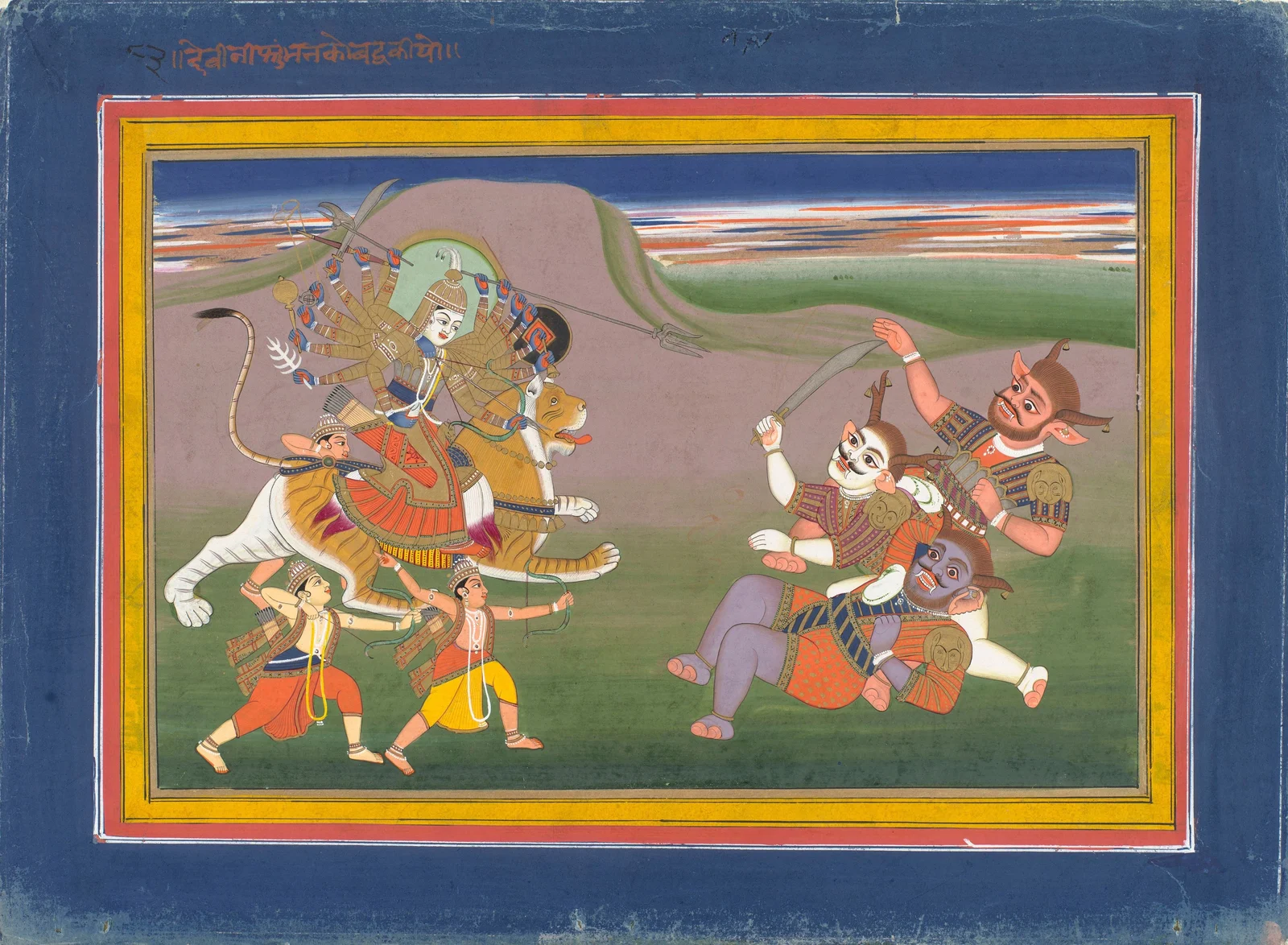
Gold-armoured many-armed goddess on a striped leonine mount attacks three horned demons at right, with three allied figures below; a Hindi inscription and full blue, red and yellow borders surround the scene.
Jaipur, ca. 1830–1840. The inscription identifies the scene as Nishumbha’s death. LACMA tentatively identifies him as the fallen demon lying on his back among the three defeated figures; that individual identification remains uncertain.
Overview
Nishumbha shares Shumbha’s conquest of the divine domains. The court’s account places the ocean ruler’s noose and sea-born treasures in his possession. He is also offered as a possible husband to the goddess, who refuses to bypass her battle condition.
In canto89 he strikes the goddess’s lion with a sword and successively loses his sword, shield, spear, dart and club. Wounded, he falls but regains consciousness. He then manifests a myriad arms and overwhelms the scene with discuses. When the goddess pierces his heart, another powerful man emerges from it and challenges her; she beheads this figure. The emerging warrior is not identified in this passage as a named son or a separately documented species.
Origins & earliest records
South Asian Hindu sacred narrative
Records & interpretation
Full relevant hosted Pargiter passages directly read; Medhas’s narration within the Markandeya Purana.
Selected bibliography
Documented works and useful reading. This is not a list of every appearance.
- 01
The Mārkaṇḍeya Purāṇa
Canto 85, 89; historical English edition date, not Sanskrit composition date.
Family & connections
A source-supported family tree or inspiration record has not yet been compiled for this profile. Related reading below indicates a connection in subject matter, not a proven lineage or creative influence.
Primary records and illustrations
The Mārkaṇḍeya Purāṇa, Pargiter translation
Devī-Māhātmya; hosted 1904 translation. Canto 85, 89
Full relevant chapter narrative directly read on Wisdomlib; source-specific translation and narrator retained; no illustration claimed.
References
Sources supporting this profile. Linked pages have their own scope and editorial standards.
- Historical primary religious-text translationPargiter, Markandeya Purana — canto 85Research access: 2026-10-05
- Historical primary religious-text translationPargiter, Markandeya Purana — canto 89Research access: 2026-10-05
Image credits
Historical narrative paintingGold-armoured many-armed goddess on a striped leonine mount attacks three horned demons at right, with three allied figures below; a Hindi inscription and full blue, red and yellow borders surround the scene.
Jaipur, ca. 1830–1840. The inscription identifies the scene as Nishumbha’s death. LACMA tentatively identifies him as the fallen demon lying on his back among the three defeated figures; that individual identification remains uncertain.